
Starkregen in Bayern: Beobachtungen und Dokumentation zählen

Starkregen in Bayern: Beobachtungen und Dokumentation zählen

m

June 27, 2026

Starkregenereignisse treten immer häufiger lokal, kurzfristig und mit hoher Intensität auf. Innerhalb weniger Stunden können sie erhebliche Überschwemmungen und Schäden verursachen. Um solche Ereignisse künftig besser zu verstehen und die wissenschaftliche Grundlage für gezielte Klimaanpassungsmaßnahmen zu verbessern, sind Beobachtungen direkt aus den betroffenen Regionen von großer Bedeutung.
Im Projekt EO4CAM – gemeinsam von Kolleginnen und Kollegen am DLR und am Earth Observation Research Cluster (EORC) durchgeführt – untersuchen wir die Auswirkungen von Starkregenereignissen in verschiedenen Regionen Bayerns. Damit wir unsere Modelle mit realen Ereignissen vergleichen und validieren können, sind wir auf Ihre Unterstützung angewiesen.
📸 Haben Sie Fotos von Überschwemmungen oder eigene Beobachtungen zu vergangenen Starkregenereignissen? Oder möchten Sie zukünftige Ereignisse dokumentieren?
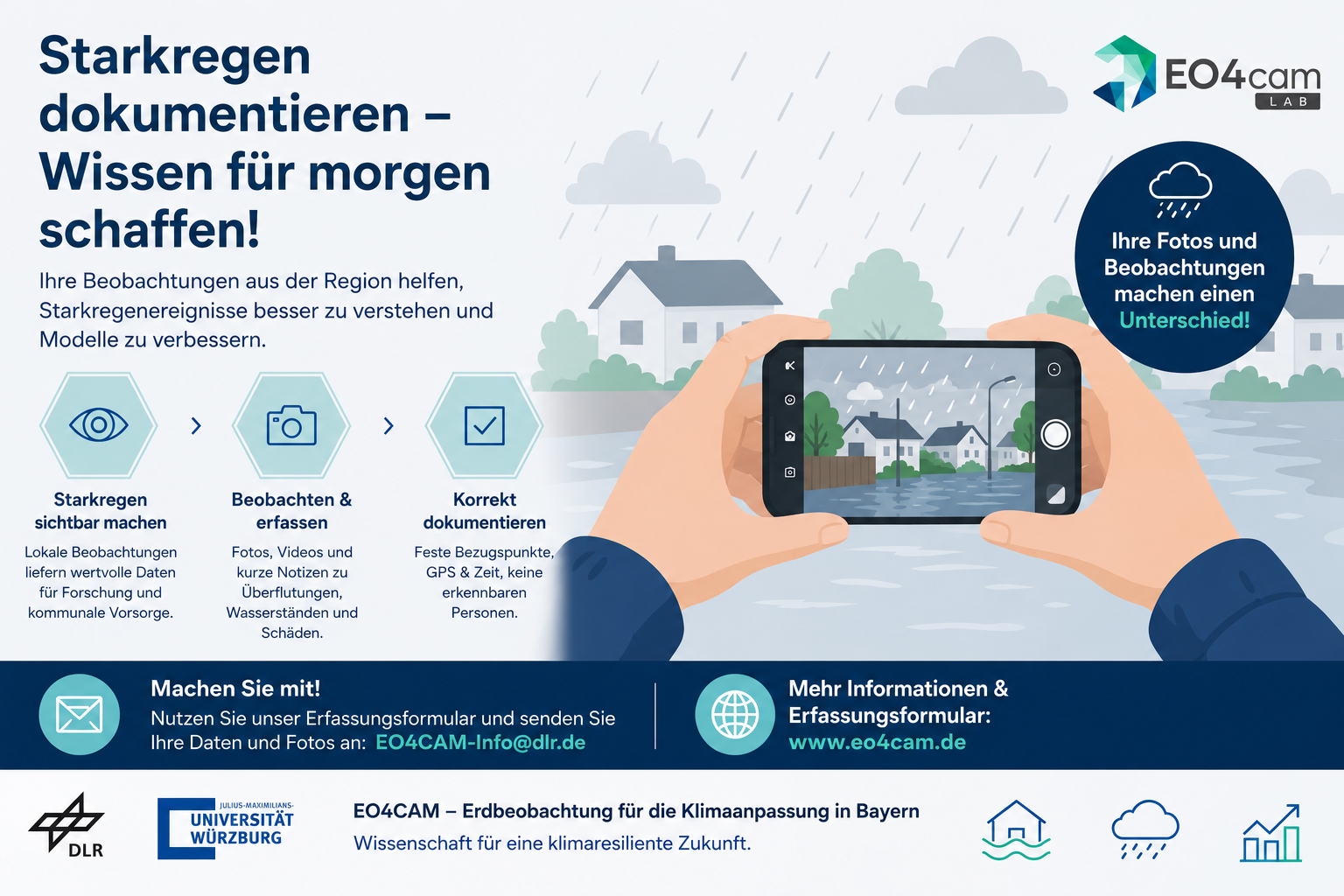
Unser Flyer mit Erfassungsformular zeigt, wie Starkregenereignisse systematisch dokumentiert werden können. Bei zukünftigen Ereignissen können Sie Ihre Beobachtungen und Fotos direkt über das Formular an uns übermitteln.
Jede eingereichte Beobachtung trägt dazu bei, unsere Modelle zu verbessern und die Auswirkungen von Starkregenereignissen künftig genauer abzubilden. Validierte Ergebnisse unterstützen Kommunen, Behörden und weitere Akteure bei der Klimaanpassung.

follow us and share it on:

you may also like:

Seeing the World in Points: Lidar Course for the EAGLEs

Seeing the World in Points: Lidar Course for the EAGLEs

Lidar has a funny way of sneaking up on you. You think you know what it is, a laser that measures distance, fine, but then someone shows you a point cloud of a forest canopy with individual branches floating in 3D space and suddenly you realize there's a whole...

RTL covers EORC: TV Crew Films MONID Habitrack Fieldwork

RTL covers EORC: TV Crew Films MONID Habitrack Fieldwork

A bit of extra excitement at EORC recently, an RTL television crew showed up to film a segment on the MONID Habitrack project, and Dr. Ariane Droin was right in the middle of it, walking them through what Earth Observation actually brings to the table for a project...

Ticks from Above: UAS Fieldwork for the MONID Habitrack Project

Ticks from Above: UAS Fieldwork for the MONID Habitrack Project

Forest edges are tricky places. They're where woodland meets open ground, where light and shade trade off every few meters, and where, it turns out, ticks tend to do really well. That last bit is exactly why Dr. Ariane Droin, Sofica Garcia de Leon, Dr. Jakob...

Course on urban EO by Michael Wurm

Course on urban EO by Michael Wurm

Walk through any city and you pick up on things that are hard to put a number on. The noise of a main road, the heat that sits between buildings in summer, the question of whether that little park around the corner is really enough green space for the whole...

EireR R package: unified gateway to Irish geospatial data

EireR R package: unified gateway to Irish geospatial data

Anyone who's tried to do geospatial work across the whole island of Ireland knows the headache. Ireland is one island geographically, but it's split across two jurisdictions, the Republic and Northern Ireland, and each one runs its own data infrastructure. Different...

Impact of agrophotovoltaic facilities – an R package

Impact of agrophotovoltaic facilities – an R package

There's a new R package on the block, and it's solving a problem that sounds simple until you actually try to do it: how do you tell whether putting solar panels over a farm field is good or bad for the soil and the crops around them? Marlene, one of our EAGLE...

Share This