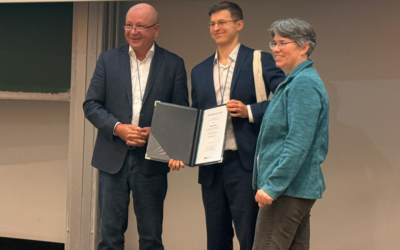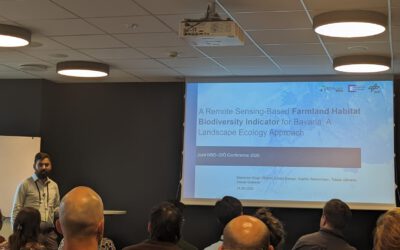


On March 31, 2026, Suriya Elango successfully defended his Master’s thesis at the Earth Observation Research Cluster (EORC), University of Würzburg. His work addressed a question that is becoming increasingly important across Europe: how can biodiversity in agricultural landscapes be understood and monitored in a consistent and scalable way?
Titled “Developing a Farmland Habitat Biodiversity Indicator for Bavaria (in line with OECD Guidelines),” the thesis highlights its practical relevance. At the core of the study is the development of a Farmland Habitat Biodiversity Indicator (FHBI) for Bavaria, covering the period from 2018 to 2024. Rather than focusing on a single variable, the approach integrates multiple elements that shape agricultural landscapes, including cropland, permanent grassland, perennial vegetation, and small woody features such as hedgerows.
A key strength of the work lies in the way these components were assessed. Grassland habitats were characterised using mowing frequency and timing of the first cut, while cropland was evaluated based on crop diversity and rotation practices. Small woody features were mapped by combining Copernicus datasets with products from the DLR GeoService. These layers were then integrated within a consistent 5 km² hexagonal grid, allowing spatial patterns to emerge across the Bavarian landscape.
Beyond developing the indicator itself, the thesis also examined how biodiversity relates to environmental and management factors. The results indicate that regions with larger field sizes and higher soil quality tend to show lower habitat diversity, highlighting the influence of agricultural intensification. At the same time, the FHBI was designed as a transferable framework, with potential applicability beyond Bavaria in line with OECD guidelines.
The thesis was supervised by Dr. Maninder Singh Dhillon (EORC), Dr. Ursula Gessner (DLR), Prof. Dr. Tobias Ullmann (EORC) and contributes to ongoing research within the EO4CAM project.
We congratulate Suriya on this achievement and wish him all the best for his future endeavours.