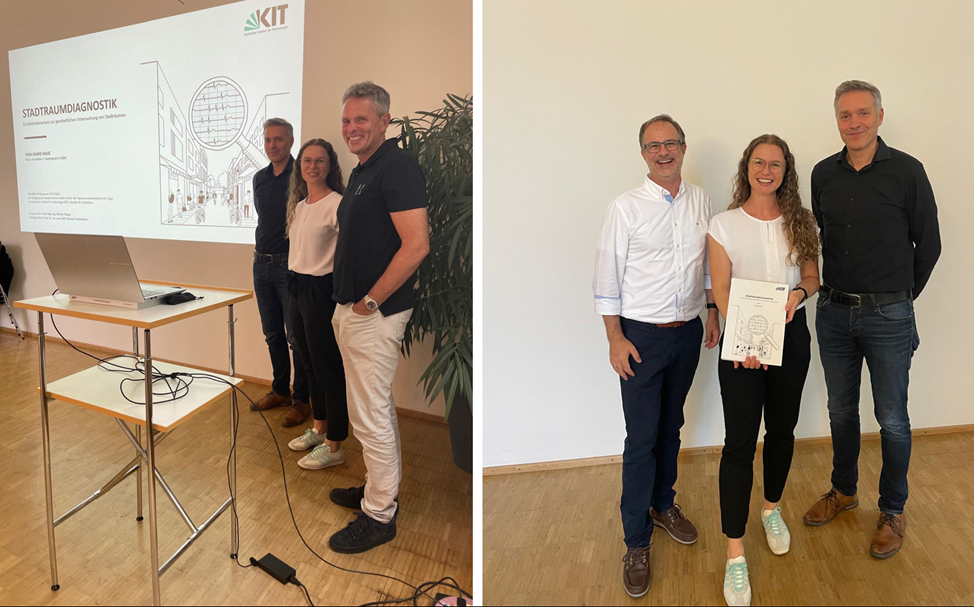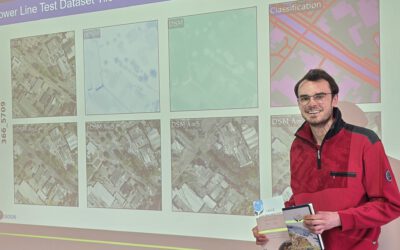
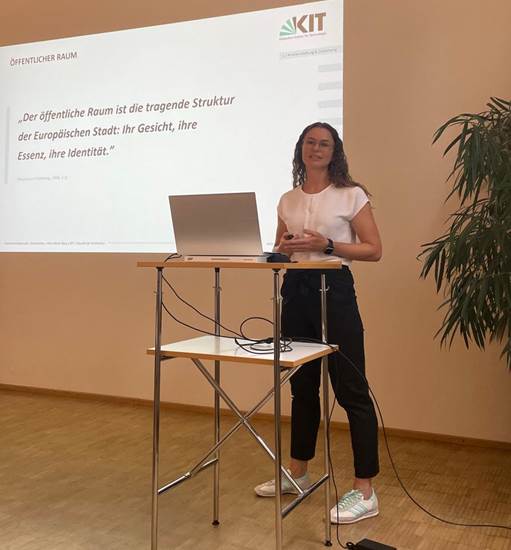

We congratulate Nina Haug from the Karlsruhe Institute of Technology (KIT) (Department of Architecture, Institute for Urban and Landscape Design, Chair of Urban Housing and Development) on her successful defense of her PhD thesis. The thesis is titled “Stadtraumdiagnostik – ein Methodenansatz zur ganzheitlichen Untersuchung von Stadträumen” [engl.: Urban space diagnostics – a methodological approach for the holistic analysis of urban spaces]. Nina examined how public urban spaces can be diagnosed by emotion sensing to identify stress hotspots. The PhD was supervised by Prof. Markus Neppl from the KIT and by our Professor Hannes Taubenböck from DLR and our EORC. The work was mentored by Dr. Peter Zeile from KIT.
Her work was partly carried out in collaboration with our ‘Super-Test-Site Würzburg’ project at the JMU (see e.g. here: https://remote-sensing.org/super-test-site-wurzburg-project-meeting-2/ and https://remote-sensing.org/super-test-site-wurzburg-from-the-idea-to-realization/). We are looking forward to future collaborations: the combination of our remote sensing top view and these in-situ sensing approaches offers great potential for a better understanding of urban space.
Here is the abstract of the PhD thesis:
Public spaces have always characterized the appearance of our cities. They form the basic spatial structure for public life and are deeply rooted in the character of the original European city. In recent decades, however, the significance of public urban spaces has changed dramatically. Due to massive structural interventions in the context of car-oriented urban redevelopment and increasing density pressure, public urban spaces in densely populated areas have increasingly developed into ‚stressful’ spaces that are lacking in attractiveness and quality of life from a human perspective.
However, with the help of the innovation of emotion sensing, these negative symptoms of dense urban spaces can now be identified relatively precisely as stress hotspots. Following this, planners are now responsible for determining the causes of these urban stress phenomena. It is essential to look at the problem from the perspective of human perception and identify factors that negatively influence people’s perception and movement in dense urban spaces.
Building on the identification of stress hotspots, the proposed methodology for urban space diagnostics is designed to take a holistic view of urban spaces with respect to stress-inducing factors. This approach is expected to enable the early identification of influential stressors in the urban context and their integration into planning processes. The framework of this approach is designed to equally consider and balance influencing factors from a wide range of subject areas.
Methodologically, the work aims to enhance stressor analysis by incorporating an analogous toolbox that has been predominantly used in the field of urban planning. For the first time, both quantitatively measurable ‚hard’ factors and qualitatively describable ‚soft’ factors will be combined in a joint analysis approach.