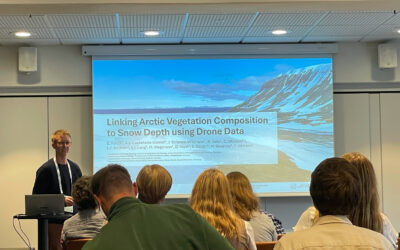
On February 24, 2026, Leonie Sonntag and Jannis Midasch will present their internship results on ” Earth Observation Application on Svalbard” at 13:00 in seminar room 3, John-Skilton-Str. 4a.
During March and April 2025, EAGLE MSc students Leonie Sonntag and Jannis Midasch completed a research internship at the University Centre in Svalbard (UNIS), working within the Department of Biology under the supervision of Prof. Dr. Larissa T. Beumer. Their stay in the High Arctic provided hands-on experience in polar field research and allowed them to actively contribute to ongoing scientific projects.
Throughout the internship, Leonie and Jannis supported a variety of research activities, combining fieldwork, drone operations, and data analysis. A central part of their work involved drone-based imagery acquisition and field data collection for snow hydrology studies. These measurements contribute to a better understanding of snow dynamics and their ecological implications in Arctic environments. In addition, the students participated in mapping food craters created by Svalbard reindeer, an important indicator of winter foraging behaviour and ecosystem interactions.
Beyond field activities, both students worked on individual technical and analytical tasks. Jannis contributed to the development of an R package designed to facilitate the use of overview maps, improving data handling and visualization workflows within the research group. Leonie focused on preprocessing and analysing UAV imagery for mapping snow buntings on Svalbard, supporting biodiversity monitoring efforts using high-resolution remote sensing data.
The internship highlights the strong collaboration between EAGLE and international Arctic research institutions, offering students the opportunity to apply their remote sensing and geospatial skills in challenging real-world conditions. Their contributions not only supported ongoing projects at UNIS but also strengthened their expertise in UAV-based environmental research in polar regions.
1st supervisors: Dr. Mirjana Bevanda Host: UNIS University Centre Svalbard