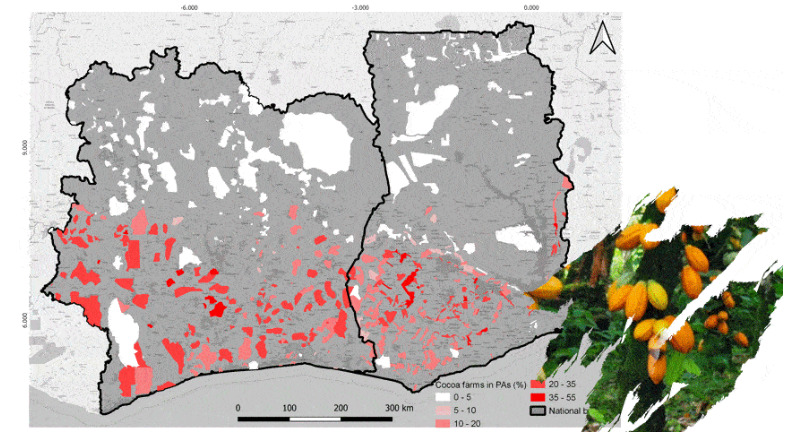

Itohan-Osa Abu and Dr Michael Thiel, have published a paper in Ecological Indicators in cooperation with the partners at the Joint Research Centre (JRC) titled “Detecting cocoa plantations in Côte d’Ivoire and Ghana and their implications on protected areas“.
From the abstract: “Côte d’Ivoire and Ghana are the largest producers of cocoa in the world. In recent decades the cultivation of this crop has led to the loss of vast tracts of forest areas in both countries. Efficient and accurate methods for remotely identifying cocoa plantations are essential to the implementation of sustainable cocoa practices and for the periodic and effective monitoring of forests. In this study, a method for cocoa plantation identification was developed based on a multi-temporal stack of Sentinel-1 and Sentinel-2 images and a multi-feature Random Forest (RF) algorithm. The Normalized Difference Vegetation Index (NDVI) and second-order texture features were assessed for their importance in an RF classification, and their optimal combination was used as input variables for the RF model to identify cocoa plantations in both countries. The RF model-based cocoa map achieved 82.89% producer’s and 62.22% user’s accuracy, detecting 3.69 million hectares (Mha) and 2.15 Mha of cocoa plantations for Côte d’Ivoire and Ghana, respectively. The results demonstrate that a combination of an RF model and multi-feature classification can distinguish cocoa plantations from other land cover/use, effectively reducing feature dimensions and improving classification efficiency. The results also highlight that cocoa farms largely encroach into protected areas (PAs), as 20% of the detected cocoa plantation area is located in PAs and almost 70% of the PAs in the study area house cocoa plantations.”
For more information, please read; https://www.researchgate.net/publication/352121193_Detecting_cocoa_plantations_in_Cote_d’Ivoire_and_Ghana_and_their_implications_on_protected_areas