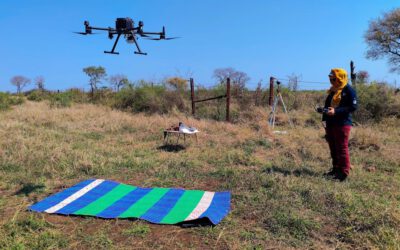
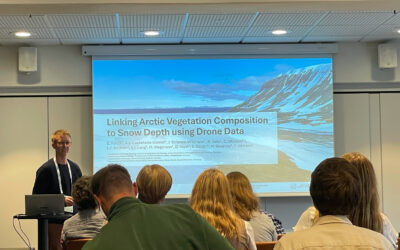
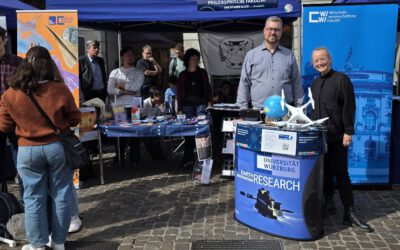
From August to November, two EAGLE students had the opportunity to do their internship at the University Centre in Svalbard (UNIS), working in the department of Arctic Biology. Their tasks included regular drone flights in Adventdalen, a valley close to the world’s northernmost settlement Longyearbyen in order to monitor Arctic vegetation phenology. Furthermore, drone flights in Bjørndalen are used to extract a Digital Surface Model to use for further analysis. While having arrived during polar day, the dark season is now approaching with days getting rapidly shorter. With this change and temperatures dropping below minus ten degrees, they spend more time inside with processing the remote sensing data.
On top of a great working environment, they enjoy the adventurous student life that includes great hiking trips, regular (student) social events or boat tours. Besides the sighting of a pregnant polar bear and fascinating encounters with the Svalbard reindeer, one highlight has definitively been a guided tour around the Svalbard Satellite Station (SvalSat) where they spend a whole day gaining great insights into their work and even watched an antenna receiving Sentinel 3 data!
Being thankful for the chance to experience life in such a unique environment, it also is a place of contrasts. Longyearbyen’s coal mining industry is deeply rooted in its history and culture, owing its existence to this industrial branch. At the same time, this place considered one of the fastest warming places on earth. Living here costs a carbon footprint almost 5 times higher than mainland Norway and makes you experience the consequences of climate crisis on a new level.
Sources / Reading suggestion:
Aquilina, E. (2022): Arctic Towns in Transition: Norway’s commitment towards a new energy solution on Svalbard. https://www.thearcticinstitute.org/arctic-towns-transition-norway-commitment-towards-energy-solution-svalbard/#. Last accessed: 10.10.2023.
Rud, J. N., Hørmann, M., Hammervold, V., Ásmundsson, R., Georgiev, I., Dyer, G., Brøndum Andersen, S., Jessen, J. E., Kvorning, P., Brødsted, M. R. (2018): Energy in the West Nordics and the Arctic: Case Studies.
Nordic Council of Ministers.
Descamps, S., Aars, J., Fuglei, E., Kovacs, K. M., Lydersen, C., Pavlova, O., Pedersen, Å. Ø., Ravolainen, V., Strøm, H. (2017). Climate change impacts on wildlife in a High Arctic archipelago–Svalbard, Norway. Global Change Biology, 23(2),