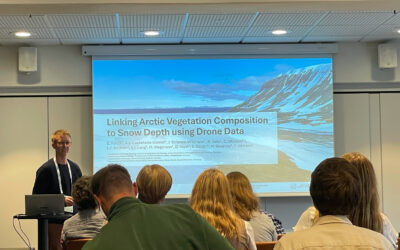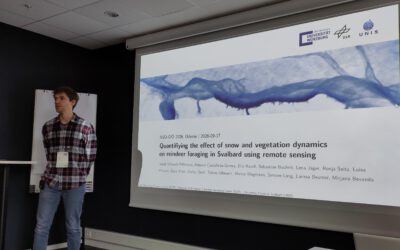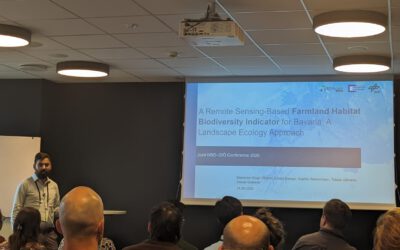
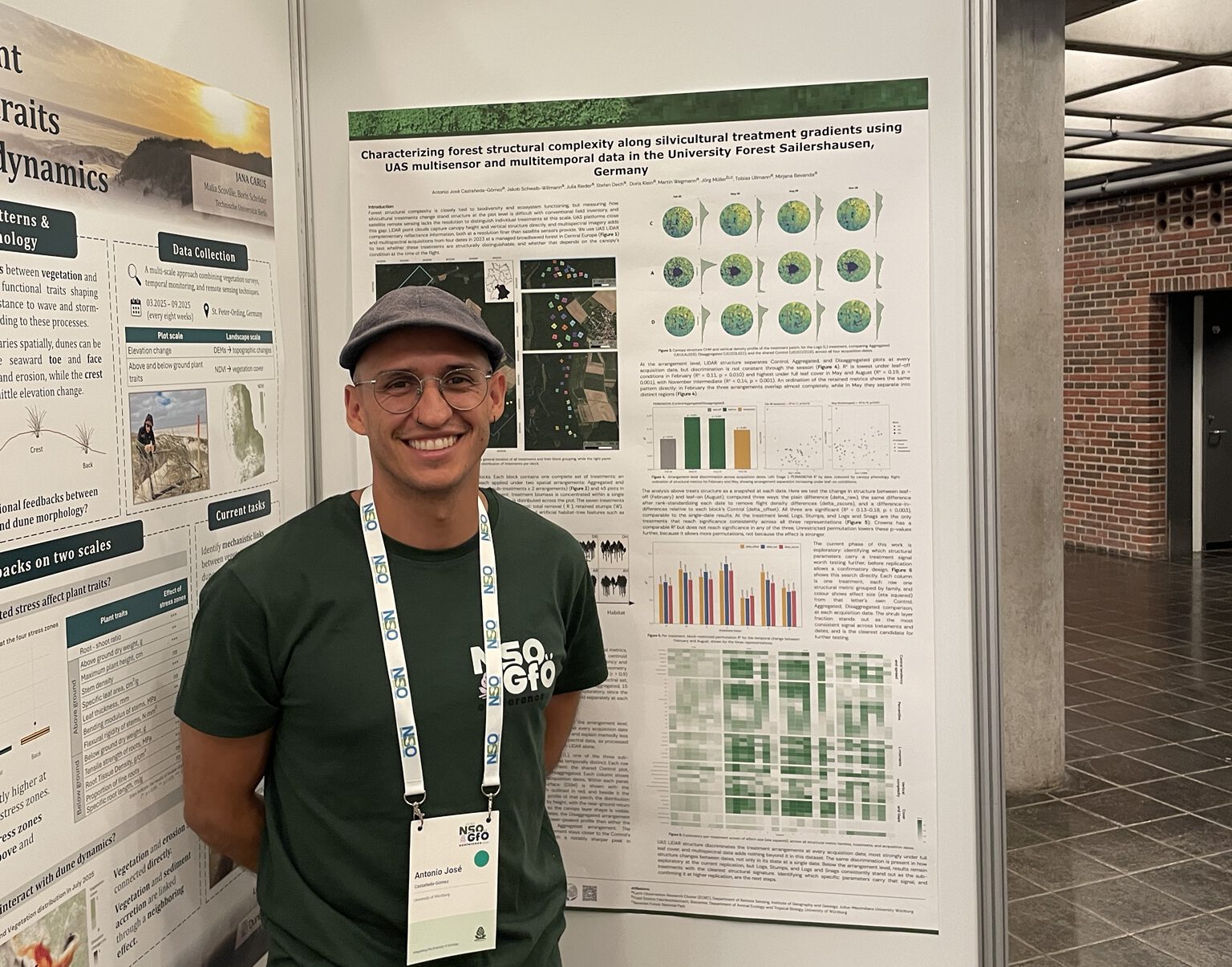

Last week, Antonio José Castañeda-Gómez, PhD student at the EORC, showed his research at the joint NSO-GfÖ 2026 ecology conference, presenting on the use of multi-sensor UAV data to characterise forest structural complexity along silvicultural treatment gradients in the University forest Sailershausen, a forest owned and managed by University of Würzburg. The study is part of Antonio’s PhD research in close collaboration with Forest researchers in and outside of University of Würzburg.
Antonio showed that multitemporal, multisensor UAV data can resolve fine-scale differences in structural complexity across a controlled gradient of silvicultural treatments. For this, he had analysed UAV data recorded at sites representing seven experimental treatments spanning a structural complexity gradient in aggregated and disaggregated configurations. Using PERMANOVA and non-metric multidimensional scaling on multisensor feature sets, he investigated treatment separability.
The NSO-GfÖ 2026 ecology conference has been jointly organised by the Nordic Society Oikos (NSO), representing the ecological societies of Denmark, Sweden, Norway, Finland, and Iceland, and the Gesellschaft für Ökologie (GfÖ), representing Austria, Switzerland, and Germany. Nearly 1000 participants attended. The conference offered a special opportunity to exchange on various ecological research fields across diverse research regions – including forest ecosystems, plant ecology, and remote sensing for ecology. The University of Würzburg was represented both through the contributions of the EORC as well as members of the Unviersity’s bio centre.