
Field campaign in Côte d’Ivoire by a Ph.D. student of the Department of Remote Sensing

Field campaign in Côte d’Ivoire by a Ph.D. student of the Department of Remote Sensing

March 9, 2022

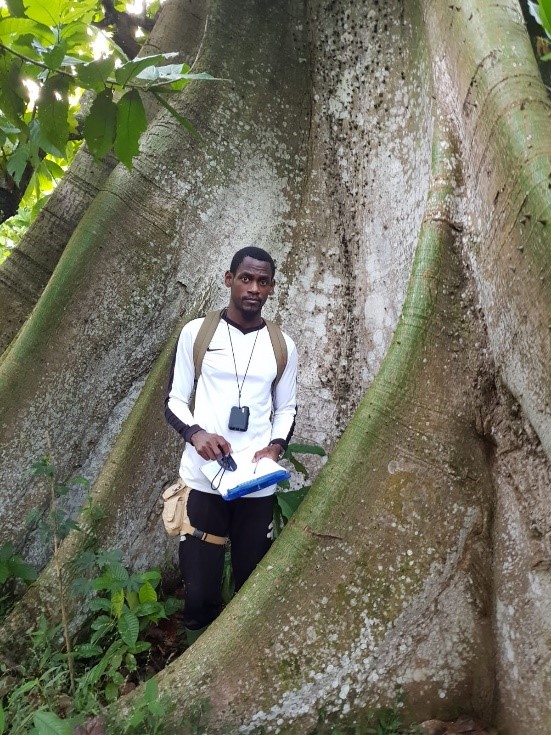
In November 2021, Dan Kanmegne Tamga, a Ph.D. student within the WASCAL-DE-Coop project at the Department of Remote Sensing at the University of Würzburg, went for a field campaign to Côte d’Ivoire, West Africa. Dan Kanmegne Tamga is working on estimating carbon sequestration in agroforestry systems.

The objective of his field campaign was to collect biometric parameters of trees. Using allometric equations, the parameters collected by him in situ (e.g., diameter and height) are used to derive the aboveground biomass (AGB).

Côte d’Ivoire is the world’s largest producer of cocoa beans, where cocoa plantations are established at the expense of forest. Because of the contribution of deforestation and forest degradation to climate change, AGB needs to be monitored in Côte d’Ivoire.

In the same period, Dan Kanmegne Tamga attended the AfricaGIS (EIS-AFRICA) conference held in Abidjan between 22 – 26 November. He presented the results of his study on modeling the spatial distribution of the classification error in agroforestry systems in Côte d’Ivoire. This research was funded by the German Federal Ministry of Education and Research (BMBF) with the technical support of the World Agroforestry Centre (ICRAF, Côte d’Ivoire).
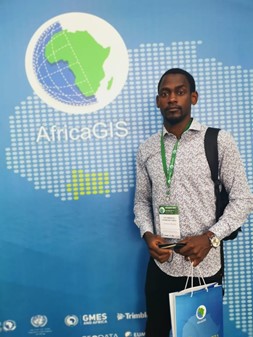
Ph.D. student Dan Kanmegne Tamga at the AfricaGIS in November 2021.

follow us and share it on:

you may also like:

When Snow Disappears Too Early

When Snow Disappears Too Early

Fieldwork during the winter season in Svalbard usually comes with a built-in advantage: snow. It acts as a natural transport layer, making it possible to move efficiently across large distances with snowmobiles and sleds. You plan your campaign around that mobility:...

Advancing Agriculture with UAS Multi-Sensor Research

Advancing Agriculture with UAS Multi-Sensor Research

Understanding how agriculture can adapt to a changing climate is one of the key challenges of our time. At EORC, we are pleased to share that our researchers are currently collaborating with the Bavarian State Research Center for Agriculture (LfL) on an innovative...

New roll-up shows Urban Collaboration and Research

New roll-up shows Urban Collaboration and Research

Remote sensing thrives on collaboration as shown (by a few selected ones) on our most recent roll-up. Many of today’s most pressing urban and environmental challenges—rapid urbanization, climate change, landcover change, migration, inequality, and economic...

Hackathon within the Super-Test-Site Project

Hackathon within the Super-Test-Site Project

What happens when researchers and developers sit down together to explore a multidisciplinary urban dataset? Our researchers from the EORC joined a hackathon that took place within the Super-Test-Site Project, organised by Prof. Dr. Gunther Gust from the Chair of...

Field Days in the Oberpfalz: Exploring FSME Hotspots

Field Days in the Oberpfalz: Exploring FSME Hotspots

On April 17th and 29th our researchers Sofía and Ariane had two field days in the areas around Amberg and Schwandorf, one of Germany's most well-known TBE (tick-borne encephalitis) risk regions. They joined Prof. Dr. Gerhard Dobler and Dr. Lidia Chitimia-Dobler from...

Share This