
MainPro remote sensing analysis products are now available online

MainPro remote sensing analysis products are now available online

May 26, 2026

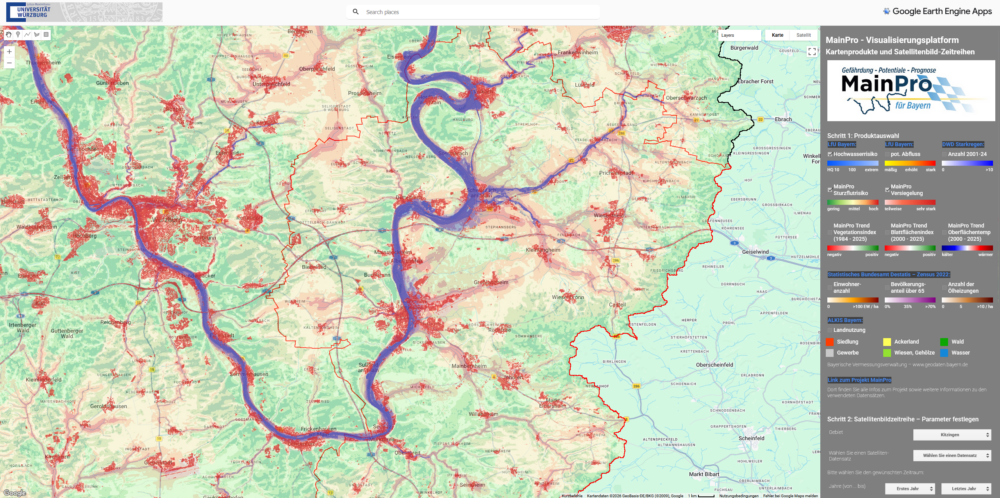
Within our interdisciplinary research project MainPro, we aim to analyse potential climate change induced geohazards in the Main valley and its tributaries and develop nature-based solutions for them.  This project involves a large-scale analysis of potential geohazards, their spatial distribution and other parameters that increase the risk. Results of this geospatial analysis are now available through a user-friendly and easily accessible Google Earth Engine (GEE) App.

This app allows users to access and explore a comprehensive flash flood risk map generated using advanced machine learning techniques, which helps to identify regions that may be particularly vulnerable to flash flood events. In addition, the platform offers an impervious surface map derived from multispectral satellite imagery, enabling detailed analyses of sealed and built-up surfaces. Users can also access information on long-term trends of spectral vegetation indices and land surface temperature, which support environmental monitoring and climate-related assessments.

The data visualization platform integrates these datasets produced within the project with valuable supplementary information from the 2022 German census survey, as well as additional data on land use, flood risk, and flash flood runoff pathways.

Furthermore, the platform provides the possibility to individually process, analyze, and visualize high-resolution satellite imagery from the past ten years. This allows users to conduct customized temporal analyses and gain deeper insights into environmental and landscape changes over time.


MainPro Contact at EORC: Sebastian Buchelt, Prof. Dr. Tobias Ullmann


follow us and share it on:

you may also like:

A Weekend together: Where the Institute Talks About Itself

A Weekend together: Where the Institute Talks About Itself

Once a year, or at least that's the idea, the Institute of Geography packs up and heads out to a remote place, this time Burg Rothenfels, an old castle not far from Würzburg, to spend a weekend doing something that almost never happens in the day to day grind:...

Graduation Day: EORC and EAGLE Celebrate at the Faculty Ceremony

Graduation Day: EORC and EAGLE Celebrate at the Faculty Ceremony

Last week the faculty held its formal graduation ceremony, and EORC and EAGLE were well represented on stage. Two of our PhD students, Dr. Ariane Droin and Dr. Johannes Mast, both joint the ceremony for their doctoral degrees, and it was great to see them walk across...

AI chatbots in research and teaching

AI chatbots in research and teaching

Let's be honest about something: AI chatbots are not coming to our courses and our research. They are already here, and they have been for a while. ChatGPT, Claude, Perplexity, Gemini, whatever your tool of choice is, our students have been using these things for...

Drone manufacturer Wingtra visits EORC

Drone manufacturer Wingtra visits EORC

Is it possible to combine the efficiency of a fixed-wing drone with the precision of a laser scanner? That question brought researchers from EORC together with Wingtra, a Swiss company designing and manufacturing fixed-wing UAS, to exchange on UAS research and discuss...

How We Learned to Fly: The Story Behind UAS Research at EORC

How We Learned to Fly: The Story Behind UAS Research at EORC

Every research group that's ever bought a drone has a story about the first one it lost. We're no different. So let's just get that out of the way up front: this is the inside story of how UAS (Unoccupied Aerial System) research grew up at the Earth Observation...

Share This