
International Symposium on Water and Land Resources in Central Asia

International Symposium on Water and Land Resources in Central Asia

m

March 29, 2018

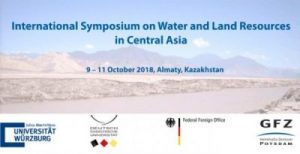
October 09 – 11, 2018 in Almaty, Kazakhstan

Registration is open!


To bring together the international scientific community and regional stakeholders and specialists focussing on water-related and environmental challenges in Central Asia

Together with the partners at the German Research Centre for Geosciences (GFZ) in Potsdam and at the German-Kazakh-University in Almaty, colleagues from the Department of Remote Sensing at the University of Würzburg will hold a conference in October 2018 in Central Asia. The Department of Remote Sensing will lead two sessions (i.e., Session 4 ‘Using water and land resources: Challenges and sustainable solutions and Session 7 ‘Practical implementation of scientific results and capacity building: Towards sustainable development in Central Asia’)

The international symposium is organized within the framework of the Central Asia Water (CAWa) project, as part of the German Initiative for Central Asia (“Berlin Process”) and is funded by the German Federal Foreign Office (grant no. AA7090002).

Session Overview

Session 1: Climate Variability and Change

Session 2: Monitoring and modeling the cryosphere

Session 3: Hydrology: Observations, Processes and Forecasting

Session 4: Using water and land resources: Challenges and sustainable solutions

Session 5: Natural hazards and risk

Session 6: Agricultural transition and natural resource management

Session 7: Practical implementation of scientific results and capacity building: Towards sustainable development in Central Asia

Registration form and Abstract submission

Date: October 09 – 11, 2018

Venue: Best Western Plus Atakent Park Hotel, Timiryazev St 42 (googlemaps), Almaty, Kazakhstan

Important dates:

May 31, 2018: Deadline for travel grant applications

July 31 , 2018: Deadline for abstract submission

August 07, 2018: Notification of acceptance

September 20, 2018: Deadline for registration


For further information on the conference and on how to apply, please consult the CAWa homepage.

follow us and share it on:

you may also like:

Seeing the World in Points: Lidar Course for the EAGLEs

Seeing the World in Points: Lidar Course for the EAGLEs

Lidar has a funny way of sneaking up on you. You think you know what it is, a laser that measures distance, fine, but then someone shows you a point cloud of a forest canopy with individual branches floating in 3D space and suddenly you realize there's a whole...

RTL covers EORC: TV Crew Films MONID Habitrack Fieldwork

RTL covers EORC: TV Crew Films MONID Habitrack Fieldwork

A bit of extra excitement at EORC recently, an RTL television crew showed up to film a segment on the MONID Habitrack project, and Dr. Ariane Droin was right in the middle of it, walking them through what Earth Observation actually brings to the table for a project...

Ticks from Above: UAS Fieldwork for the MONID Habitrack Project

Ticks from Above: UAS Fieldwork for the MONID Habitrack Project

Forest edges are tricky places. They're where woodland meets open ground, where light and shade trade off every few meters, and where, it turns out, ticks tend to do really well. That last bit is exactly why Dr. Ariane Droin, Sofica Garcia de Leon, Dr. Jakob...

Course on urban EO by Michael Wurm

Course on urban EO by Michael Wurm

Walk through any city and you pick up on things that are hard to put a number on. The noise of a main road, the heat that sits between buildings in summer, the question of whether that little park around the corner is really enough green space for the whole...

EireR R package: unified gateway to Irish geospatial data

EireR R package: unified gateway to Irish geospatial data

Anyone who's tried to do geospatial work across the whole island of Ireland knows the headache. Ireland is one island geographically, but it's split across two jurisdictions, the Republic and Northern Ireland, and each one runs its own data infrastructure. Different...

Impact of agrophotovoltaic facilities – an R package

Impact of agrophotovoltaic facilities – an R package

There's a new R package on the block, and it's solving a problem that sounds simple until you actually try to do it: how do you tell whether putting solar panels over a farm field is good or bad for the soil and the crops around them? Marlene, one of our EAGLE...

Share This