
Lidar has a funny way of sneaking up on you. You think you know what it is, a laser that measures distance, fine, but then someone shows you a point cloud of a forest canopy with individual branches floating in 3D space and suddenly you realize there’s a whole universe of detail you’d been missing with other sensors. That’s pretty much the experience our EAGLE students had this term in Julia Rieder’s Lidar course.
Julia didn’t just stick to one flavor of Lidar either. She took the students on a proper tour, starting all the way up in orbit with space-borne systems like GEDI, and working her way down through the scales: airborne Lidar, UAS-based systems, terrestrial laser scanning, and even mobile phone based Lidar. It’s a neat way to teach it, because each platform comes with its own tradeoffs in resolution, coverage, and cost, and seeing them side by side really drives home why you’d pick one over another depending on your research question.
Julia didn’t just stick to one flavor of Lidar either. She took the students on a proper tour, starting all the way up in orbit with space-borne systems like GEDI, and working her way down through the scales: airborne Lidar, UAS-based systems, terrestrial laser scanning, and even mobile phone based Lidar. It’s a neat way to teach it, because each platform comes with its own tradeoffs in resolution, coverage, and cost, and seeing them side by side really drives home why you’d pick one over another depending on your research question.
GEDI was a great place to start since a lot of students had already heard the name but maybe not really understood what it does. Mounted on the International Space Station, it gives you vertical structure information on forests at a near-global scale, which is incredible for big picture questions about biomass and canopy height. But of course, it can’t give you the kind of fine detail and spatially continuous information you’d want if you’re, say, mapping trees or trying to characterize undergrowth. That’s where airborne and UAS Lidar come in, and that’s where things get interesting and also a lot more complicated.
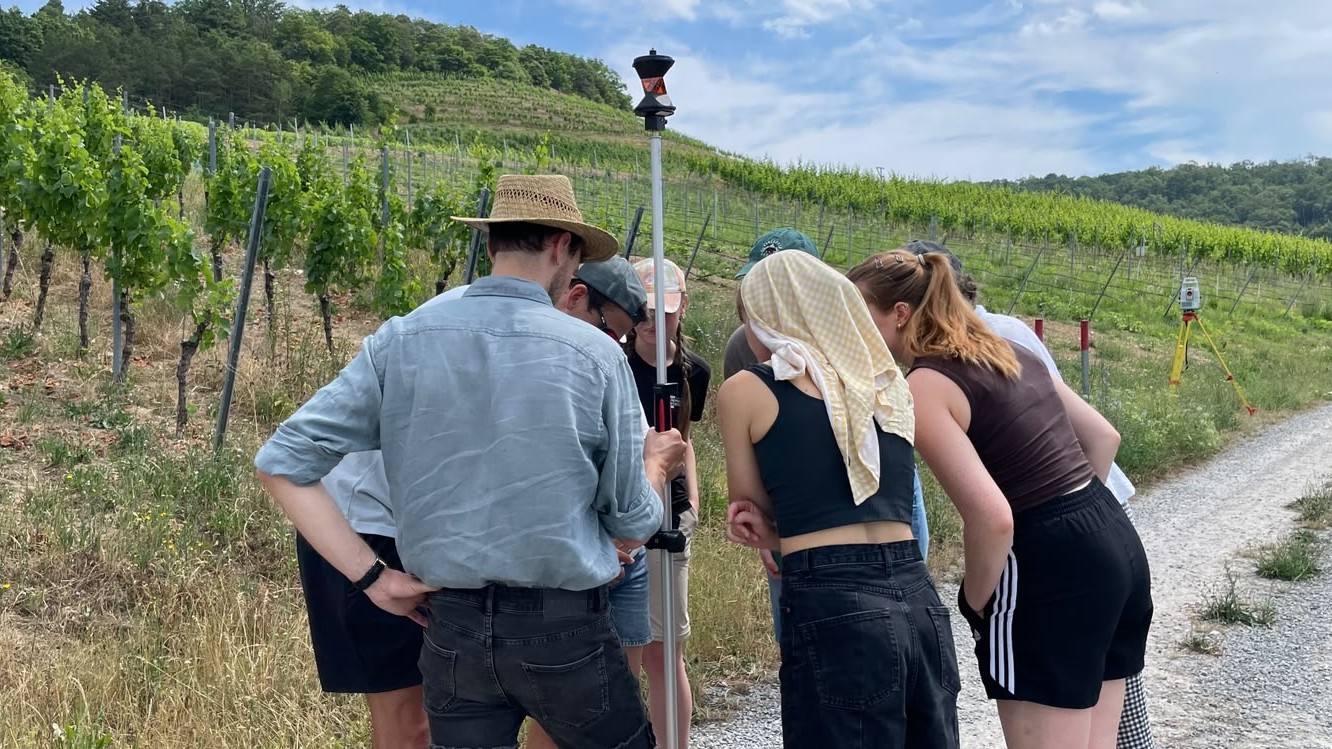
A big chunk of the course was dedicated to UAS-based Lidar missions, and Julia was refreshingly honest (in collaboration with our UAS research team) about how much work actually goes into them. It’s easy to look at a finished point cloud and think it just magically appeared, but planning a UAS Lidar flight, dealing with flight permissions, battery life, weather windows, and then processing and georeferencing the data afterward, that’s a serious time investment. The EAGLEs got a real sense of just how much fieldwork and patience sits behind a clean dataset, which is honestly one of the most valuable lessons you can learn in this field. Knowing what a sensor can do is only half the story, you also need to know what it costs you in time and effort to get there.
A big chunk of the course was dedicated to UAS-based Lidar missions, and Julia was refreshingly honest (in collaboration with our UAS research team) about how much work actually goes into them. It’s easy to look at a finished point cloud and think it just magically appeared, but planning a UAS Lidar flight, dealing with flight permissions, battery life, weather windows, and then processing and georeferencing the data afterward, that’s a serious time investment. The EAGLEs got a real sense of just how much fieldwork and patience sits behind a clean dataset, which is honestly one of the most valuable lessons you can learn in this field. Knowing what a sensor can do is only half the story, you also need to know what it costs you in time and effort to get there.
Terrestrial laser scanning and mobile phone based Lidar rounded out the platform overview, showing students that you don’t always need a massive budget or a drone license to get useful 3D data. Phones with Lidar sensors, the kind a lot of people already carry around, can capture surprisingly solid small scale structural information, which opens up some fun and accessible options for quick fieldwork or teaching exercises..
On the analysis side, Julia introduced the students to dedicated R packages for processing and interpreting Lidar data for environmental applications. Working through actual point clouds in R, rather than just looking at pretty pictures in a slideshow, forced students to grapple with the messier reality of Lidar data: noise, classification, normalization, all the stuff that happens between “raw data” and “usable result.”
But if there was one thread running through the whole course, it was this: understanding the limits of a method is just as important as understanding its potential. Lidar can give you incredibly rich spatial information, structure you simply can’t get from passive optical sensors. But it’s not free information. It comes with real constraints, technical, logistical, and sometimes financial, and a good remote sensing researcher needs to be honest about those tradeoffs rather than treating any one sensor as a silver bullet.
On the analysis side, Julia introduced the students to dedicated R packages for processing and interpreting Lidar data for environmental applications. Working through actual point clouds in R, rather than just looking at pretty pictures in a slideshow, forced students to grapple with the messier reality of Lidar data: noise, classification, normalization, all the stuff that happens between “raw data” and “usable result.”
But if there was one thread running through the whole course, it was this: understanding the limits of a method is just as important as understanding its potential. Lidar can give you incredibly rich spatial information, structure you simply can’t get from passive optical sensors. But it’s not free information. It comes with real constraints, technical, logistical, and sometimes financial, and a good remote sensing researcher needs to be honest about those tradeoffs rather than treating any one sensor as a silver bullet.
Big thanks to Julia for putting together such a thorough and honest look at the Lidar landscape, and to all the EAGLEs who got their hands dirty with point clouds this term. Next time you see a 3D scan of a forest or a building, you’ll know there’s a lot more going on behind the scenes than just “pointing a laser at something.”