

Anyone who’s tried to do geospatial work across the whole island of Ireland knows the headache. Ireland is one island geographically, but it’s split across two jurisdictions, the Republic and Northern Ireland, and each one runs its own data infrastructure. Different portals, different APIs, different coordinate systems, different standards for basically everything. So before you can even start analyzing anything, you’re stuck hopping between websites trying to figure out which dataset matches which on the other side of the border.
Aoibhin, one of our EAGLE students, built a package for her 1st semester programming course that gets rid of that whole mess. It’s called EireR, named after Éire, the Irish word for the island, and the whole point is right there in the name: one gateway to geospatial data for the entire island, not just one half of it.
What EireR actually does is pull together 1,023 datasets across 12 themes, all auto discovered from four different open data APIs spanning both jurisdictions. The EPA and GeoHive on the Republic’s side, DAERA and OpenDataNI on the Northern Ireland side. You browse the whole thing with one function, eire_catalogue(), filter by jurisdiction or theme or just search by keyword, and then pull whatever you need with get_layer() and a dataset ID. Everything that comes back gets reprojected automatically to ITM, the Irish Transverse Mercator system, and lands in your R session as a standard sf object, ready to go.
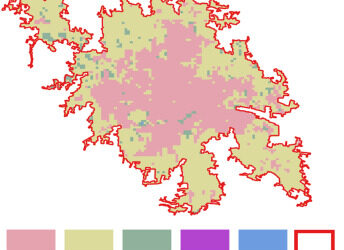
The part that makes this genuinely clever isn’t just the access, it’s the comparison angle. Datasets from the two jurisdictions almost never line up perfectly. Different agencies, different schemas, different variable names, sometimes even different units. EireR doesn’t pretend they’re identical, it’s honest about that in the documentation, but it gets you close enough fast enough that you can actually do the comparison instead of giving up halfway through. There’s a built in example in the README comparing EPA catchment boundaries from the Republic against DAERA’s hydrological catchments from the North, same CRS, same plotting function, side by side with patchwork in about five lines of code.
It also comes with a few quality of life touches that show some real thought went into the design. There’s local caching so you’re not redownloading the same files every session, helper functions for grabbing all 32 counties harmonized in one call, and built in bounding boxes for the island, the Republic, or just the North, depending on what you’re working on.
For anyone doing cross border environmental or spatial research, which honestly describes a good chunk of what gets studied on that island, this cuts out a ton of the grunt work that used to eat up the first week of any project.
You can find EireR on GitHub at github.com/Aoibhinmurphy/EireR.