
new article on remote sensing of ecosystems: opportunities, challenges and way forward

new article on remote sensing of ecosystems: opportunities, challenges and way forward

August 28, 2017

Our new article on remote sensing applications for ecosystem functions is now online “Satellite remote sensing of ecosystem functions: opportunities, challenges and way forward“. The article is lead by Nathalie Pettorelli and consists of members of the GEO BON Working Group. From the abstract: Societal, economic and scientific interests in knowing where biodiversity is, how it is faring and what can be done to efficiently mitigate further biodiversity loss and the associated loss of ecosystem services are at an all-time high. So far, however, biodiversity monitoring has primarily focused on structural and compositional features of ecosystems despite growing evidence that ecosystem functions are key to elucidating the mechanisms through which biological diversity generates services to humanity. This monitoring gap can be traced to the current lack of consensus on what exactly ecosystem functions are and how to track them at scales beyond the site level. This contribution aims to advance the development of a global biodiversity monitoring strategy by proposing the adoption of a set of definitions and a typology for ecosystem functions, and reviewing current opportunities and potential limitations for satellite remote sensing technology to support the monitoring of ecosystem functions worldwide. By clearly defining ecosystem processes, functions and services and their interrelationships, we provide a framework to improve communication between ecologists, land and marine managers, remote sensing specialists and policy makers, thereby addressing a major barrier in the field.

continue reading:

Pettorelli, N., Schulte to Bühne, H., Tulloch, A., Dubois, G., Macinnis-Ng, C., Queirós, A. M., Keith, D. A., Wegmann, M., Schrodt, F., Stellmes, M., Sonnenschein, R., Geller, G. N., Roy, S., Somers, B., Murray, N., Bland, L., Geijzendorffer, I., Kerr, J. T., Broszeit, S., Leitão, P. J., Duncan, C., El Serafy, G., He, K. S., Blanchard, J. L., Lucas, R., Mairota, P., Webb, T. J., Nicholson, E. (2017), Satellite remote sensing of ecosystem functions: opportunities, challenges and way forward. Remote Sensing in Ecology and Conservation. doi: 10.1002/rse2.59

follow us and share it on:

you may also like:

Ticks from Above: UAS Fieldwork for the MONID Habitrack Project

Ticks from Above: UAS Fieldwork for the MONID Habitrack Project

Forest edges are tricky places. They're where woodland meets open ground, where light and shade trade off every few meters, and where, it turns out, ticks tend to do really well. That last bit is exactly why Dr. Ariane Droin, Sofica Garcia de Leon, Dr. Jakob...

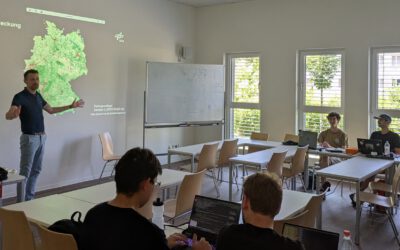
Course on urban EO by Michael Wurm

Course on urban EO by Michael Wurm

Walk through any city and you pick up on things that are hard to put a number on. The noise of a main road, the heat that sits between buildings in summer, the question of whether that little park around the corner is really enough green space for the whole...

EireR R package: unified gateway to Irish geospatial data

EireR R package: unified gateway to Irish geospatial data

Anyone who's tried to do geospatial work across the whole island of Ireland knows the headache. Ireland is one island geographically, but it's split across two jurisdictions, the Republic and Northern Ireland, and each one runs its own data infrastructure. Different...

Impact of agrophotovoltaic facilities – an R package

Impact of agrophotovoltaic facilities – an R package

There's a new R package on the block, and it's solving a problem that sounds simple until you actually try to do it: how do you tell whether putting solar panels over a farm field is good or bad for the soil and the crops around them? Marlene, one of our EAGLE...

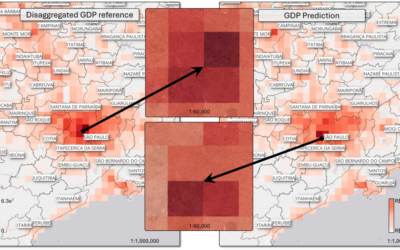
New paper on GDP estimatation from space

New paper on GDP estimatation from space

Reliable and up-to-date sub-national data on the gross domestic product (GDP) data remain scarce in many regions across the globe. However, in a new study we show how high-resolution GDP estimates can be derived from multisource remote sensing and auxiliary inputs...

Share This