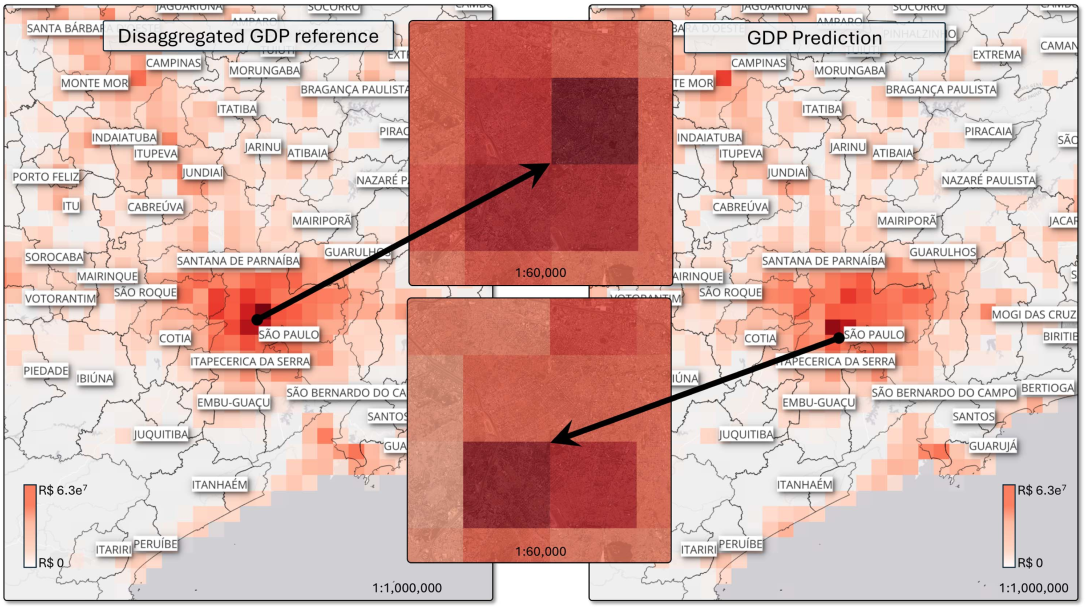

Reliable and up-to-date sub-national data on the gross domestic product (GDP) data remain scarce in many regions across the globe. However, in a new study we show how high-resolution GDP estimates can be derived from multisource remote sensing and auxiliary inputs using a deep learning fusion framework. In a new publication titled “From Space to Economy: Deep Learning Fusion of Remote Sensing Data for Sub-National GDP Estimation“, we combine optical day- and night-time satellite imagery, and auxiliary geospatial layers with several backbone architectures and fusion strategies to assess the robustness of multimodal learning for economic prediction. This research was a joint undertaking by researchers from NASA in Washington D.C., the Yale University, in New Haven, USA, our Earth Observation Research Cluster (EORC) of the University of Würzburg in Germany and the Earth Observation Center (EOC) of the German Aerospace Center (DLR). The study was just published in the Journal ‘IEEE Journal of Selected Topics in Applied Earth Observation and Remote Sensing’ by Thomas Stark, Michael Wurm, Simon Krenn, Wolfgang Sulzer, Eleanor Stokes, Karen C. Seto, and Hannes Taubenböck.
Here is the abstract of the paper: Reliable and up-to-date sub-national data on the gross domestic product (GDP) remain scarce in many regions across the globe. This limits the ability to analyze spatial economic disparities and to design evidence-based development policies. In this study, we investigate whether high-resolution GDP estimates can be derived from multisource remote sensing and auxiliary inputs using a deep learning fusion framework. We combine optical day- and night-time satellite imagery, and auxiliary geospatial layers with several backbone architectures and fusion strategies to assess the robustness of multimodal learning for economic prediction. Across extensive experiments in Brazil, we evaluate multiple encoders (ResNet-18, EfficientNet-B3, and SwinV2-T), alternative fusion layers (concatenation, attention pooling, graph-based multilayer perceptron, and mixture-of-experts), and diverse input modality combinations. Our best-performing model, an EfficientNet-B3 encoder with concatenation fusion using all available input modalities, achieves an R2 value of 0.87 for GDP prediction at a spatial resolution of 5 km × 5 km, demonstrating that our multimodal approach effectively captures the complex relationships between spatial patterns and economic activity. These findings highlight the potential of multimodal remote sensing to complement traditional statistical sources by providing spatially consistent, high-resolution representations of economic activity.
Read the full article here: https://ieeexplore.ieee.org/stamp/stamp.jsp?tp=&arnumber=11540348
This work is closely related to previous works in the fields of socio-economy – see here for more information:
- Learning Income Levels and Inequality from Spatial and Sociodemographic Data in Germany https://www.sciencedirect.com/science/article/pii/S0143622823001893
- EU Cohesion Policy on the Ground: Analyzing Small-Scale Effects Using Satellite Data https://www.sciencedirect.com/science/article/pii/S0166046223000893
- Satellite-based fine-grained spatio-temporal monitoring of urban building activities as an indicator of economic development https://ieeexplore.ieee.org/document/11075972
- GDP Estimation using a Deep Learning Fusion Model for Multi-Source Remote Sensing Data https://ieeexplore.ieee.org/document/11076044
- Urbanization, Economic Development, and Environmental Quality: Insights from Urban Growth Dynamics and NO2 Pollution in Megacities https://ieeexplore.ieee.org/document/11076023
- Spatio-temporal Estimation of Electricity Consumption in Bolivian Municipalities Using Nighttime Lights https://www.tandfonline.com/doi/full/10.1080/10106049.2026.2657705
- Blinded by the light: Monitoring local economic development over time with nightlight emissions https://ieeexplore.ieee.org/document/9554428
- Europe’s socio-economic disparities reflected in settlement patterns derived from satellite data https://ieeexplore.ieee.org/document/8809033
- Detecting social groups from space – Remote sensing-based mapping of morphological slums and assessment with income data https://www.tandfonline.com/doi/full/10.1080/2150704X.2017.1384586
- Are the poor digitally left behind? Analyzing urban divides using remote sensing and twitter data https://www.mdpi.com/2220-9964/7/8/304
- Capturing the urban divide in nighttime light images from the International Space Station https://ieeexplore.ieee.org/document/8362725
- Analyzing links between spatio-temporal metrics and socio-economic factors at a semi-global scale https://www.mdpi.com/2220-9964/9/7/436
- Delineation of Central Business Districts in mega city regions using remotely sensed data https://www.sciencedirect.com/science/article/pii/S0034425713001739