
New RapidEye datasets granted from RESA platform of DLR/Black Bridge

New RapidEye datasets granted from RESA platform of DLR/Black Bridge

July 14, 2015

The Dept. of Remote Sensing recently applied for a time series of 7 RapidEye scenes to support a PhD thesis by M.Sc Omid Karami (Sari University of Agricultural and Natural Resources Sciences, Iran). The proposal is now accepted, and th PhD work will be supported by a time series of RapidEye scenes acquired between 07.2009 and 09.2014 over a semi-Meditteranean forested site in Lorestan province in Western Iran.

The PhD thesis which will use these processed datasets is entitled  “Monitoring and modelling of Zagros forest oak decline using high resolution satellite data”, supervised and advised by Dr. Asghar Fallah (Sari University of Agricultural and Natural Resources Sciences), Dr. Shaban Shataee (University of Gorgan) and Dr. Hooman Latifi (University of Würzburg). Additional multisource datasets to be used within the work include very high resolution data from Quickbird and World View-2.

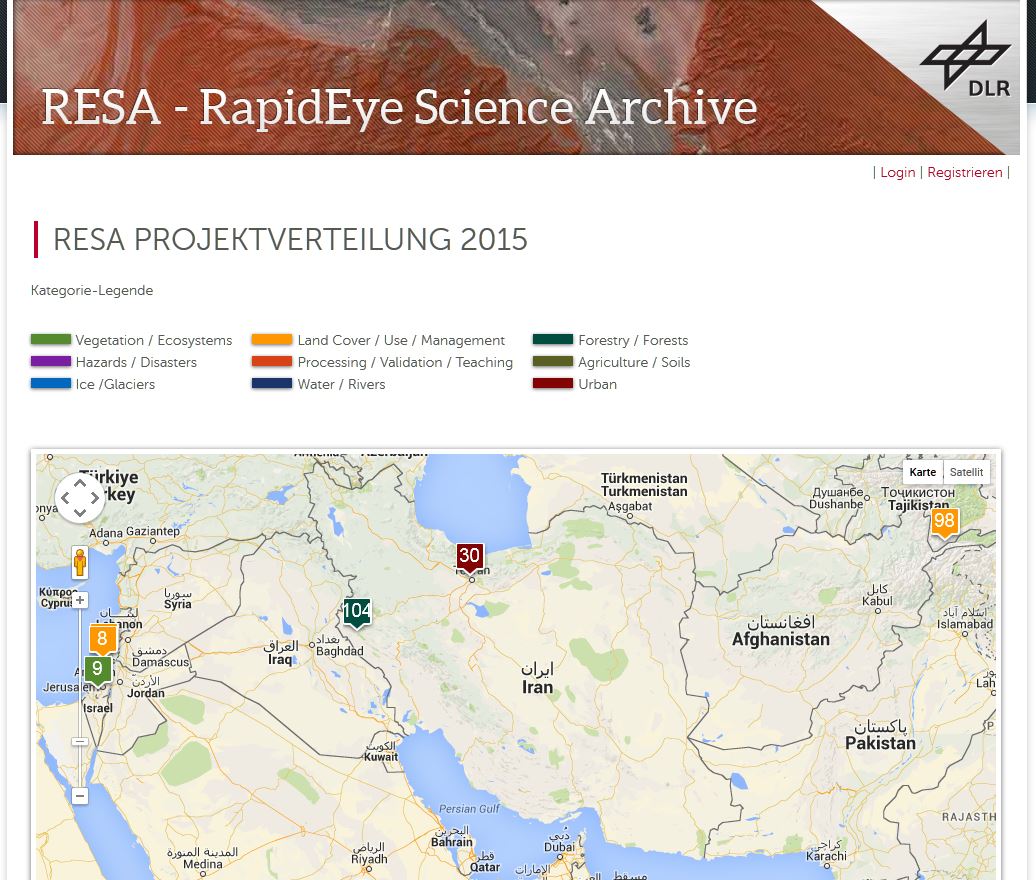
RESA already published this project in RESA project map 2015 which can be found online HERE. The project area is flagged under No. 104 (project number 168) in the map.
resa_iran

The RapidEye Science Archive (RESA) supported by DLR (BMWi) and Black Bridge AG supports scientific projects with German participation through the provision of free image data of the RapidEye satellite constellation. The projects are given the opportunity on an extensive image archive to get current and archived satellite image data to ensure optimal support for individual research projects.

follow us and share it on:

you may also like:

EAGLEs at SANParks – Kruger National Park

EAGLEs at SANParks – Kruger National Park

Our EAGLEs Sebastian Rothaug and Clemens Schömig just finished their 2+ months for the internship/InnoLab in Kruger National Park. The work was done with SANparks, Dr. Coetsee and Dr. Wigley within a year-long collaboration of EORC researcher Dr. Bevanda. The...

Fieldwork in Focus: Our New “Hex Wall” Installation

Fieldwork in Focus: Our New “Hex Wall” Installation

At EORC, the transition from physical reality to digital analysis is a core part of our methodology. While our primary output consists of Earth Observation data the foundation of this work is laid in the field. To document this essential aspect of our research, we...

Super-Test-Site Würzburg consortium meeting

Super-Test-Site Würzburg consortium meeting

The team of our "Super-Test-Site Würzburg" consortium (University of Würzburg, the Karlsruhe Institute of Technology, the Friedrich-Alexander-University Erlangen-Nürnberg, Leibniz-Institute for Länderkunde in Leipzig  and the German Aerospace...

EORC collaborations: Nature and Conservation with Remote Sensing

EORC collaborations: Nature and Conservation with Remote Sensing

Our Earth Observation Research Centre (EORC) at the University of Würzburg is involved in many collaborations applying remote sensing to environmental monitoring, conservation, and ecosystem research. Our work spans mountain ranges, forests, savannahs, and protected...

Share This