
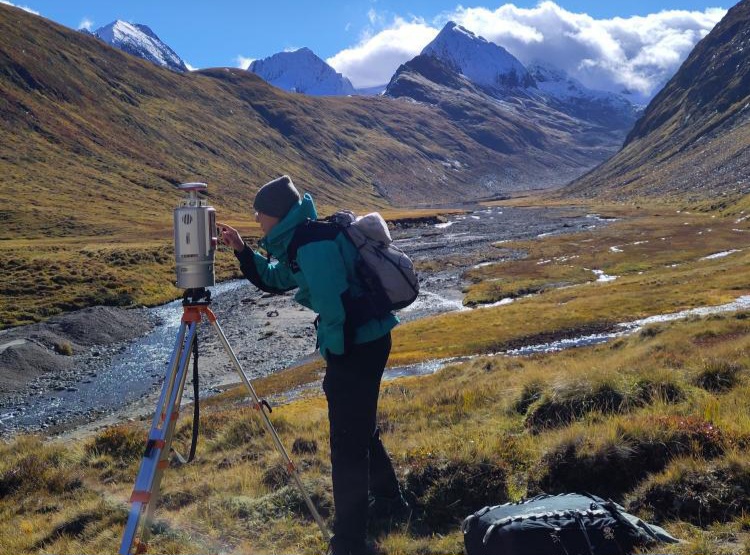

Last week, Laura, an 8th gen EAGLE Student, participated in the Summer School of Alpine Research, conducted by the University of Innsbruck, in the beautiful location of the Austrian Oetztal in Obergurgl. The focus of the Summer School was on Close Range Sensing Techniques for investigating Alpine Environments. Talks by experts from TU Delf, TU Wien, TU Dresden, TU Munich and Heidelberg University were accompanied by fieldwork to collect and analyze data on the alpine environment.
Laura’s group was assigned with quantifying erosion rates along an alpine riverbed through Terrestrial Laser Scanning (TLS). After the fieldwork, the analysis of the multitemporal 3D point clouds with the py4Dgeo Python library and in CloudCompare followed. The group aims at publishing the results in the ISPRS Journal of Photogrammetry and Remote Sensing. If successful, the work will also be presented by one of her colleagues at the ISPRS Geospatial Week in Dubai in April 2025.
The Summer School of Alpine Research is organized every two years by the University of Innsbruck and focuses on LiDAR, photogrammetry and thermal sensors. During this year’s summer school, interdisciplinary topics like creating a digital twin of the valley as well as creating 3D models of rock climbing routes were also concerned.
Links:
https://www.uibk.ac.at/en/geography/sensing-mountains/2024/
https://py4dgeo.readthedocs.io/en/stable/intro.html
follow us and share it on:

you may also like:
EORC at the Zugspitze
The CSU Working Group for Environment and Consumer Protection recently visited the Environmental Research Station Schneefernerhaus (UFS) on the Zugspitze. The visit provided an opportunity to present current research activities connected to this unique high-alpine...
Urban Form and Urban Heat: Insights from the Latest EORC Talk
On 6 October 2026, the Earth Observation Research Cluster (EORC) welcomed Stephan J. Schmidt from the Department of City and Regional Planning at Cornell University for an EORC Talk on "Urban form and the heat island effect". Urban...
Night shifts with the black-footed cat: Jolien Grafe’s internship in Benfontein
Most remote sensing work happens in the daylight, at a desk or in a field with a drone. Jolien Grafe, one of our EAGLE M.Sc. students, spent a good part of her internship doing the opposite: sitting on a hill at dusk, listening for a beeping signal from a very small,...
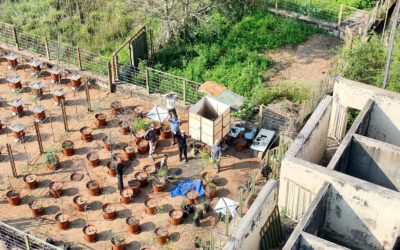
UAS analysis of fire and drought stress under controlled conditions
New update from the field work of our PhD researcher Luisa Pflumm in Kruger National Park! After weeks of fieldwork in the open savanna, Luisa's work now moves into a more controlled setting, a burn chamber experiment carried out together with our collaborators from...
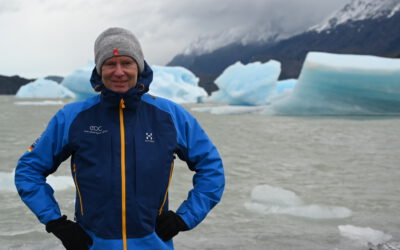
Welcome, Prof. Dr. Stefan Dech!
Big news at the EORC: as of today, October 1st, 2026, Stefan Dech is officially a senior professor at the University of Würzburg, and he's staying right where he belongs, with us at the EORC. Stefan will keep working with us on a whole range of Earth Observation...
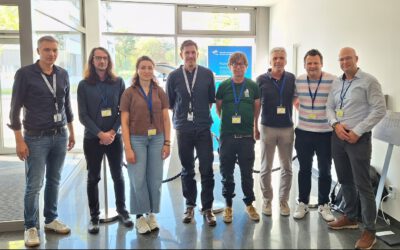
EO4CAM Meeting with LfU and StMUV at DLR
On 30 September 2026, representatives from the Bavarian State Ministry of the Environment and Consumer Protection (StMUV), the Bavarian Environment Agency (LfU), the EORC of the University Würzubrg (JMU), and the...
bzgl. Art. 50 Verordnung (EU) 2024/1689 (AI Act):
Überwiegend werden eigene originäre Texte und Bilder des EORC genutzt, jedoch sind einige Inhalte von blog post Texten teilweise mit Hilfe von KI überarbeitet worden und einige Bilder sind ganz mit KI erstellt, die jedoch deutlich keine photorealistische Darstellungen abbilden. Aussnahmen sind KI generierte fernerkundliche Datensätze, die explizit für Forschungszwecke mit KI erstellt wurden, hier wird aber durch den assoziierten Text der wissenschaftliche Grund der KI generierten Bilder erläutert.