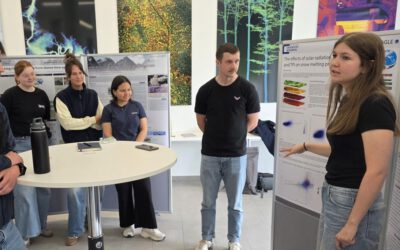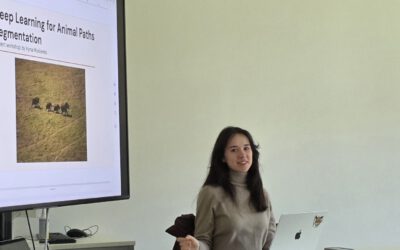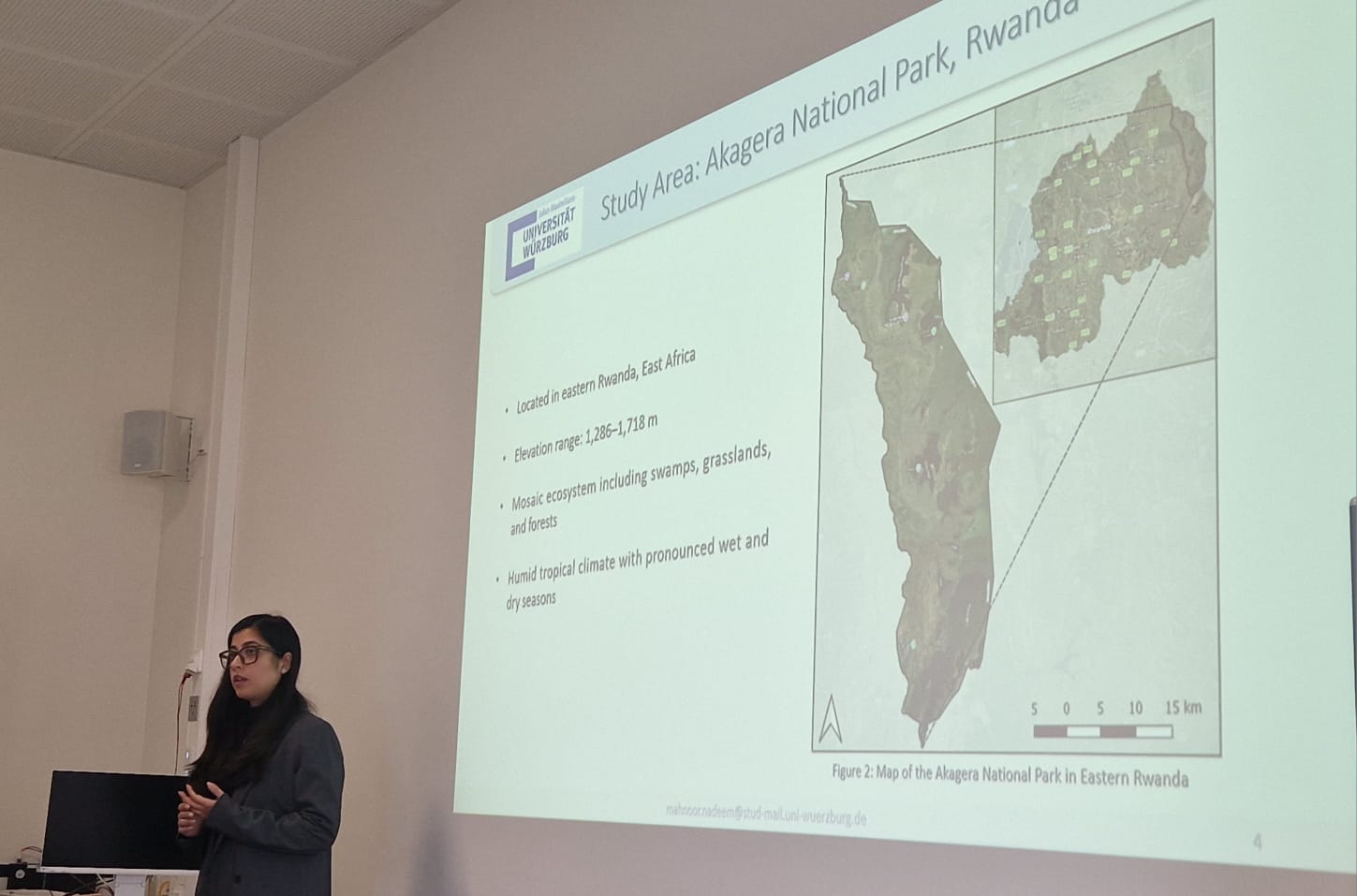

Our Master’s student Mahnoor Nadeem successfully presented her research project at the Innolab, showcasing an innovative approach to vegetation monitoring in a savannah ecosystem in Rwanda, namely Akagera National Park. Persistent cloud cover often limits the use of optical satellite data for calculating the Normalized Difference Vegetation Index (NDVI). To address this challenge, the project explored the use of Sentinel-1 SAR–derived indices for gap-filling NDVI time series. Vegetation-related features derived from VV and VH backscatter data were combined with elevation data to train a Random Forest regression model. A segment-based approach was applied to improve spatial consistency, while cloud-free Sentinel-2 data were used for training and validation. The model achieved an accuracy of approximately 60%, demonstrating the potential of SAR data for NDVI estimation in cloud-prone regions. While spatial smoothness was improved, limitations remained in capturing fine-scale details and extreme NDVI values. The presentation sparked valuable discussion and was very well received.
The InnoLab was supervised by Dr. Insa Otte and Sebastian Buchelt.

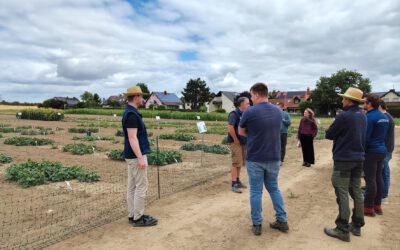
Earth Observation Meets Agricultural Practice: The Final Excursion of the EAGLE Block Course
The EAGLE block course "Linking Science and Practice in Earth Observation for Climate Adaptation" concluded with a visit to the Bavarian State Office for Agriculture (LfL) and its Research Center for Agriculture in Dry Regions in Schwarzenau. Following earlier visits...