
We are pleased to announce that our PhD student Baturalp Arisoy has just released the open soure Python package stac2cube, dedicated to transform Sentinel-2 satellite imagery into analysis ready data.
The package addresses a number of typical challenges arising during processing Sentinel-2 data. Specifically, stac2cube
- implements probabilistic cloud masking and offers user-defined thresholds with realistic cloud contours. This helps to overcome common issues with the standard SCL layers and STAC metadata.
- provides a co-registration routine that ensures sub-pixel alignment over complex, dynamic landscapes to produce accurate temporal metrics and improved change detection capabilities.
- comes with a deep learning super-resolution algorithm refining all bands to 2.5 m. This allows to analyze landscapes at an unprecented level of spatial, temporal and spectral detail.
Besides, the package also provides a data cube update mechanism that significantly reduces the computation cost of processing long-term time series, making the production of datacubes suitable for low-spec users, too.
Most important, the package is extremely well documented and provides a series of interactive Python notebooks where users can learn about the use of the provided tools, including guidance for installation Linux and Windows systems.
The package is designed for both – local machines and high performance compute environments. Local users can get started with the provided notebooks while HPC users can work with SLURM jobs. In particular, the package supports “terrabyte”, a compute platform jointly hosted by our colleagues from the German Aerospace Center and the Leibniz Supercomputing Center.
The code repository is hosted on github: https://github.com/BaturalpArisoy/stac2cube. In addition, the package is also archived on Zenodo with a persistent DOI: https://doi.org/10.5281/zenodo.18459201.
A scientific reference to the package with a description and evaluation of the implemented methods is available as preprint in Earth Observation: https://egusphere.copernicus.org/preprints/2026/egusphere-2026-619.
Original Sentinel-2 time series
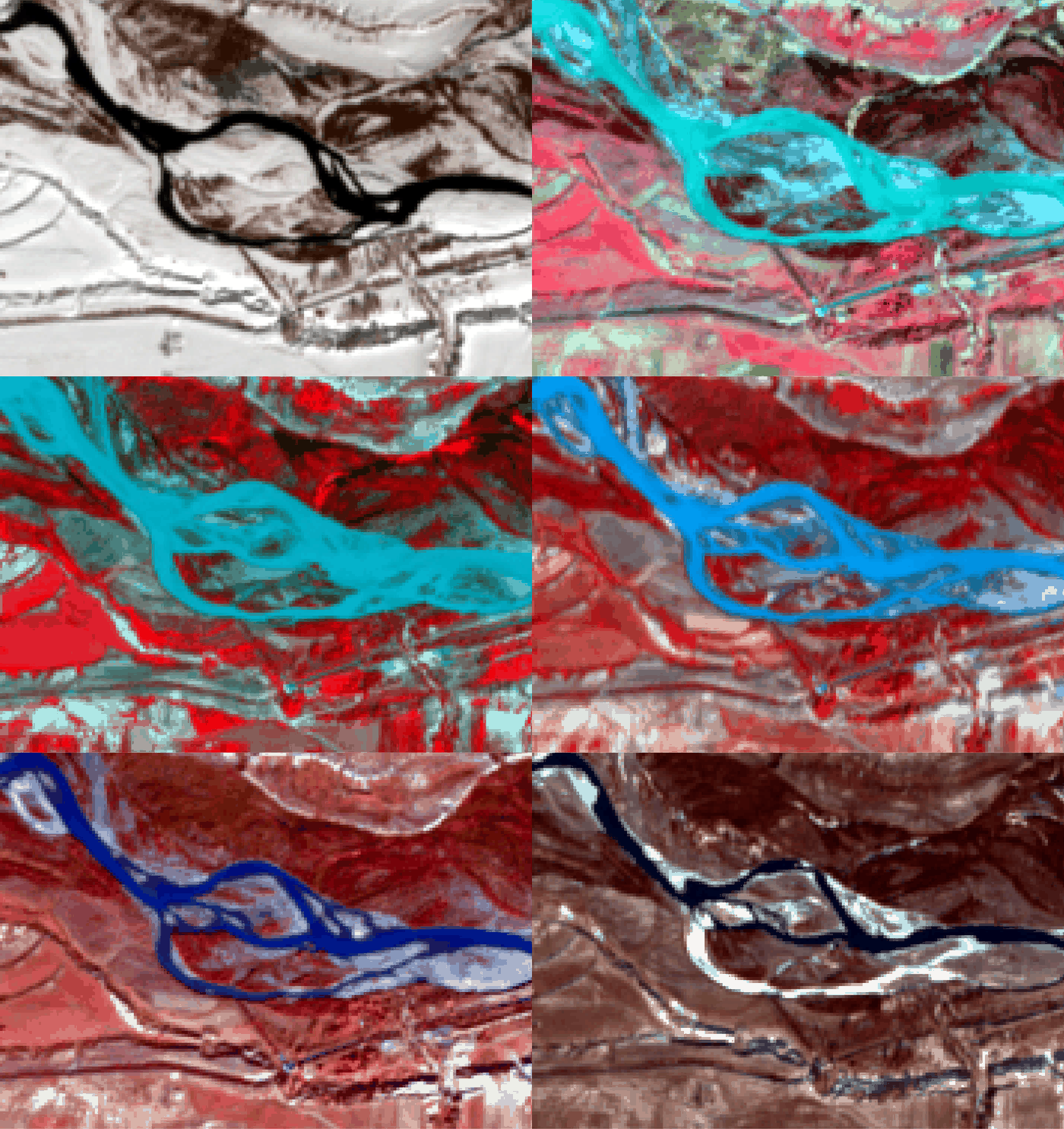
Co-registered and super-resolved datacube processed by stac2cube