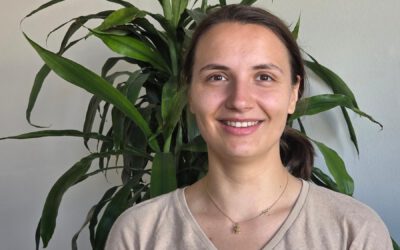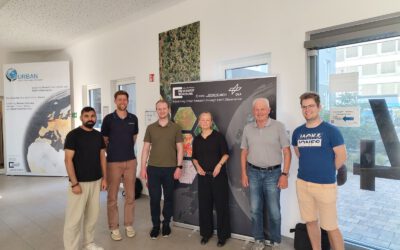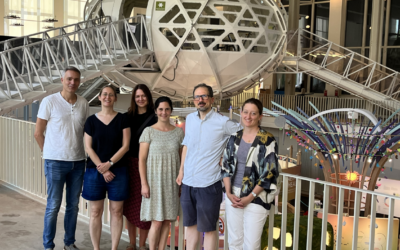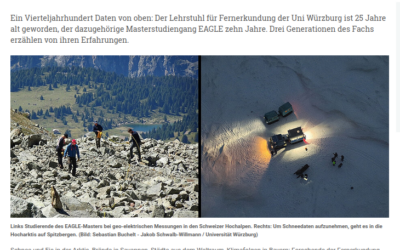


In the research environment at EORC, as in many scientific institutions, the contributions of female scientists are integral to our work. Their perspectives and dedication form part of the foundation upon which our Earth observation research is built.
Especially our international EAGLE MSc programme brings together young female scientists whose approaches to Earth observation often complement established methods. These young researchers as well as our more senior PhD and postdoc at EORC work on applications ranging from agriculture to georisk, from urban to cryosphere, from biodiversity monitoring to climate change analysis, and their questions—sometimes different from those posed by male colleagues—contribute to the breadth of our research.
We have observed that diverse teams tend to examine problems from multiple angles. Different backgrounds and experiences lead to different entry points into scientific questions, which can strengthen methodology and interpretation.
It is worth remembering that the field of space-borne remote sensing itself was built, in part, by women whose contributions laid essential groundwork. From early satellite image analysis to the development of classification algorithms and spectral analysis techniques, female scientists were there at critical junctures.
Without their foundational work in satellite data interpretation, sensor calibration, and the theoretical frameworks that underpin modern Earth observation, much of what we research today would simply not be possible. These contributions often went unrecognised at the time, yet they form the bedrock of contemporary remote sensing science.
The research we conduct at EORC stands on these foundations. It is a useful reminder that scientific progress is cumulative, and that excluding any group from participation means losing not only present contributions but future possibilities.
The female scientists at EORC have contributed substantially to our research output. Beyond individual research, they have helped create a collaborative research environment. Knowledge sharing and mentorship are practical necessities in any research institution!
However, there are concerning developments in various countries regarding opportunities for women in science. Some movements seek to reverse progress made over recent decades. This is neither acceptable nor scientifically defensible.
The evidence supports diversity in research teams. Gender equity in STEM is not ideological; it is practical. Restricting who can contribute to scientific work restricts the quality and scope of that work.
This applies beyond gender. A functional research community requires diverse participation—different backgrounds, cultures, perspectives, and experiences all contribute to addressing complex environmental challenges.
Earth observation science addresses global issues – impacting everybody therefore all can and should be able to be part of it.