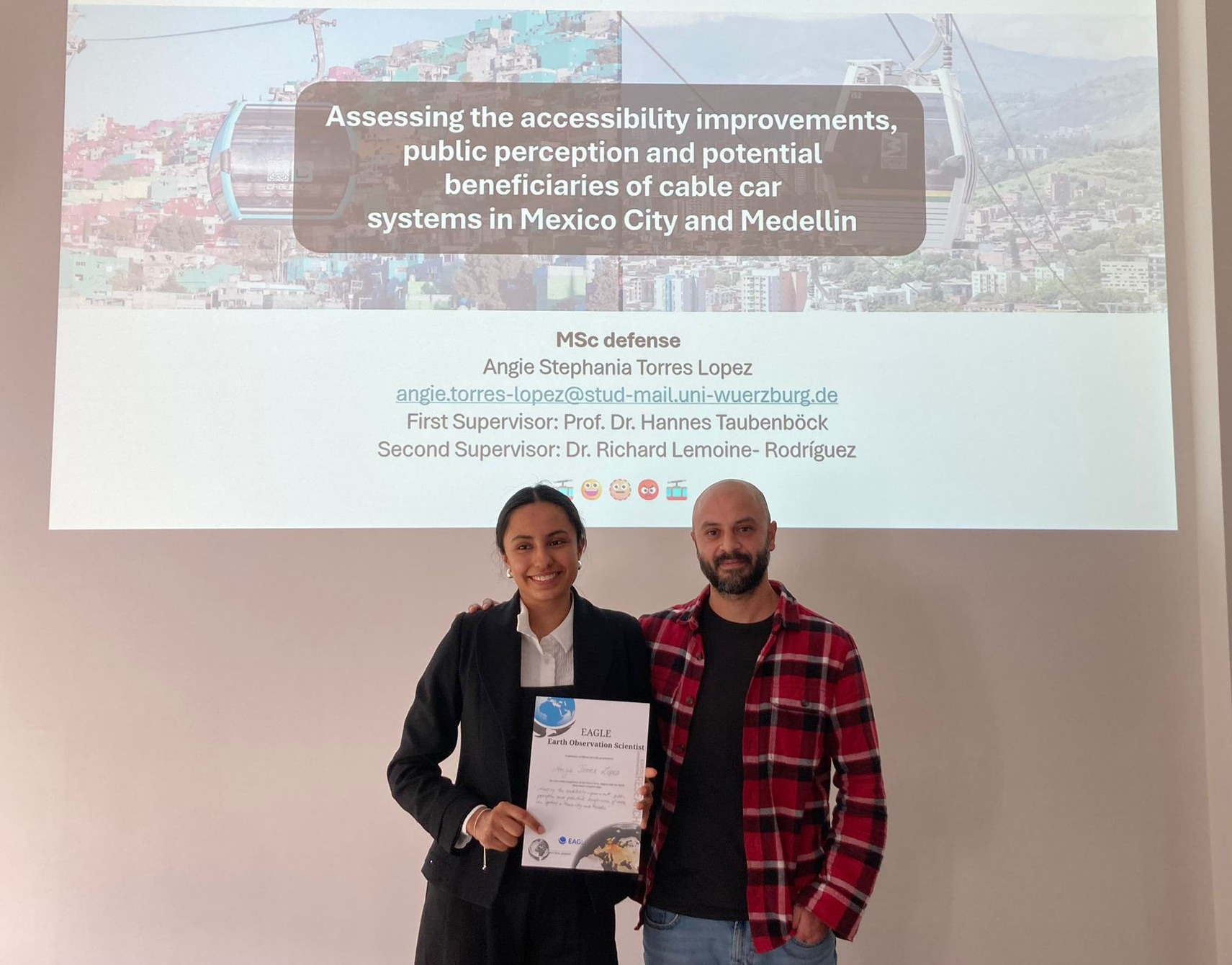
On 26 March 2026, EAGLE MSc student Angie Torres López successfully defended her Master’s thesis titled “Assessing the accessibility improvements, public perception and potential beneficiaries of cable car systems in Mexico City and Medellin”.
In her thesis, she examined how urban cable car systems affect mobility and social inclusion in informal settlements in Mexico City and Medellín. She designed a multimodal methodology that combined morphological mapping of slum areas using satellite imagery, population estimation to identify current and potential beneficiaries, GTFS-based routing and accessibility analysis to compare travel times with and without cable cars, and social media analysis using Twitter data through natural language processing. The goal was not only to measure transport efficiency, but also to understand how these systems are experienced and perceived by the people who use them.
The main results show that cable cars do improve accessibility, but in different ways in the two cities. The study found clear travel-time savings, in some cases up to 35 minutes, and showed that cable cars reduced travel times in 43.72% of the assessed trajectories in Mexico City and 34.54% in Medellín. On the perception side, social media analysis showed that both cities had positive comments about mobility and urban transformation, but Mexico City received more negative comments, especially about maintenance and infrastructure, while Medellín was perceived more positively, especially regarding service and operation.
This study shows that transport infrastructure should not be evaluated only by speed or engineering performance. The thesis offers a more complete way to assess whether a project actually helps marginalized communities and supports urban integration. It is especially important for cities in Latin America and other unequal urban contexts, where accessibility, trust in infrastructure, and social perception can determine whether a transport intervention truly reduces fragmentation and expands access to jobs, education, and services. In that sense, the thesis contributes to more socially informed and more equitable transport planning.
It was supervised by Prof. Dr.
Hannes Taubenböck and Dr. Richard Lemoine-Rodríguez from our Earth Observation Research Cluster and DLR.