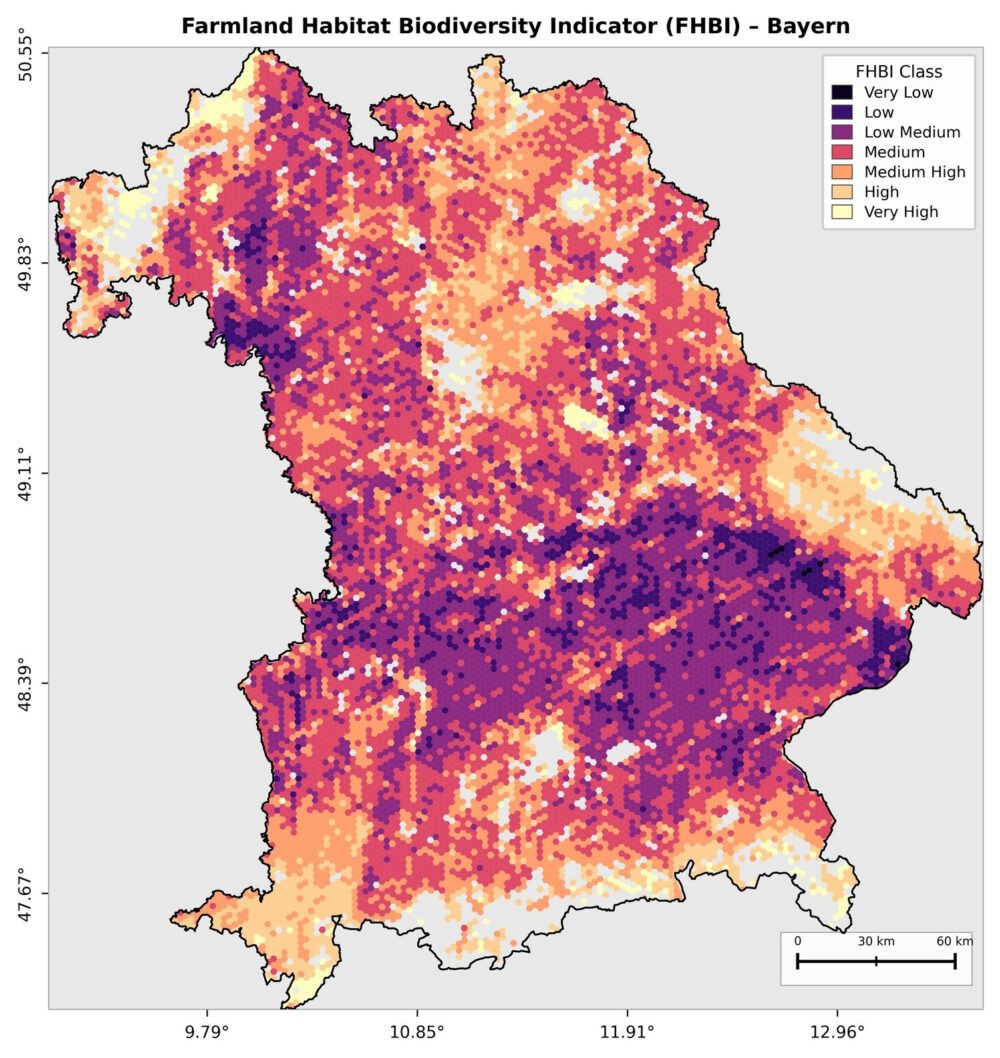

On March 31, 2026, Suriya Elango will present his Master Thesis on ” Developing a Farmland Habitat Biodiversity Indicator for Bavaria (in line with OECD Guidelines)” at 12:00 in seminar room 3, John-Skilton-Str. 4a.
From the abstract:
Farmland Biodiversity is declining across Europe due to agricultural intensification, yet scalable and repeatable monitoring frameworks that can track habitat quality at regional scale remain limited. This study presents the first wholistic regional implementation of a Farmland Habitat Biodiversity Indicator (FHBI) for the state of Bavaria, Germany, covering the period of 2018 to 2024. The indicator was derived from four habitat components, namely cropland, permanent grassland, perennial vegetation, and semi-natural small woody features (SWF), using open-source high-resolution Earth observation data products from the German Aerospace Center (DLR) and from the Copernicus Land Monitoring Service (CLMS). The Grassland habitat quality was assessed through a two-dimensional 12-class matrix combining annual mowing frequency with the date of the first mowing cut. Cropland habitat quality was evaluated using three indicators: unique crop count, legume and arable grass share, and a functional rotation typology of broad-leaved crop to spring crops. Small woody features were mapped using a composite of the Copernicus SWF layer and a Bavarian based deep-learning hedgerow product. All habitat scores were aggregated to a five sq.km hexagonal grid. The Bavarian FHBI provides a transferable, data-driven regional monitoring product and contributes methodological insights applicable across the Organization for Economic Co-operation and Development (OECD) member countries. Furthermore, the FHBI variation were examined through correlation analyses with the Müncheberg Soil Quality Rating (SQR), and average field size. A significant negative correlation was found with SQR and average field size with Pearsons’s coefficient of r = -0.394 and r = -0.432, respectively.
Keywords: Farmland Biodiversity; Habitat Indicator; OECD; FHBI; Bavaria; Remote Sensing; Grassland; Crop Rotation; Small Woody Features; Soil Quality Rating; Earth Observation
1st supervisors: Dr. Maninder Singh Dhillon
2nd supervisor: Dr. Ursula Gessner, DLR