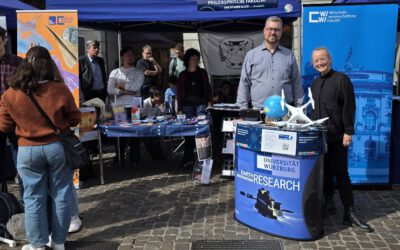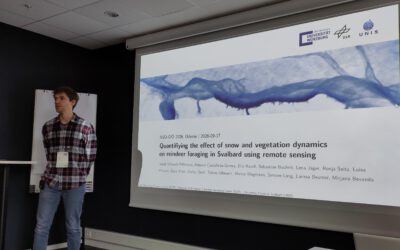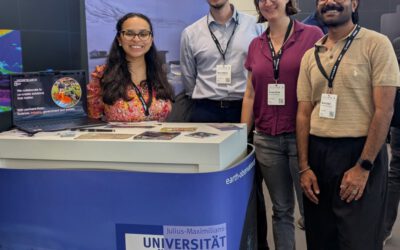

This week, the Arctic System Science Conference 2026 brought together researchers from across disciplines in Potsdam to discuss the past, present, and future of Arctic science. Hosted by the Alfred Wegener Institute (AWI), the conference provided a platform for exchange on oceanic, atmospheric, terrestrial, and socio-ecological Arctic systems.
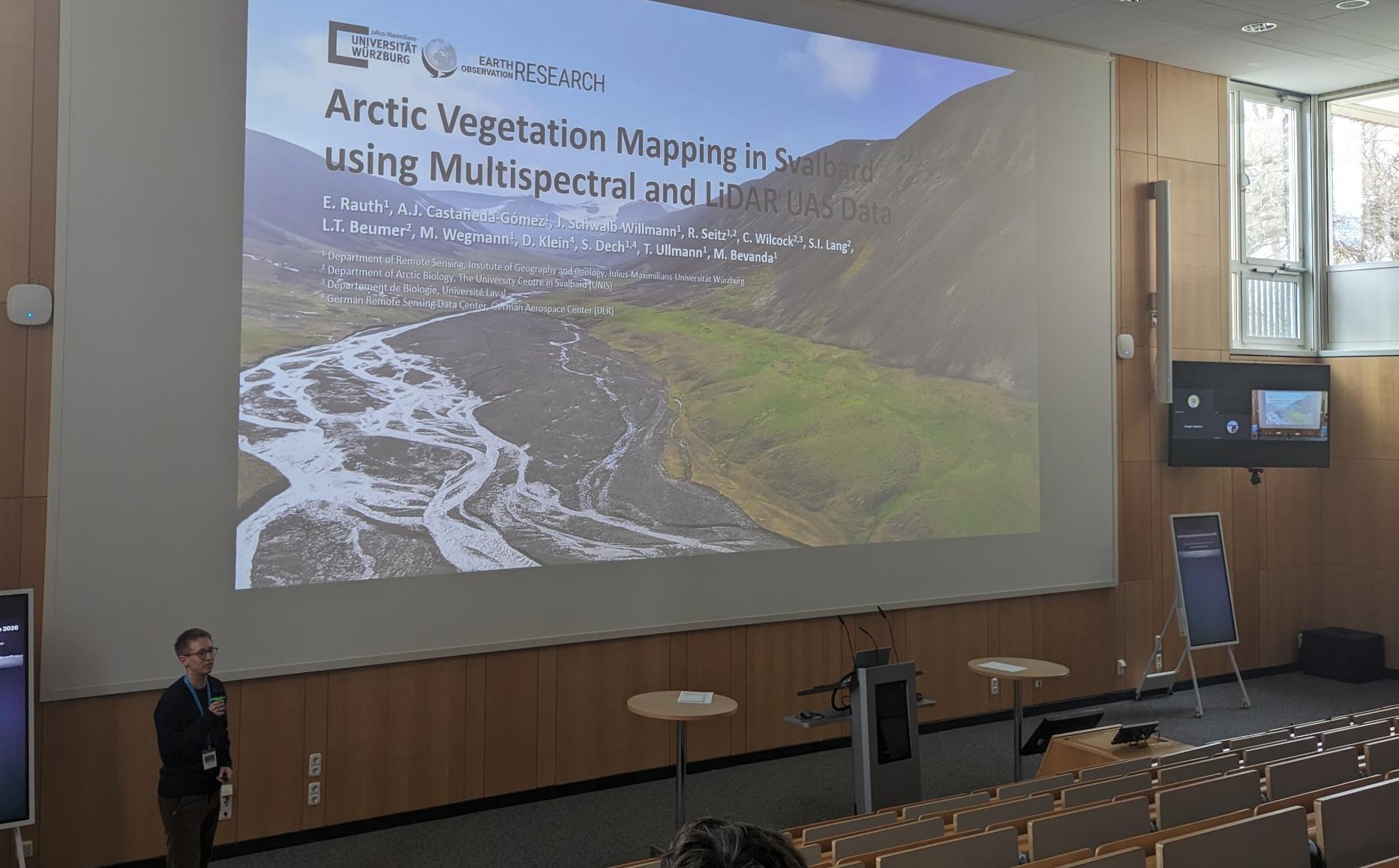
Among the contributions, the Earth Observation Research Cluster (EORC) at the University of Würzburg presented research on terrestrial Arctic ecosystems. In his talk, Elio Rauth showcased his PhD work on high-resolution Arctic vegetation mapping in Svalbard using multispectral and LiDAR data acquired from uncrewed aerial systems (UAS). His work is done within the framework of ongoing collaborations with UNIS by our postdocs Dr. Mirjana Bevanda and Dr. Jakob Schwalb-Willmann.
Why centimetre-scale mapping matters
Arctic vegetation is highly heterogeneous, with plant communities strongly controlled by micro-topography, moisture gradients, and snow distribution. Traditional satellite-based land cover mapping often struggles to capture this fine-scale variability due to mixed pixels and limited spatial resolution.
To address this, Elio’s study uses UAS data at 10 cm resolution. By combining multispectral imagery with LiDAR-derived terrain features, the research captures environmental drivers such as slope and topographic wetness—key factors shaping plant community composition.
From field plots to machine learning
The workflow integrates in situ vegetation plot data with remotely sensed features. Using a random forest classifier, the team mapped 13 distinct land cover types across a 140-hectare study site in Bjørndalen, Svalbard.
The results are:
- A class-weighted F-score of 74%
- Detailed delineation of ridge, heath, snowbed, and wetland communities
- Strong agreement with existing large-scale products for aggregated classes
At the same time, the study highlights a crucial limitation of satellite-based approaches: significant sub-pixel heterogeneity remains hidden at coarser resolutions.
Implications for Arctic research
This work demonstrates that matching classification detail to spatial resolution is essential when studying Arctic ecosystems. Centimetre-scale UAS data opens new possibilities for:
- Monitoring vegetation shifts under climate change
- Linking plant communities to micro-environmental conditions
- Improving ecological modelling at local scales
Ultimately, the study underscores the importance of high-resolution remote sensing for understanding the complexity of High Arctic landscapes.
The project is a collaborative effort between the EORC at the University of Würzburg and the University Centre in Svalbard (UNIS), highlighting the value of international cooperation in Arctic research.
The conference provided an inspiring environment to exchange ideas with researchers working across the Arctic system—from ocean to atmosphere to land. We are grateful for the opportunity and look forward to future editions of the Arctic System Science Conference.