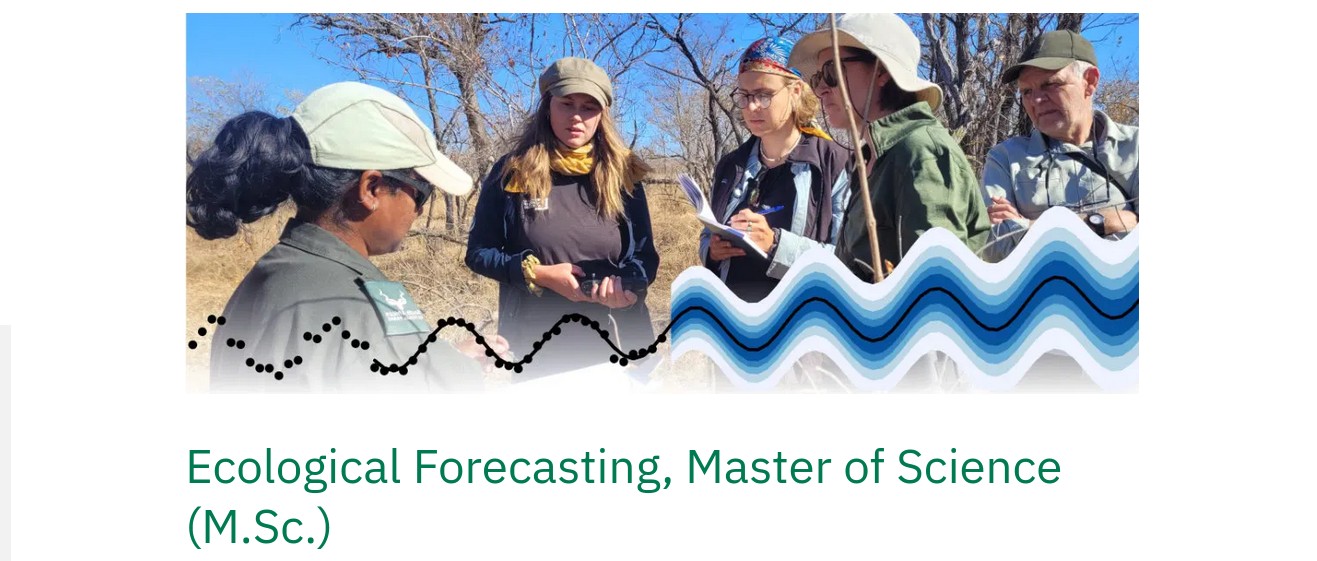

We would like to share that we are contributing to a newly launched Master of Science programme in Ecological Forecasting at the University of Bayreuth. The programme is supported by the Elite Network of Bavaria (ENB) and represents a valuable step toward strengthening interdisciplinary education at the interface of ecology, data science, and environmental decision-making.
Starting in the winter semester 2026/27, the Ecological Forecasting (M.Sc.) programme aims to train the next generation of scientists to better anticipate and interpret ecological change. At its core, the programme focuses on data-driven modelling, validation, and the iterative improvement of forecasts, equipping students with tools to generate robust and actionable insights.
Ecological forecasting goes beyond prediction; it aims to transform data into knowledge that can support informed environmental decisions. By combining ecology, statistics, computer science, and decision sciences, the programme follows a genuinely interdisciplinary approach. Our contribution is modest, consisting of one to two courses within a broad and diverse teaching team, primarily based at the University of Bayreuth with contribution by the University of Würzburg in informatics, biology and remote sensing.
Remote sensing plays an important role in ecological forecasting. Earth observation data provide continuous and spatially explicit information on ecosystem dynamics—from vegetation conditions to snow cover and biodiversity-related indicators. Integrating these datasets into forecasting frameworks supports, for example improved monitoring of ecosystem change or integration of observations into predictive models.
Our involvement reflects the growing relevance of remote sensing in ecological modelling and environmental decision support.
The programme is designed for students from diverse academic backgrounds – primarily biology and related life sciences, but also geosciences and quantitative disciplines – who share an interest in understanding and predicting ecological systems.
With its emphasis on adaptive management, students learn not only how to develop models, but also how to refine them as new data becomes available. This is closely aligned with current developments in remote sensing, including data assimilation, machine learning, and near-real-time environmental monitoring.
As part of the Elite Network of Bavaria, the programme offers a research-oriented and selective environment, characterised by small cohorts, close supervision, and an international perspective, as well as early involvement in ongoing research activities.
This provides a suitable setting for advancing approaches that link remote sensing, ecology, and predictive modelling.
We see this programme as an opportunity to further strengthen collaboration between the remote sensing and ecological modelling communities as well as University of Bayreuth and University of Wuerzburg. By contributing expertise in Earth observation, data processing, and spatial analysis, we aim to support the development of forecasting approaches that are both scientifically sound and relevant for practice.
We look forward to engaging with students and colleagues in Bayreuth and beyond, and to exploring how remote sensing can continue to contribute to ecological forecasting.
👉 Learn more about the programme:
https://www.uni-bayreuth.de/en/master/ecological-forecasting