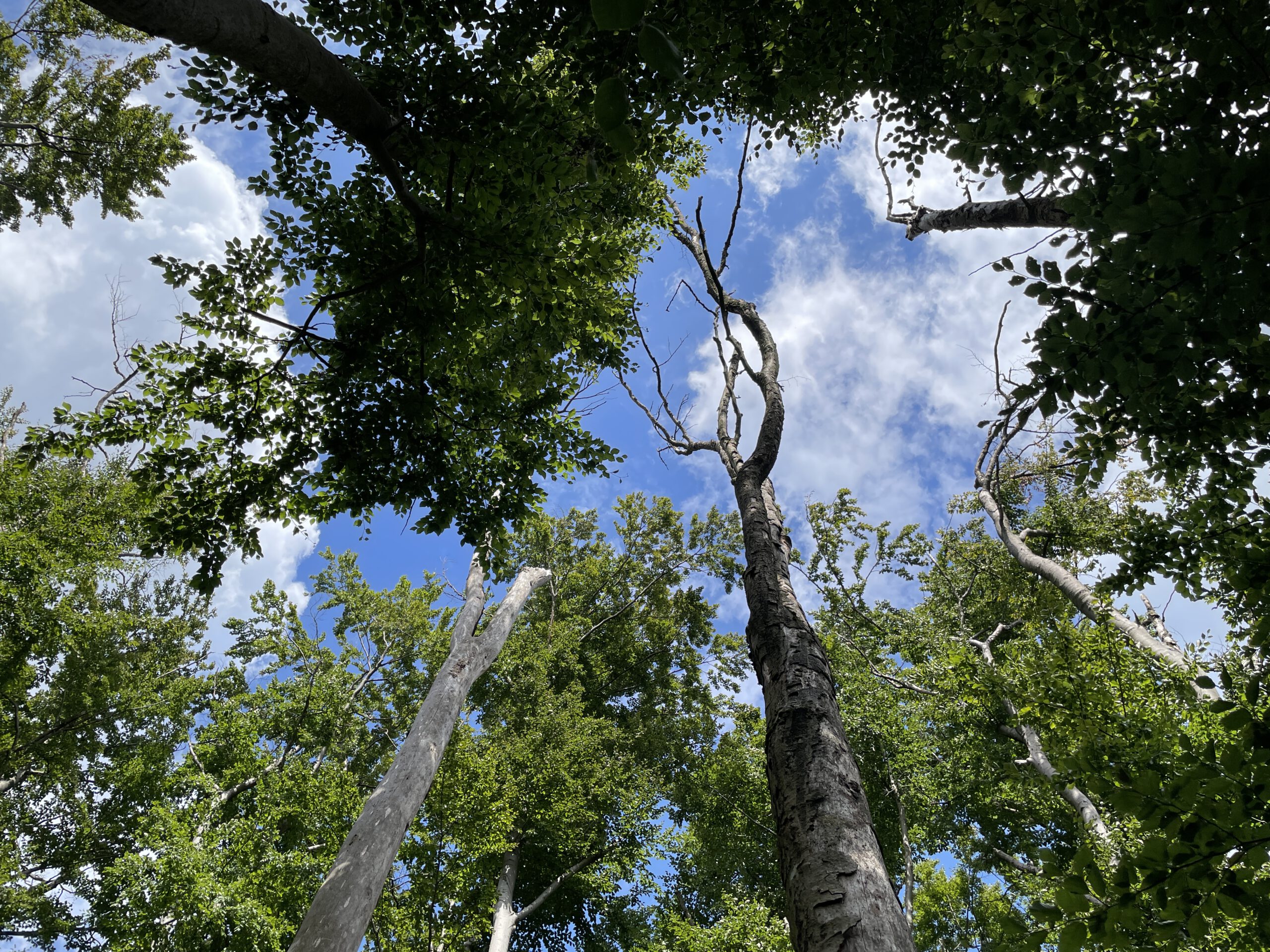

Recent drought years have raised concerns about the future vitality of different tree species in Bavaria. Focussing on European beech (Fagus sylvatica) in Bavaria as an example, drought impacts vary considerably, with pronounced decline in part of the stands while others remain comparatively stable under similar climatic stress. A recent short communication from the Bavarian Office for Forest Genetics (AWG) and the Bavarian State Institute of Forestry (LWF), co-authored by Dr. Julian Fäth (EORC), proposes a systematic framework to identify potentially drought-resilient European beech populations by integrating climate niche modelling, in-situ forest damage observations, and site information.
The study links observed vitality loss with the concept of climatic marginality, derived from species distribution modelling using climate variables such as summer temperature and precipitation. As an initial proof of concept, results show a significant relationship between modelled vulnerability and observed drought damage, indicating that marginal climatic conditions can serve as a useful indicator for identifying potentially resilient populations. Particularly promising are stands that show comparatively low vitality loss despite high climatic vulnerability, suggesting increased phenotypic plasticity or local adaptation potential. Furthermore, site-specific parameters such as available water capacity are used to explain small-scale differences in drought response. Overall, the study illustrates how combining regional climate indicators with local site information can help narrow down candidate seed stands for further genetic testing and practical forest management applications.
Within the EO4CAM project, we are currently exploring how spatially continuous Earth observation data can complement this approach. Remote sensing enables consistent monitoring of forest vitality indicators such as canopy condition, phenology or drought stress signals across large areas. Integrating EO-based indicators with existing vulnerability concepts may help to identify climate-plastic provenances more efficiently and at larger spatial scales.
In this context, we are in close exchange with the Bavarian Office for Forest Genetics to investigate how Earth observation can support the identification of resilient beech populations. The combination of ecological modelling, field observations and remote sensing offers promising perspectives for improving the spatial targeting of future seed sources under climate change.
Link to publication: https://doi.org/10.61326/silvaworld.v5i1.456