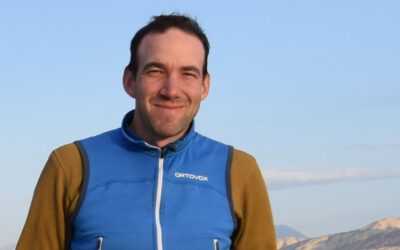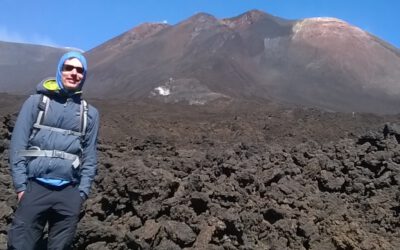
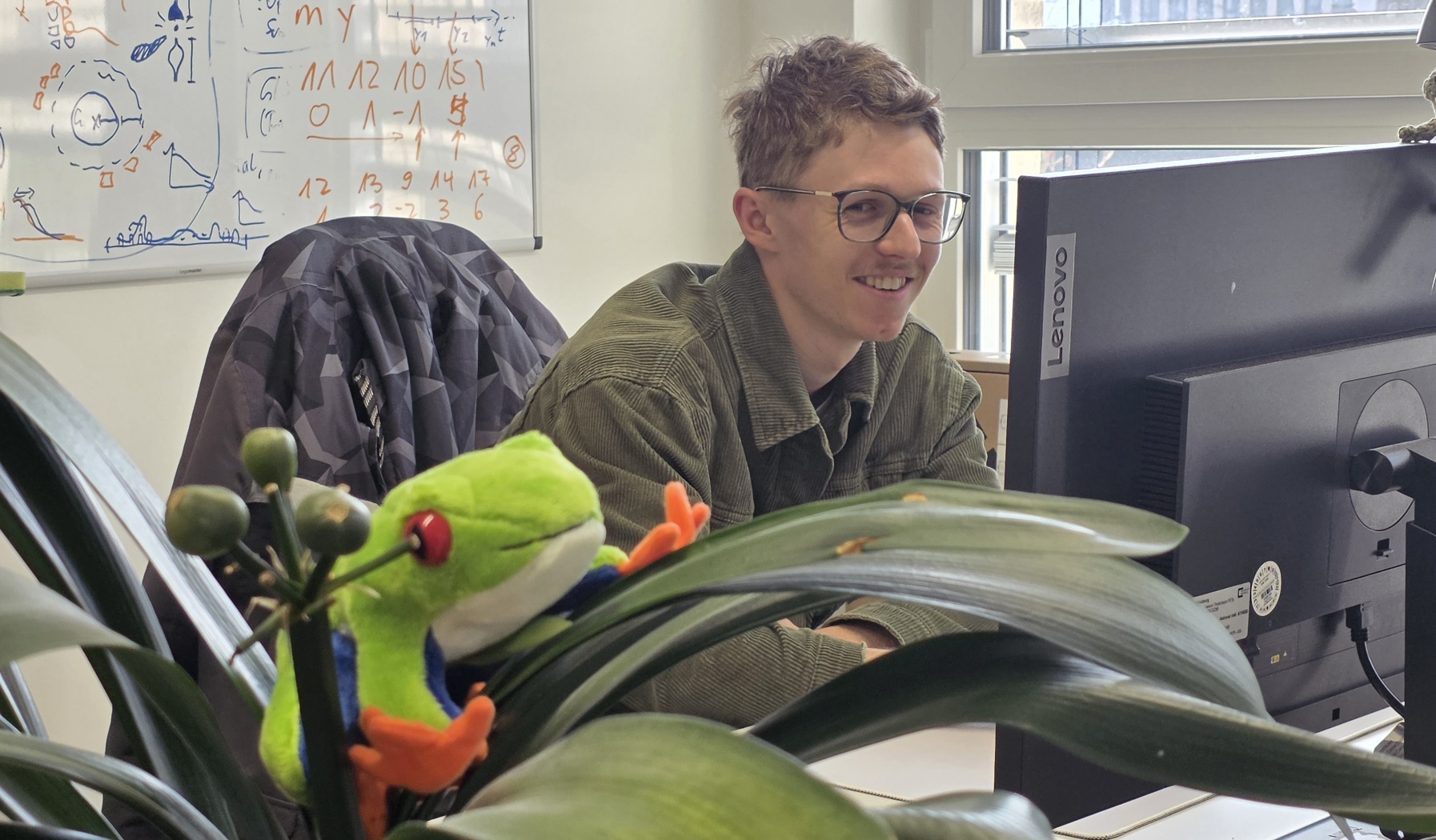

Our spotlight series highlights the diverse backgrounds and research interests of the scientists working at the Earth Observation Research Cluster. Today we introduce Konstantin Müller, a PhD student whose work combines remote sensing, deep learning, and its applications.
From Computer Science to Earth Observation
Konstantin Müller originally studied computer science at the Julius-Maximilians-Universität Würzburg, where he developed a strong foundation in programming and machine learning. His bachelor’s thesis focused on generating high-resolution normalized digital surface models from satellite data using deep learning techniques, an early indicator of his interest in combining artificial intelligence with Earth observation.
After completing his B.Sc., Konstantin expanded his interdisciplinary perspective through studies in aerospace informatics before joining the EAGLE M.Sc. program in Applied Earth Observation. During this time he deepened his expertise in geospatial data analysis, machine learning, and remote sensing applications.
Research at the Intersection of AI and Ecology
During his master’s studies, Konstantin investigated how deep neural networks can be used to detect and analyze animal movement patterns from UAV imagery. His thesis, “Animal Path Segmentation and Analysis via Generalized Deep Neural Network Regression,” explored the automatic extraction of animal paths from high-resolution aerial imagery.
The approach focuses on identifying traces such as paths rather than observing animals directly, allowing researchers to infer movement behavior while avoiding many logistical and ethical challenges of traditional tracking methods. The research was applied to UAV imagery from Kruger National Park, contributing insights relevant to conservation and ecosystem monitoring.
Software Development and Open Science
Alongside his research, Konstantin is strongly engaged in scientific software development. He contributed to the redevelopment of the R package for remote sensing analysis, RStoolbox, and actively works with programming languages such as Python, R, Java, and Kotlin.
His work emphasizes reproducibility and open tools that allow researchers and practitioners to process and analyze Earth observation data more efficiently.
International Research Experience
Konstantin has also gained international research experience. During his studies he worked as a guest scientist at the International Research Institute of Disaster Science at Tohoku University in Japan. There he explored how large-scale textual datasets and topic-modeling approaches can be used to analyze global media reporting on disasters.
These experiences reflect his interest in combining remote sensing with broader data science approaches to better understand environmental and societal processes.
Current Work
Today, Konstantin continues his research as a PhD student at our EORC at the University of Würzburg. His work focuses on applying deep learning and Earth observation data to analyze environmental change, specifically mining areas in Africa.
By bridging machine learning, geospatial analysis, and environmental research, he contributes to advancing data-driven approaches for monitoring our changing planet.