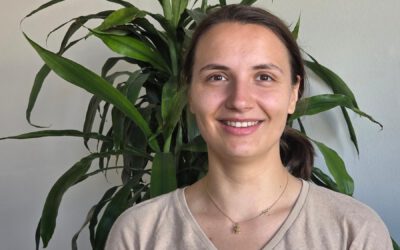

We are delighted to congratulate our former EAGLE M.Sc. student, Dr. Aida Taghavi, on the successful defense of her PhD thesis, “Multi-Sensor Soil-Moisture Estimation and Freeze–Thaw Detection across Alpine Grasslands of the Tibetan Plateau, Peatland Permafrost in Northern Sweden, and Temperate Lowland Landscapes in Germany.”
We are especially proud to see another EAGLE graduate reaching this important milestone and continuing to contribute to cutting-edge Earth observation and environmental research. Aida’s work demonstrates the interdisciplinary and international spirit of the EAGLE program, combining remote sensing, machine learning, hydrology, and cryosphere science across diverse environmental settings.
Her PhD research was co-supervised by Tobias Ullmann as second supervisor, and reflects years of dedicated scientific work spanning multiple countries, ecosystems, and methodological approaches.
Advancing Soil Moisture and Freeze–Thaw Monitoring with Sentinel-1
Surface soil moisture and freeze–thaw dynamics play a critical role in regulating water, energy, and carbon exchanges across terrestrial ecosystems. However, accurately retrieving these variables at high spatial resolution remains a major challenge, particularly in regions affected by complex terrain, vegetation cover, seasonal freezing, and sparse ground observations.
In her thesis, Aida developed and evaluated advanced approaches for estimating soil moisture and freeze–thaw states at 10 m spatial resolution using Sentinel-1 C-band SAR data and complementary environmental datasets. Her research addressed three major challenges:
- Soil moisture retrieval under vegetation and complex alpine terrain conditions
- Adaptive detection of frozen, thawed, and transitional surface states
- Robust and transferable machine-learning approaches under limited training data availability
The work covered three contrasting environmental regions:
- Alpine grasslands of the Tibetan Plateau
- Subarctic peatland permafrost environments in northern Sweden
- Temperate mixed land-use landscapes in Germany
By integrating radar remote sensing, environmental variables, and advanced machine-learning techniques, the thesis provides important methodological advances for monitoring hydro-thermal states across cold and temperate environments.
Key Scientific Contributions
Soil Moisture Retrieval in Alpine Grasslands
The first part of the thesis investigated soil moisture retrieval in the Nagqu alpine grasslands on the Tibetan Plateau using Sentinel-1 SAR data from 2017–2019.
Aida compared a semi-empirical water cloud model parameterised with SAR-derived vegetation indices against a distributed random forest model that integrated Sentinel-1 backscatter, terrain metrics, and meteorological variables.
The results demonstrated that:
- Sentinel-1 dual-polarisation features can effectively reduce vegetation-related attenuation effects without relying on cloud-prone optical datasets
- The water cloud model achieved strong performance with R² values around 0.70
- The distributed random forest model further improved performance, reaching R² values of approximately 0.75 while successfully capturing complex non-linear ecohydrological interactions
These findings highlight the strong potential of combining SAR data with environmental predictors for operational soil moisture estimation in seasonally frozen mountain environments.
Improved Freeze–Thaw Detection
The second part of the thesis focused on detecting freeze–thaw dynamics using Sentinel-1 VV/VH time series.
Aida developed a percentile-based freeze–thaw identification method using the 5th and 95th percentiles of Sentinel-1 time series data and validated the approach against in-situ observations from both the Tibetan Plateau and Stordalen Mire in northern Sweden.
The proposed method significantly improved the identification of frozen and thawed states and, importantly, enabled the detection of transitional conditions such as partially frozen or partially thawed surfaces.
Among the key findings:
- Overall classification accuracies reached 94% in Stordalen and 77% in Nagqu
- Transitional states were detected with notable accuracy, especially in the subarctic peatland environment
- VH polarisation showed stronger sensitivity in vegetated peatland systems
- VV polarisation performed better in sparsely vegetated alpine grasslands
- Descending Sentinel-1 orbits consistently outperformed ascending acquisitions due to reduced diurnal variability
This work contributes valuable insights into freeze–thaw monitoring strategies across different climatic and vegetation conditions.
Self-Supervised Learning for Soil Moisture Estimation
The third study introduced a highly innovative machine-learning framework based on self-supervised learning.
Aida designed a reconstruction-based self-supervised TabTransformer framework capable of learning transferable feature representations from large amounts of unlabelled multi-source environmental data.
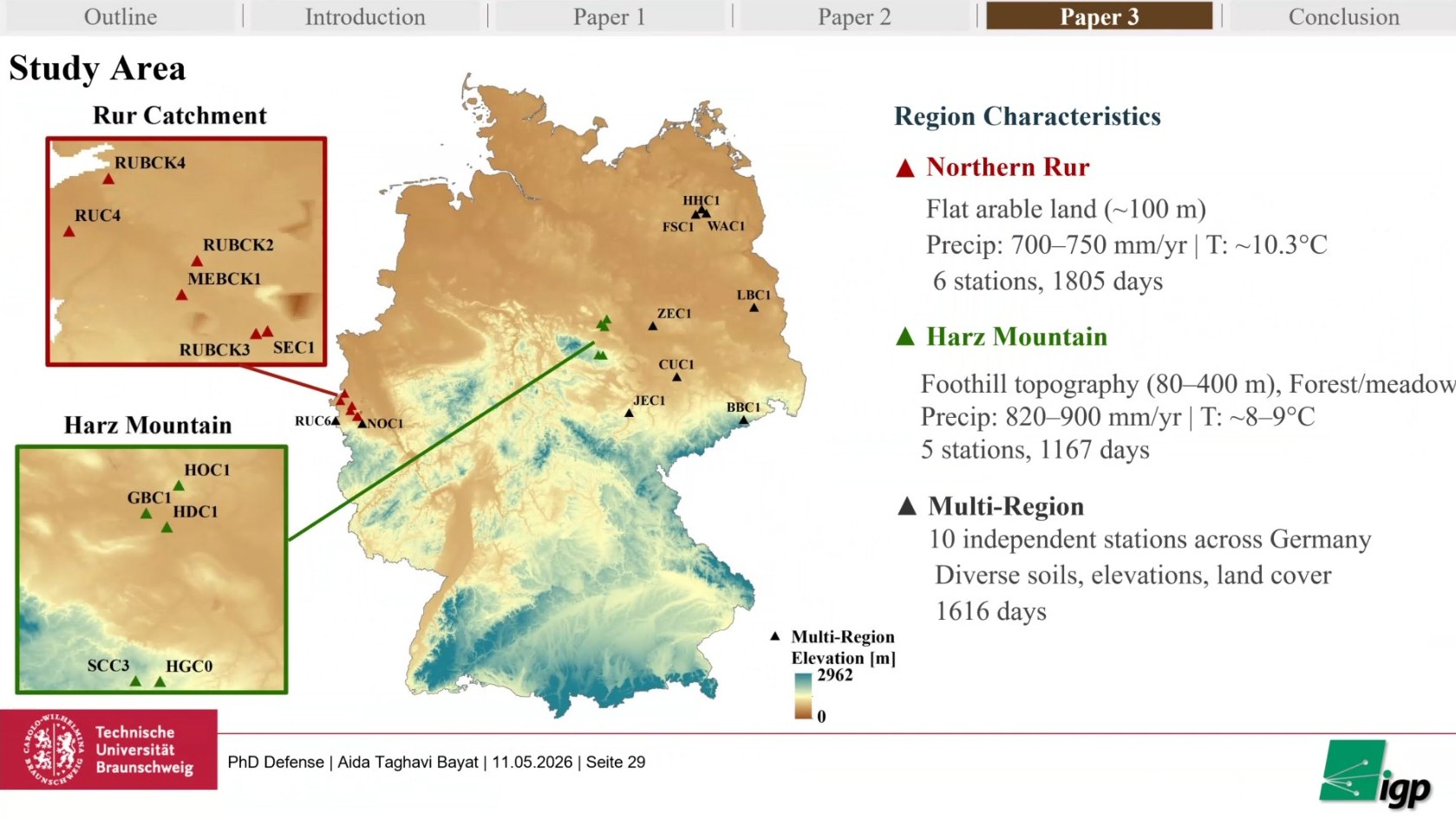
The framework was trained and evaluated using sparse in-situ measurements from TERENO stations in the Harz region and northern Rur catchment between 2017 and 2023.
The results demonstrated that:
- The TabTransformer framework outperformed tuned random forest and XGBoost baselines
- Model performance remained robust even during drought years
- Pre-training with geographically diverse unlabelled data substantially improved transferability to independent stations
- Spatial transfer experiments showed clear reductions in RMSE and MAE alongside improved R² values
The study demonstrates how self-supervised learning can help overcome domain shift and training data scarcity in environmental remote sensing applications.
A Strong Contribution to Earth Observation Science
Together, the three studies establish a comprehensive methodological framework linking:
- Semi-empirical scattering models
- Percentile-based freeze–thaw detection
- Self-supervised machine learning
The thesis demonstrates how Sentinel-1 SAR data, combined with optical, topographic, and meteorological information, can provide accurate and transferable estimates of soil hydro-thermal states across highly contrasting hydro-climatic regions.
Beyond the methodological innovations, the research also contributes directly to improving operational environmental monitoring in data-sparse cold and temperate environments under ongoing climate change.
Congratulations, Dr. Taghavi!
We warmly congratulate Dr. Aida Taghavi on this outstanding achievement and are proud to see another EAGLE graduate successfully completing a PhD!
Her work represents an impressive contribution to Earth observation research and highlights the importance of interdisciplinary approaches combining remote sensing, environmental science, and machine learning.
We also extend our congratulations to everyone involved in supporting this successful research journey, including Tobias Ullmann as second supervisor.
We wish Aida continued success in her future scientific and professional career and look forward to following her future contributions to the remote sensing and Earth system science communities.
Congratulations, Dr. Taghavi!