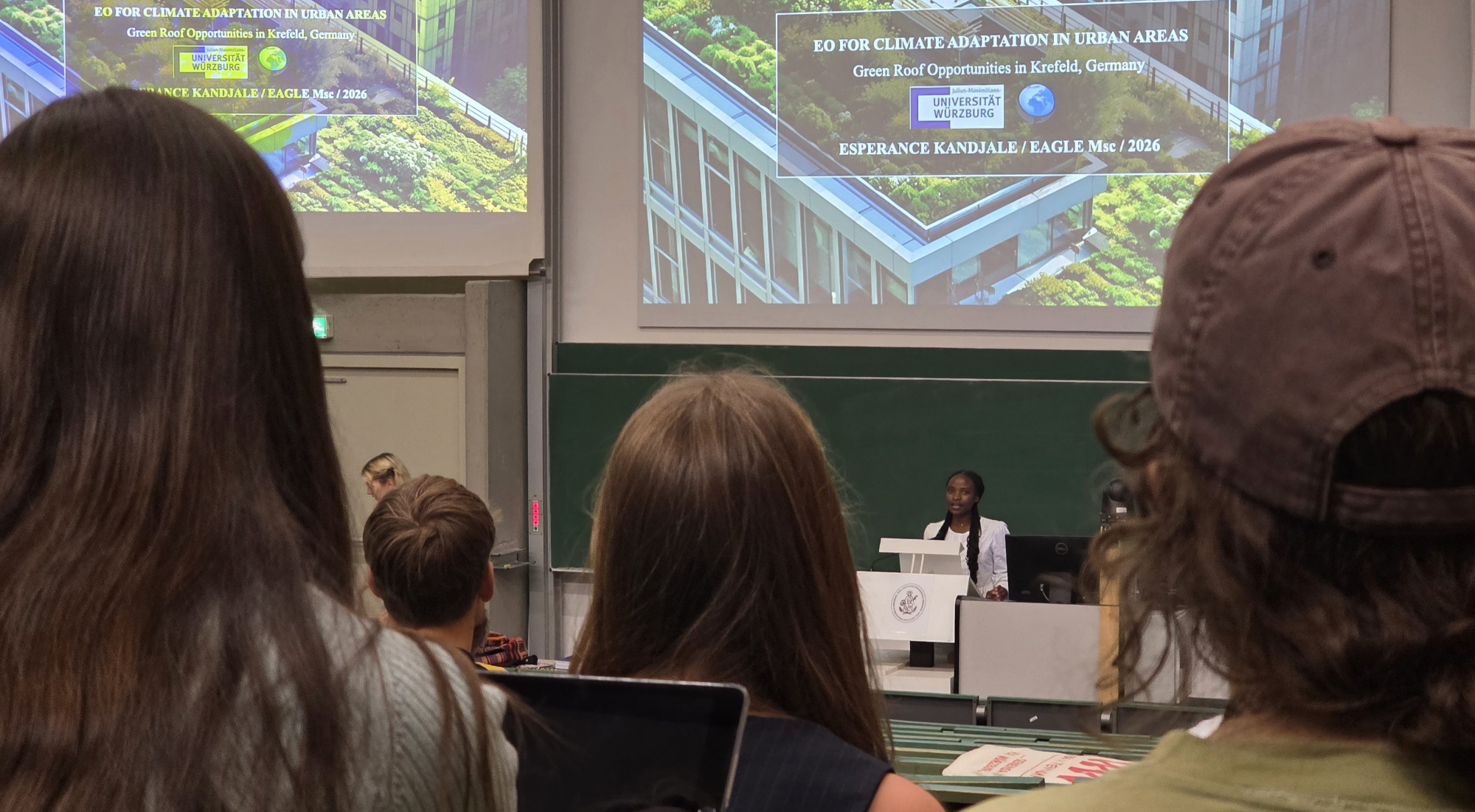

At the EAGLE MSc program, we believe that the exchange of knowledge is just as important as the research itself. Recently, three of our students, Esperance, Patience, and Rosemary, had the opportunity to contribute to the Remote Sensing BSc lecture. As part of their Scientific Presentation course, they shared insights from their own ongoing research, providing an accessible look at how Earth Observation (EO) tools are being used to address current environmental and social challenges.
The session allowed for a practical discussion on how data from various sensors can be combined to solve real-world problems. By integrating both active and passive remote sensing data through data fusion approaches, our students demonstrated how they are tackling some of the most pressing questions in the field.
Key Research Themes
The presentations covered a diverse range of applications, each highlighting the versatility of modern remote sensing techniques:
Urban Greening and Heat Management:
The students discussed how EO data can assist in mapping urban heat islands. By analyzing surface temperatures and vegetation dynamics, they explored how informed urban planning specifically through green infrastructure can help mitigate the effects of rising temperatures in cities.
Rapid Flood Mapping:
In the context of disaster management, they presented on the utility of rapid flood mapping for emergency response. The focus was on the effective use of data fusion, combining the all-weather capabilities of active SAR (Synthetic Aperture Radar) with passive optical data to provide timely information for decision-makers.
Monitoring Coral Reef Health:
The session also touched upon environmental monitoring, specifically the use of remote sensing to track coral bleaching. By observing changes in ocean surface conditions over time, the research aims to provide better data to support the conservation of these vital ecosystems.
The Value of Student-Led Exchange
Integrating research into the classroom is a key component of the EAGLE program. For the MSc students, preparing these presentations provided a valuable opportunity to refine their communication skills and explain complex methodological workflows to their peers in the BSc program. For the undergraduates, it offered a chance to see how the foundational principles they are currently studying can be applied to advanced, specialized research.
We appreciate Esperance, Patience, and Rosemary for taking the time to present their work. It was a productive session that highlighted the importance of clear scientific communication and the collaborative spirit of the EAGLE community.
We look forward to seeing how these research projects progress and hope that these presentations provided useful context for the BSc students as they continue their studies in remote sensing.