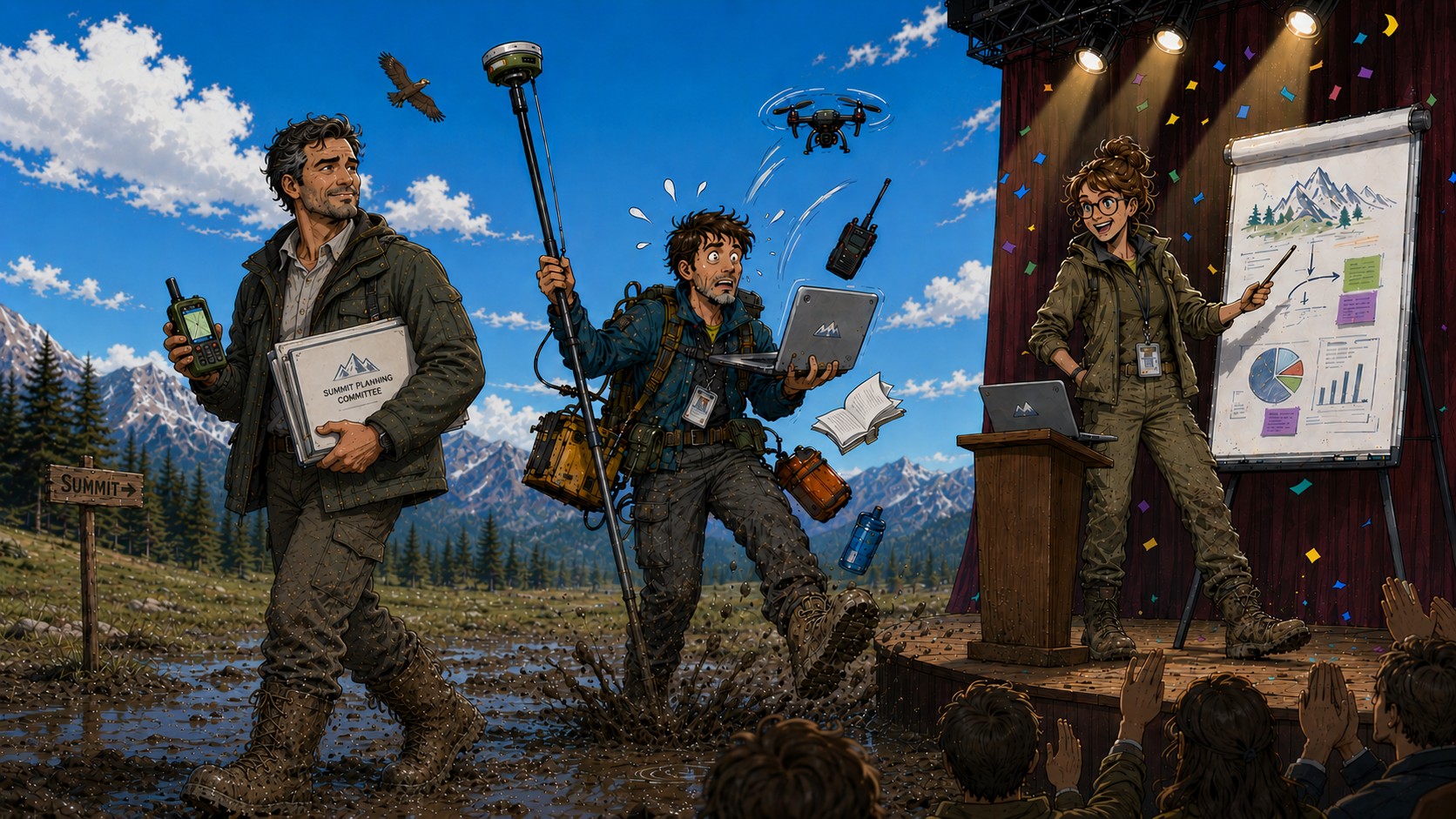

A while ago, we shared a lighthearted post about our EORC Earth observation characters. What stayed with us afterward were the reactions from colleagues around the world. Quite a few professors commented, half joking and half serious, that sometimes they wish they could still spend more time being the “field scientist” rather than the “committee and grant-writing scientist.”
First of all, we were pleased to see that our news blog is being read by colleagues across the globe. But the comments also got us thinking. Is this transition in academia really inevitable, or can we organize things differently?
The traditional academic storyline often seems to be like the MSc student spends months collecting data in the field, the PhD student analyzes it, the postdoc keeps projects running and deliverables on track, and the professor spends much of the day in meetings. It seems to a certain degree that the “fun part” is steadily decreasing. In reality, at least at EORC, that is often true but these roles are also often much more flexible than we tend to assume.
Over the past years, we at EORC have deliberately tried to blur some of these boundaries. Students in our EAGLE M.Sc. program are introduced early to project management, proposal writing, scientific publishing, and presentation skills. Many of them quickly become comfortable with tasks that were once considered the domain of postdocs, from preparing Gantt charts to calculating personnel costs and helping organize larger projects. Surprisingly, many even welcome it.
At the same time, the reverse is often more challenging. Senior scientists can find it difficult to step away from project deliverables, committees, administrative duties, and proposal writing – and frankly speaking many of our postdocs are the backbone of our research projects, they keep the collaboration working, have the deliverables in mind and just feel deeply responsible for the projects and our EORC, if they step away a lot of things would collapse. Once those responsibilities become part of the daily routine, they tend to stay there. But that does not mean the situation is fixed forever.
Of course we have to accept that reality remains reality. Nobody completely escapes meetings, reporting obligations, or administrative work. Still, research groups have choices in how they organize themselves.
We think that the most successful groups today often feel less like the structure outlined above and more like expedition teams. One person may be the expert on the latest drone workflows, another may be deeply immersed in deep learning methods, someone else may excel at building collaborations, while another colleague has a remarkable talent for writing proposals or navigating complex funding regulations. And the strength comes from working together, everybody contributing their specific skill.
Over the past decade, we have often tried to build exactly this kind of team spirit within EORC. Rather than defining people primarily by their position or project, we increasingly work around skills, interests, and strengths. So far, that approach has served us well in many cases. And importantly, research ideas no longer move only from the top down. Questions, hypotheses, and new approaches can come from anyone in the group which increases the novelty of research approaches.
Of course, senior researchers still contribute things that only experience can provide. They often bring a broader view of scientific developments, long-term collaborations, publication strategies, field campaigns, and funding opportunities. At the same time, younger researchers arrive with skills that are often right at the cutting edge. They may spend countless hours refining their coding, automation, AI, visualization, and data processing workflows. They are usually more willing to experiment with tools and methods that others have not yet adopted. And, admittedly, they often have more energy for carrying equipment up a mountain or spending weeks in the field.
Perhaps the healthiest transition in academia is not from field scientist to office scientist, but from scientist to mentor, without ever really stopping being a field scientist. The ideal senior researcher still remains involved in many aspects of the job: fieldwork, science, mentoring, presenting, and strategic planning. Perhaps not always with the same intensity as earlier in their career, largely because responsibilities at the university and often in private life continue to grow. But they retain the overview and help guide where the research is heading.
Maybe that is the balance worth aiming for. A few fewer meetings, a little more time outdoors, and occasionally a pair of muddy boots standing next to the office door. And perhaps some of the colleagues who inspired this reflection will find their way back into the field a bit more often as well.
(of course we ignored all the challenges of funding limits, project deadlines, ending contracts and so so – many aspects are only an option for the ones with permanent positions, so … it is a post for the professors mentioned above who have more freedom and flexibility than others – but also of course more responsibility that they do not loose their researchers … )
(and thanks to AI for helping us with the post, creating a matching image, after very-long prompts – another skill necessity that evolved in the past years …)