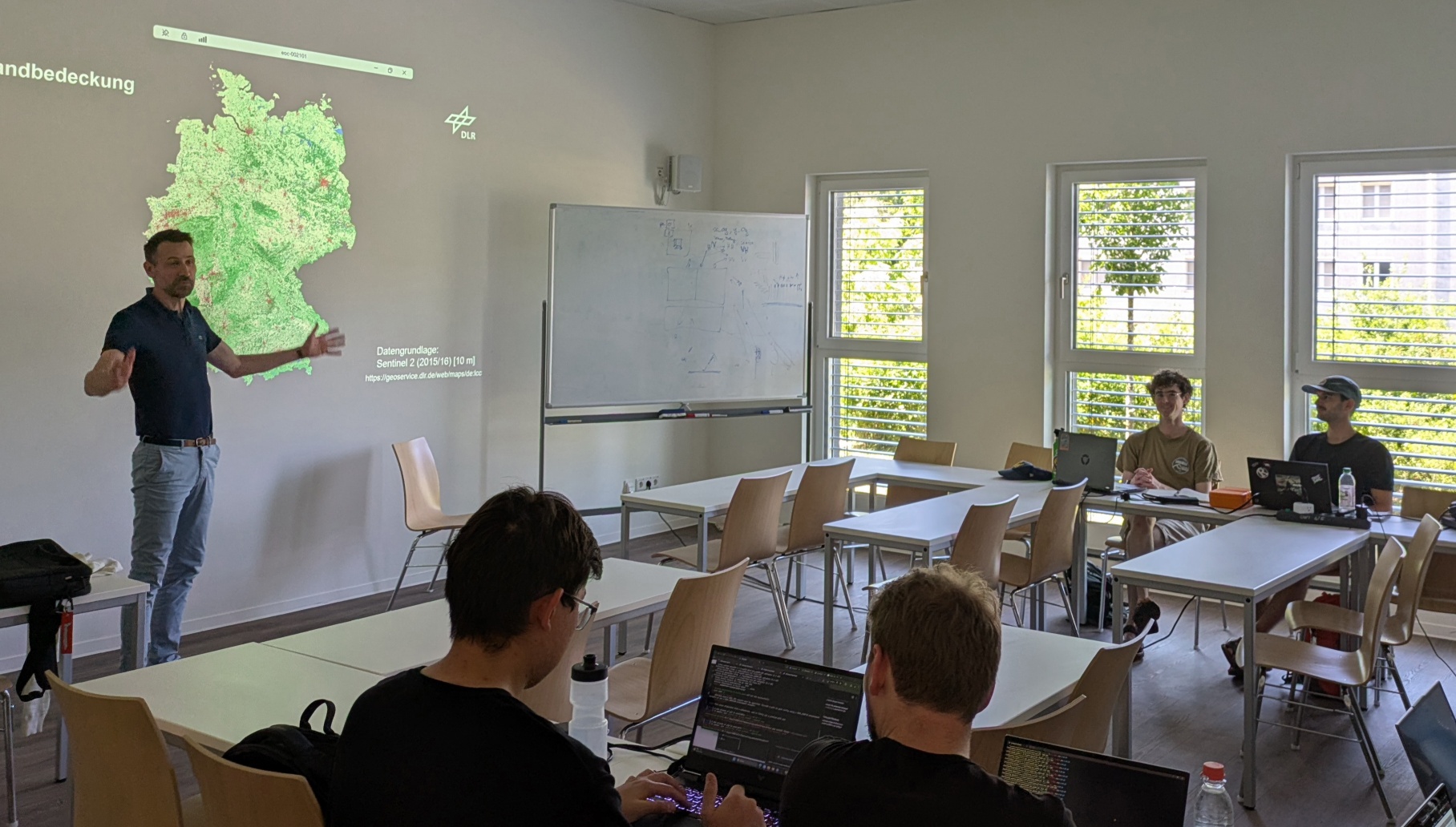

Course on urban EO by Michael Wurm

Course on urban EO by Michael Wurm

m

June 22, 2026

Walk through any city and you pick up on things that are hard to put a number on. The noise of a main road, the heat that sits between buildings in summer, the question of whether that little park around the corner is really enough green space for the whole neighborhood. These are exactly the kinds of questions Michael Wurm’s course in the EAGLE Master’s program digs into, and it does it in a way that changes how you see a city afterward.
At its core, the course is about environmental exposure in urban areas, basically how people in cities end up exposed to environmental burdens and how you actually measure that using earth observation data. Air pollution is just one piece of it. Noise exposure matters just as much, along with urban heat islands, access to green space, and traffic, which runs through all of it and shapes it at the same time. Wurm teaches students not to look at these things in isolation but as a web of factors that feed into each other and end up defining what it actually feels like to live in a given neighborhood.
In practice that means working with satellite data, sensor networks, modeling approaches, and always asking what it all means for real people on real streets. Anyone who’s ever laid a noise map or a surface temperature map over a city knows how fast abstract pixel values turn into social questions. Who lives next to the loud street. Who doesn’t have a park within walking distance. That’s exactly where the course picks up, and it’s exactly why it tends to stick with EAGLE students long after the semester ends.

follow us and share it on:

you may also like:

EireR R package: unified gateway to Irish geospatial data

EireR R package: unified gateway to Irish geospatial data

Anyone who's tried to do geospatial work across the whole island of Ireland knows the headache. Ireland is one island geographically, but it's split across two jurisdictions, the Republic and Northern Ireland, and each one runs its own data infrastructure. Different...

Impact of agrophotovoltaic facilities – an R package

Impact of agrophotovoltaic facilities – an R package

There's a new R package on the block, and it's solving a problem that sounds simple until you actually try to do it: how do you tell whether putting solar panels over a farm field is good or bad for the soil and the crops around them? Marlene, one of our EAGLE...

Presentation at the Kolloquium of the Technical University of Graz

Presentation at the Kolloquium of the Technical University of Graz

Dr. Ariane Droin presented the works of her PhD-Thesis at the Geo-Kolloquium of the Technical University of Graz with the title "Hochauflösende, skalenübergreifende Modellierung von Nachbarschaftserreichbarkeiten im urbanen Raum" on the 17th of June 2026. She showed...

Academic Evolution in Earth Observation

Academic Evolution in Earth Observation

A while ago, we shared a lighthearted post about our EORC Earth observation characters. What stayed with us afterward were the reactions from colleagues around the world. Quite a few professors commented, half joking and half serious, that sometimes they wish they...

Visiting Scientists from CIGIDEN R+ (Chile) at DLR-EOC

Visiting Scientists from CIGIDEN R+ (Chile) at DLR-EOC

Our Department Head Prof. Hannes Taubenböck was honored to welcome Prof. Alejandra Stehr from the Universidad de Concepción and Prof. Rodrigo Cienfuegos from the Pontificia Universidad Católica de Chile at the Earth Observation Center (EOC) of the German Aerospace...

Privacy Policy

Lehrstuhl für Fernerkundung & Lehrstuhl für Urbane Fernerkundung

Erdbeobachtung an der Universität Würzburg