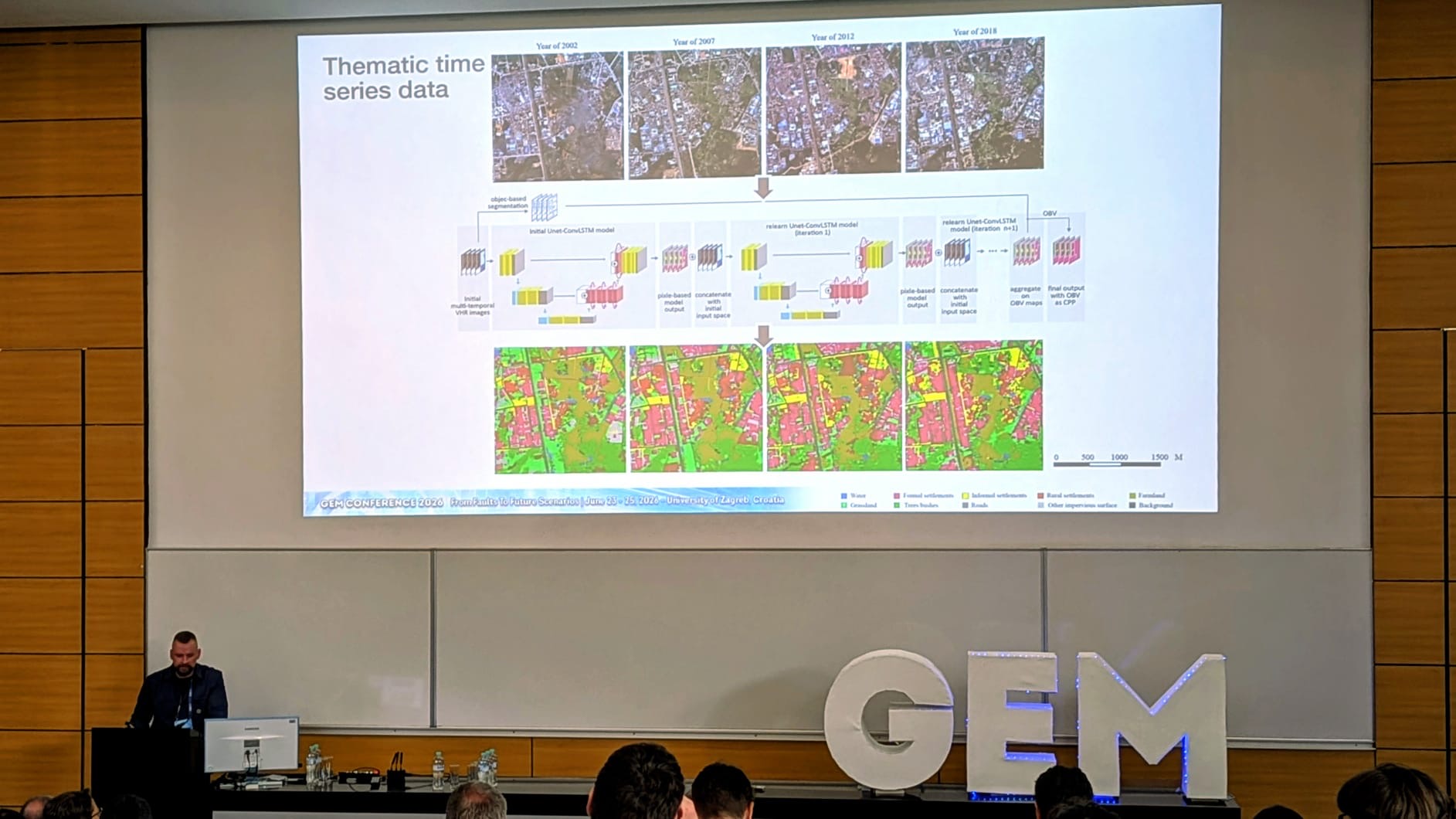

This week (23–25 June 2026), the GEM Conference 2026: From Faults to Future Scenarios brought together the global earthquake risk community in Zagreb, Croatia, marking the release of GEM’s 2026 global seismic hazard and risk models. Among the presenters were Prof. Dr. Christian Geiß (German Aerospace Center, DLR – https://remote-sensing.org/prof-dr-christian-geis-successfully-passed-his-habilitation-colloquium/ ) and Joshua Dimasaka (PhD student at the University of Cambridge and guest researcher at DLR), contributing two papers that apply artificial intelligence to some of the field’s exigent problems.
What They Presented
Geiß, C., Taubenböck, H., and Zhu, Y. — Machine Learning Forecasting Techniques for Earth Observation Data
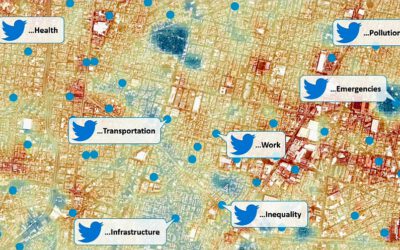
Cities change constantly, but risk models often don’t keep pace. This contribution addresses that gap: by applying machine learning to satellite-derived time series, the team demonstrated how earth observation data can be used not just to map the present, but to forecast how exposure and vulnerability will evolve. For seismic risk, where a static snapshot can quickly become outdated, forward-looking models like these are essential.
Dimasaka, J., Geiß, C., and So, E. — Spatial Disaggregation and Temporal Projection of Building Exposure and Physical Vulnerability using Deep Constrained Clustering and Probabilistic Graph Deep Learning
National census data tells you how many buildings exist — but not precisely where they are, or what condition they’ll be in next decade. This paper combines deep constrained clustering (which respects known physical and statistical constraints) with probabilistic graph deep learning (which captures spatial dependencies across urban structures) to disaggregate coarse exposure data to fine spatial scales and project it forward in time. The result is a more granular, uncertainty-aware picture of where seismic risk actually arises.
Related Work: A Growing Research Programme
These GEM 2026 contributions build on a track record of peer-reviewed research applying AI and remote sensing to EO-based and disaster risk forecasting.
Dimasaka, J., Geiß, C., Muir-Wood, R., and So, E. (2025): GRAPHCSVAE: Graph Categorical Structured Variational Autoencoder for Spatiotemporal Auditing of Physical Vulnerability Towards Sustainable Post-Disaster Risk Reduction. Progress in Disaster Science, 30, 100601. https://doi.org/10.1016/j.pdisas.2026.100601
Dimasaka, J., Geiß, C., and So, E. (in press): DeepC4: Deep Conditional Census-Constrained Clustering for Large-scale Multi-task Spatial Disaggregation of Urban Morphology. ISPRS Journal of Photogrammetry and Remote Sensing. https://doi.org/10.48550/arXiv.2507.22554
Zhu, Y., Burlando, P., Zhang, Y., Chi, D., Wang, J., Qiu, Y., Bonatesta, M., Zou, W., Geiß, C., Tan, P. Y., and Fatichi, S. (2025): The influence of urban landscape morphological changes on pluvial flooding during urban expansion. Sustainable Cities and Society, 135, 107018. https://doi.org/10.1016/j.scs.2025.107018
Zhu, Y., Geiß, C., and So., E. (2024): Simulating urban expansion with interpretable cycle recurrent neural networks. GIScience and Remote Sensing, 61, 1, 2363576. https://doi.org/10.1080/15481603.2024.2363576
Zhu, Y., Geiß, C., So. E., Bardhan, R., Taubenböck, H., and Jin, Y. (2024): Urban expansion simulation with an explainable ensemble deep learning framework. Heliyon, 10, 7, e28318. https://doi.org/10.1016/j.heliyon.2024.e28318
Geiß, C., Maier, J., So, E., Schoepfer, E., Harig, S., Gómez Zapata, J.C., and Zhu, Y. (2024): Anticipating a risky future: long short-term memory (LSTM) models for spatiotemporal extrapolation of population data in areas prone to earthquakes and tsunamis in Lima, Peru. Natural Hazards and Earth System Sciences, 24, 3, 1051–1064. https://doi.org/10.5194/nhess-24-1051-2024
Zhu, Y., Geiß, C., So. E., and Jin, Y. (2021): Multitemporal Relearning With Convolutional LSTM Models for Land Use Classification. IEEE Journal of Selected Topics in Applied Earth Observation and Remote Sensing, 14, 3251–3265. https://doi.org/10.1109/JSTARS.2021.3055784
The GEM 2026 global seismic hazard and risk products are available at globalquakemodel.org/products.