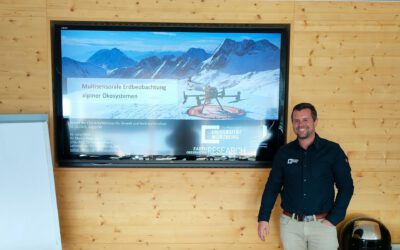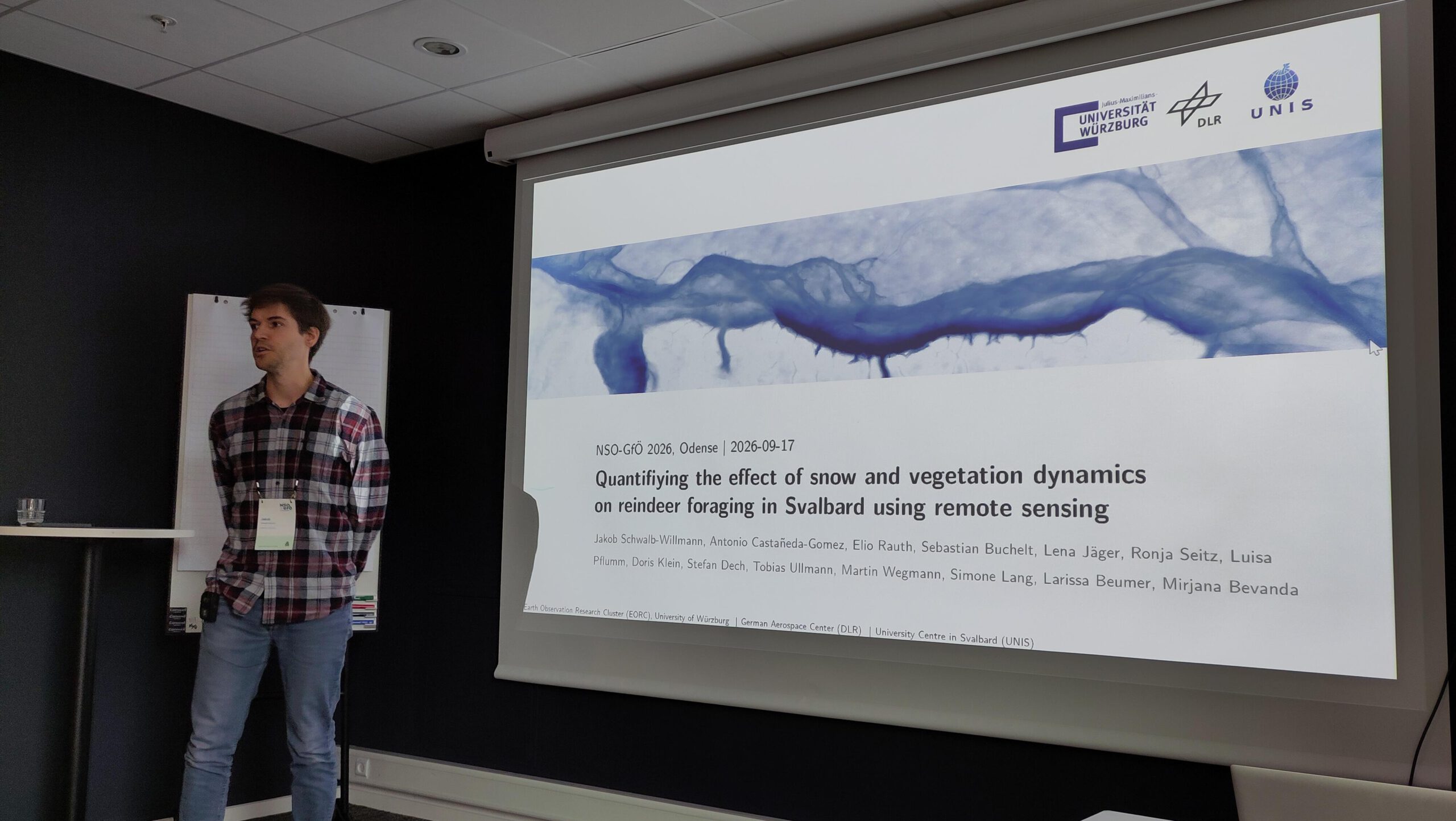

Yesterday, at the joint NSO-GfÖ 2026 conference in Odense, Denmark, EORC postdoc Dr. Jakob Schwalb-Willmann presented research on the use of UAV and satellite remote sensing data of winter and summer surface conditions to model winter foraging selection of Svalbard reindeer on fine spatial scales. This research is part of an ongoing collaboration between University of Würzburg’s EORC and the Arctic Biology department at the University Centre in Svalbard (UNIS).
In his talk, Jakob showed that cm-resolution, LiDAR-derived snow depth data and multi-spectral vegetation indices from UAV (drone) remote sensing are significant predictors for reindeer foraging selection. UAV remote sensing at cm-resolution is of tremendous value for modelling foraging selection of Svalbard reeinder, as only such high resolutions match the small scales at which these animals negotiate their paths through the landscape. With his talk titled “Quantifiying the effect of snow and vegetation dynamics on reindeer foraging in Svalbard using remote sensing”, Jakob gave an example on how UAV and satellite remote sensing data combined could contribute to improve the understanding of animal behavior. Besides his talk, Jakob had the honor to co-chair the session “Arctic ecology” earlier in the week.
The NSO-GfÖ 2026 ecology conference has been attended by nearly 1000 researchers. Jointly organised by the Nordic Society Oikos (NSO), representing the ecological societies of Denmark, Sweden, Norway, Finland, and Iceland, and the Gesellschaft für Ökologie (GfÖ), representing Austria, Switzerland, and Germany, it offered a special opportunity to bring together researchers from various ecological research fields and research regions – including High Arctic ecosystems, herbivore animal ecology, and remote sensing for ecology. The University of Würzburg was represented both through the contributions of the EORC as well as members of the Unviersity’s bio centre.