
TV Crew Films EORC at MONID Habitrack Fieldwork

TV Crew Films EORC at MONID Habitrack Fieldwork

m

June 26, 2026

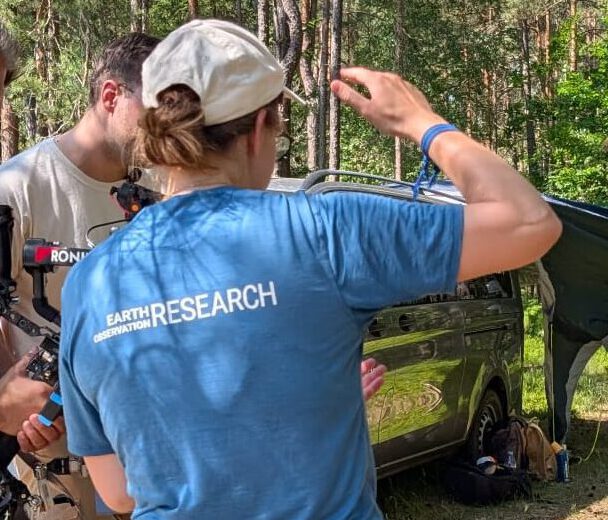
A bit of extra excitement at EORC recently: A television crew showed up to film a segment on the MONID Habitrack project financed by the BMFTR, and Dr. Ariane Droin was right in the middle of it, walking them through what Earth Observation actually brings to the table for a project like this.

The crew talked with Ariane about why Earth Observation matters here at all. It’s not always obvious from the outside why you’d need drones and satellites to study ticks, so Ariane took the time to explain how Earth Observation data helps characterize forest structure and link it to where infected ticks tend to show up. She didn’t just talk through it either, she pulled up actual UAS based EO data collected for the project and showed the crew what it really looks like once it’s been gathered and processed.

What really caught the TV team’s attention, though, was watching the data collection itself. They were especially keen to see a UAS in action, and got to watch a VTOL system go through its paces, taking off vertically before transitioning into fixed-wing flight to cover the study area. It’s one thing to describe how these systems work, it’s another to actually watch one take off, fly a survey pattern, and come back down. The crew seemed genuinely interested in the mechanics of it, which made for a pretty good afternoon out in the field.

It’s always a nice moment when a project that started out as a fairly technical question about forest structure and tick ecology ends up being interesting enough to bring a TV crew out to EORC. Once the segment airs in a few weeks, we’ll share the link here so everyone can see how it turned out.



follow us and share it on:

you may also like:

DBU scholar Josipa Subotic

DBU scholar Josipa Subotic

Almost a year ago, Josipa Subotic showed up at EORC as a DBU scholar, and now her stay with us is coming to an end. Josipa spent her time digging into snow cover properties around the Zugspitze, working with Sentinel-2 time series data. Multispectral imagery, lots of...

GLS-team visits Planetary Health exhibition

GLS-team visits Planetary Health exhibition

One of the aims of Geolingual Studies Geolingual Studies - Geolingual Studies is to ensure effective science communication beyond the scientific community and into the wider society. The Geolingual Studies team was given the opportunity to look at concepts and methods...

University press covered our anniversaries

University press covered our anniversaries

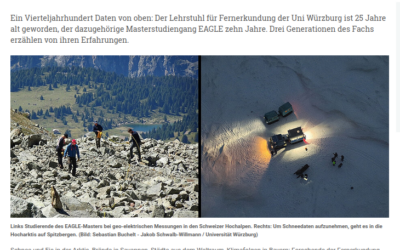
Einblick, the University of Würzburg's press medium, published an article on our double anniversary, 25 years of Earth observation research and 10 years of EAGLE M.Sc. program, today. Recently, they has visited us at our EORC to hear about our research and teaching...

Mapping Lava Tubes on Mauritius with iPhone Pro LiDAR

Mapping Lava Tubes on Mauritius with iPhone Pro LiDAR

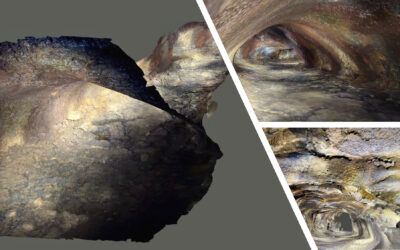
Lava tube structures on Mauritius are quite hard to survey - tight, dark, and largely inaccessible to classical scanning equipment. As part of ongoing research by Dr. Kim Lea Holzmann (Chair of Animal Ecology and Tropical Biology, University of Würzburg), we're...

Johannes Mast wins Bernd Rendel Prize

Johannes Mast wins Bernd Rendel Prize

Johannes Mast is awarded the 2026 Bernd Rendel Prize for Geosciences by the Deutsche Forschungsgemeinschaft (DFG) for outstanding research as part of his dissertation. Johannes’s highly interdisciplinary work bridges the Geosciences, Linguistics, Data Science, and...

Share This