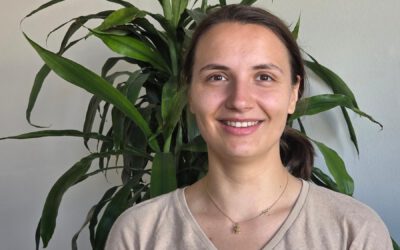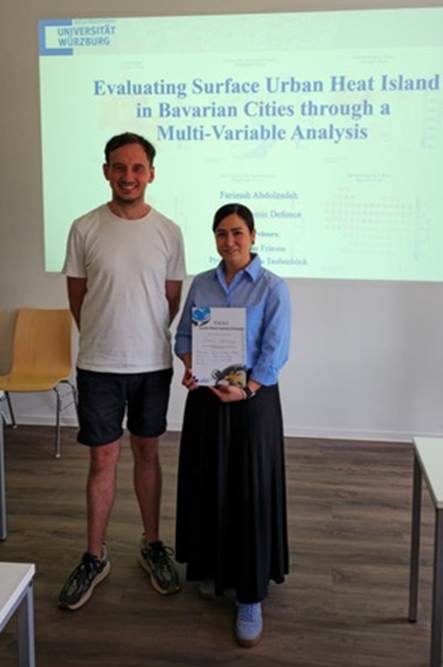

On July 7, 2026, Farimah Abdolzadeh successfully defended her Master’s thesis at the Earth Observation Research Cluster (EORC), University of Würzburg. Her research explored one of the central questions in urban climate science: which factors shape land surface temperatures across cities, and how can spatial statistical methods improve their analysis?
In her thesis, “Evaluating Surface Urban Heat Islands in Bavarian Cities through a Multi-Variable Analysis“, she analysed land surface temperatures in 100 Bavarian cities using Earth observation data from the MODIS and Landsat satellite missions. The study examined how vegetation, albedo, building density and the distance to water bodies influence urban thermal environments while explicitly comparing cities of different sizes. By extending the analysis beyond large metropolitan areas, the work addresses a notable gap in current urban heat island research.
A particular focus of the thesis was the comparison between conventional ordinary least squares (OLS) regression and spatial regression models. The findings clearly demonstrate that accounting for spatial autocorrelation leads to more reliable models of land surface temperature. Spatial Lag Models consistently outperformed OLS and were particularly effective in representing complex temperature patterns in alpine regions, where neighbouring cities exert a stronger spatial influence.
The study also provides valuable insights into the strengths and limitations of different satellite sensors for urban climate applications. The thesis investigated vegetation cooling thresholds, illustrating how increases in urban greenness relate to reductions in land surface temperature and highlighting the practical relevance of satellite-based analyses for climate adaptation planning.
The thesis was supervised by Dr. John Friesen (EORC) and Prof. Dr. Hannes Taubenböck (EORC, DLR). The work contributes to ongoing research on urban climate, Earth observation and spatial modelling, demonstrating how satellite data can support evidence-based strategies for creating more climate-resilient cities. Her work also supports our EO4Cam project.
We congratulate Farimah Abdolzadeh on this achievement and wish her every success in her future academic and professional career.