
Our EORC staff member Dr. Julia Rieder has published a new study in Forestry: An International Journal of Forest Research, together with colleagues from TU Dresden, the University of Göttingen, HSWT Weihenstephan, and the University of Würzburg.
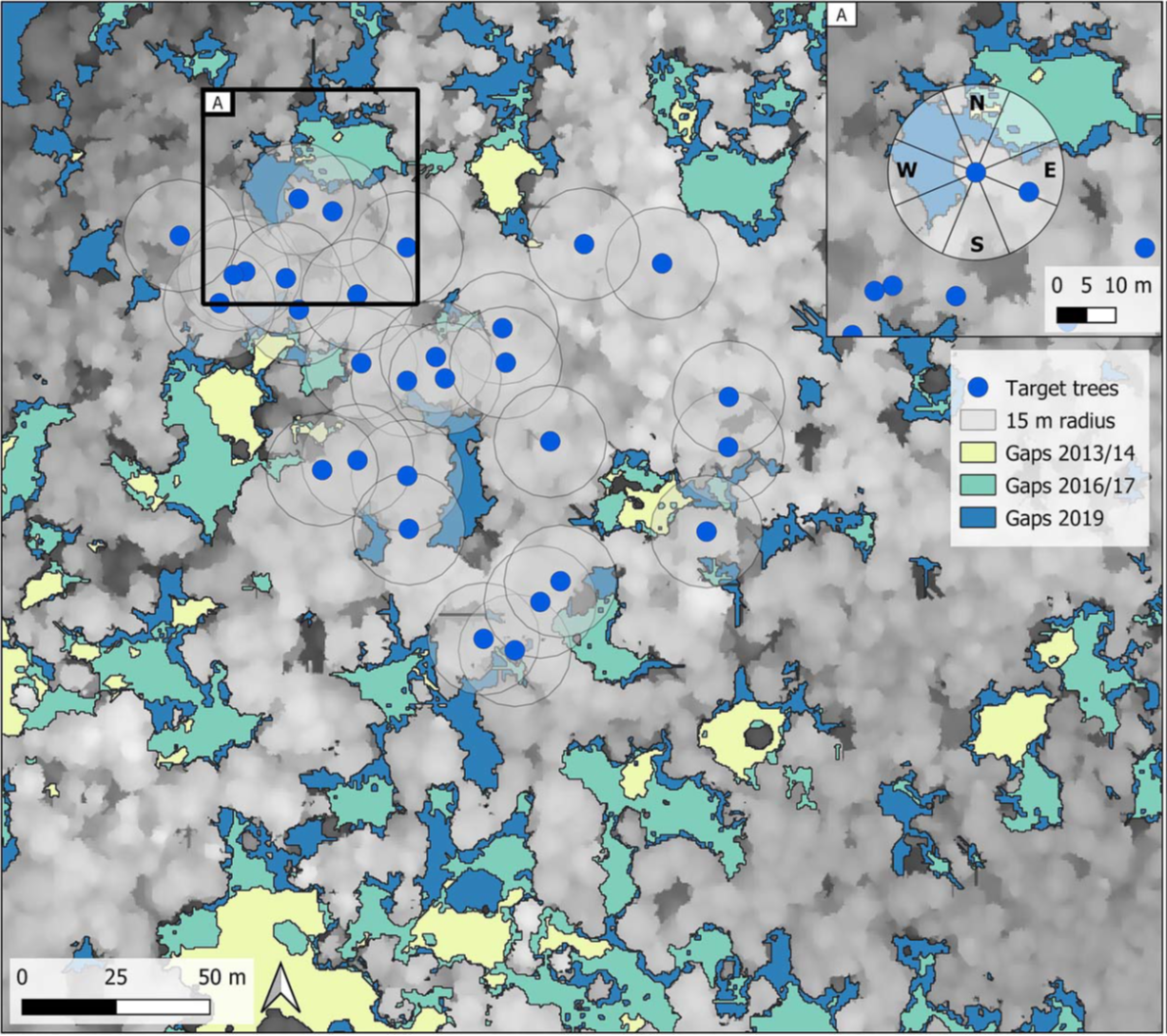
This study, based on data collected within the BeechDecline project, investigates how the size, orientation, and temporal dynamics of canopy gaps influence drought-induced crown defoliation of European beech. Using multitemporal digital surface models derived from aerial orthophotos, canopy gap dynamics around individual trees were analysed across 19 beech-dominated forest sites in Bavaria. The results showed that canopy gap configuration contributed to variation in drought-related crown defoliation, particularly for western and southwestern gap exposure, although site-level conditions accounted for substantially more of the observed variability. The findings provide a scientific basis for the development of operational remote sensing products within EO4CAM‘s “Forestry” work package, supporting future assessments of beech stability in Bavaria and beyond.
Abstract
European beech (Fagus sylvatica L.), one of the most important deciduous timber species in Central Europe, experienced widespread crown defoliation and tree mortality during the severe drought in 2018/19,but responses varied strongly among individuals. Canopy gaps were found to be one driver of this variability. In this study, we investigated how the size, orientation, and the temporal dynamics of canopy gaps and open areas affect crown defoliation in European beech during the 2018/19 drought across 19 beech-dominated sites in Bavaria, Germany. To quantify canopy gap dynamics around individual beechtarget trees, we derived gap area metrics from multitemporal digital surface models derived from orthophotosacross three timesteps. For each target tree, total canopy gap area was calculated within a 15 m buffer. To capture directional effects, the gap area was additionally partitioned into eight cardinal and intercardinal directions, allowing us to characterize the spatial configuration of gaps relative to each tree. Our results indicate that trees exposed to gaps on their western side (meaning the tree was located at the eastern edge of the gap) exhibited significantly higher defoliation, highlighting possible combined influences of higher exposure to wind and solar radiation. In contrast, gaps towards the north of the trees were associated with lower defoliation. Increases in gap area between2013/14 and 2019 towards the southwest were linked to higher drought stress. While the gap-related predictors explained only a modest proportion of the total variability, site-level differences in general conditions accounted for a substantially larger portion. Our findings demonstrate the potential of digital surface models from orthophotos as a reproducible, remote sensing-based workflow for capturing detailed spatial and temporal canopy gap dynamics across forest sites. For practical management, the directional orientation of canopy openings should be considered when planning silvicultural interventions, as western and southwesternexposures may increase drought vulnerability of valuable target trees.
Read the full publication: https://doi.org/10.1093/forestry/cpag060