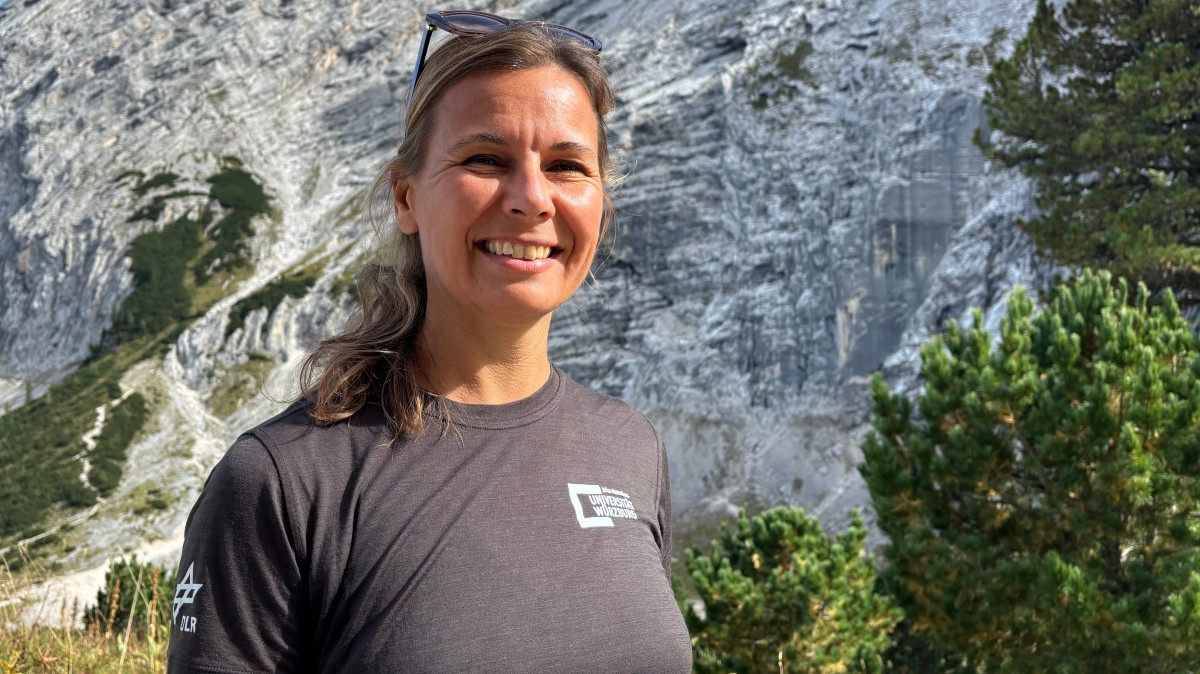

Tanja is the lecturer whose work keeps landing directly on the desks of the people who actually have to act on it: Bavarian ministries, municipalities, foresters, farmers and planners. She joined DLR’s German Remote Sensing Data Center (DFD) in 2002 and has been scientific advisor to the institute’s director since 2008, a role that is essentially about connecting people, linking the institute’s leadership, its departments and its external partners. Her own expertise sits in remote sensing of forests and vegetation: forest ecosystems, vegetation parameters and vegetation dynamics.She earned her doctorate at the University of Erlangen-Nürnberg in 2008, validating the MODIS leaf-area-index data for East African rainforest ecosystems and since then her work has stayed close to one consistent question: how do you turn vegetation and forest data into something a forest manager or a farmer can actually use? That question reached a milestone with EO4CAM. Since January 2024 she has been leading and coordinating the initiative, funded by the Bavarian Ministry of Economic Affairs. EO4CAM provides Bavarian authorities with earth-observation-based information, models and scenarios to support adaptation to climate change. Together with co-lead Prof. Tobias Ullmann and a joint expert group that brings together colleagues from DFD and the University of Würzburg’s Earth Observation Research Cluster, she guided the project to a major milestone in March 2026, the public launch of its public data portal, which has involved city administrations, federal state authorities and ministries involved from the start. The portal delivers data for urban development, agriculture, and forestry, alongside cross-cutting datasets on geohazards, biodiversity, and health.
Within the EAGLE programme, Tanja co-runs the “Advanced Skills on the Master’s Level” seminar at the University of Würzburg together with her DLR colleague Doris Klein. The course focuses on practical competencies such as scientific presentation, session moderation, the preparation and moderation of panel discussions, and scientific outreach. Their teaching builds on the expertise they acquired through joint activities, notably the delivery of the “Earth Observation” module for ESA’s 2022 astronaut class (taught in 2023) and for ESA’s reserve astronaut cohort (taught in 2026).