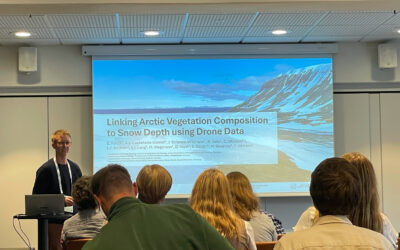
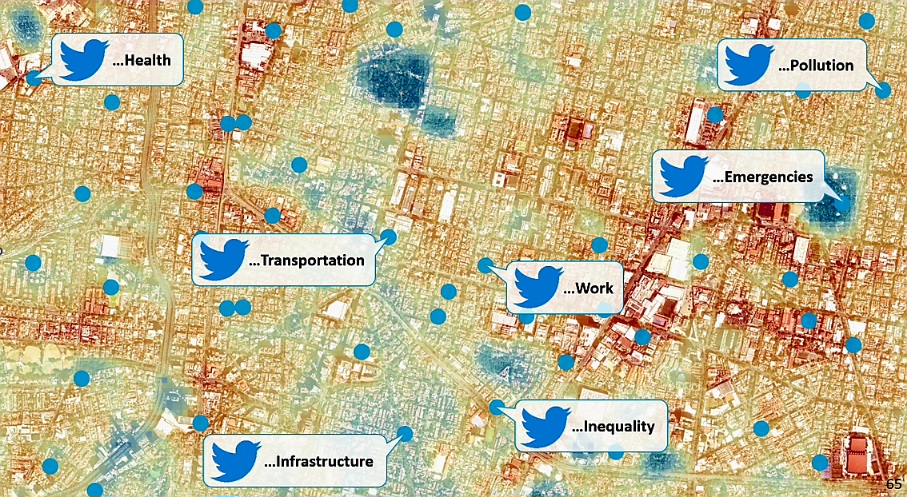

Today, Dr. Richard LEMOINE-RODRÍGUEZ gave a talk at the DLR Open Search Colloquium. The title of his talk was ‘Multimodal urban sensing: Integrating social media and remote sensing data for urban research’.
Here is the Abstract of his talk: Remote sensing has advanced our understanding of cities’ physical structure through detailed multitemporal spatial analyses. Yet it rarely captures the people who shape and experience urban spaces. Geolocated text data offers a way to bridge this gap by linking user-produced content to urban dynamics and revealing how citizens experience the urban environment. Multimodal urban sensing approaches can integrate remote sensing and text data using AI and NLP to explore how the physical space and urban citizens interact, enhancing our understanding of the city as both a material and social construct. This talk will illustrate, through diverse examples, how integrating the spatial and social dimensions of cities through a multimodal approach can provide a more holistic understanding of urban life.
In the talk, Richard introduced concepts, methods and results from the Geolingual Studies team (https://www.phil.uni-wuerzburg.de/gls). In particular, he introduced the following studies:
- “From Measured to Experienced Heat: A Multimodal Analysis of Temperature, Urban Form, and Social Media in Mexico City“, corresponding to an assessment of the relationship between the built environment, urban temperatures, and the digital discourses related to heat that emerge among urban residents on social media during periods of extreme heat. See the full paper here: https://ieeexplore.ieee.org/document/11668678.
- “Global regularities and regional patterns in social media discourse: Topic variety, language diversity, and user behavior across 29 cities“, were online discourses and their geographic diffusion was analyzed based on social media data. The related paper is expected to be published soon.
- “Disparities in social media discourses between morphological slums and formal areas around the world“, showing how topics discussed and the polarity of social media content is contrasting between intraubran areas where urban structure reflects different life situations. The related paper is currently in preparation and will be a follow-up to the published paper “Are the poor digitally left behind? Analyzing urban divides using remote sensing and twitter data” https://www.mdpi.com/2220-9964/7/8/304
Please find here a selection of other research works from Geolingual Studies:
- “Are urban form and function related to urban discourse? Insights from remote sensing and social media data for 15 major cities across the globe”: https://doi.org/10.1016/j.habitatint.2026.103907
- “The digital urban frontier: Disparities in social media activity between consolidated and newly urbanized areas in Africa”: https://doi.org/10.1016/j.apgeog.2025.103687
- “Geospatiality: the effect of topics on the presence of geolocation in English text data”: https://doi.org/10.1080/13658816.2025.2460051
- “Integrating corpus linguistics and NLP methods to explore social media discourse from Edinburgh and London”: https://www.degruyterbrill.com/de/document/doi/10.1515/csh-2025-0026/html
- “The voices of the displaced: Mobility and Twitter conversations of migrants of Ukraine in 2022”: https://doi.org/10.1016/j.ipm..2024.103670
And, please see a compilation of studies on urban spaces based on Geolingual Studies here in the very recently published book: https://edinburghuniversitypress.com/book-geolingual-studies-on-urban-space.html