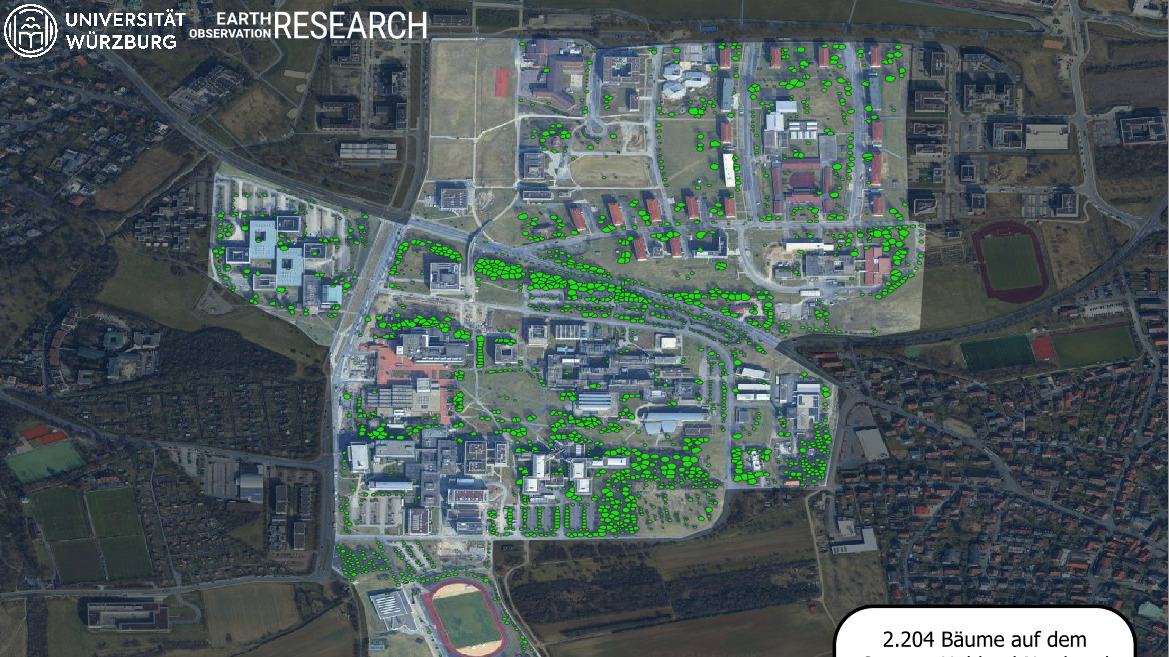

Have you ever wondered how many trees there are on our campus?

Have you ever wondered how many trees there are on our campus?

m

November 10, 2026

Sometimes a chat during a formal event like the one for the Urban:Pulse funding celebration, results in something totally different. Following a discussion with the vice-president of our University, we promised to look into the research by one of our PhD students concerning a tree count within our campus using remote sensing. And of course we did it right the day after.

Andrea Sofía García de León, who is currently doing her PhD at the EORC with Hannes Taubenböck, has tested a tree detection and segmentation algorithm based on Leichtle et al. (2021). Individual trees were detected using local maximum filtering, and their crowns were delineated using marker-controlled watershed segmentation. The analysis was based on aerial imagery and the digital surface model available through the Open Data Portal of the Bavarian Surveying Authority.

On a first test, we found more than 2000 trees. We look forward to validating the results to see how well our algorithm performed. And of course we are happy to help the sustainable campus initiative by our vice president with the number of trees. 


Leichtle, T., Zehner, M., Kühnl, M., Martin, K., Taubenböck, H., 2021. Urban Trees – Detection, Delineation, Quantification, and Characterisation based on VHR Remote Sensing, in: REAL CORP 2021: CITIES 20.50. Creating Habitats for the 3rd Millennium: Smart – Sustainable – Climate Neutral. Presented at the 26th International Conference on Urban Planning, Regional Development and Information Society, Vienna, Austria.

follow us and share it on:

you may also like:

A dashboard for multi-UAS thermal data

A dashboard for multi-UAS thermal data

Mapping an active fire with various drones flying in parallel is hard enough. But getting the data processed, evaluated and turned into research datasets is a different story. The publication is on its way, and for now we’d like to share a dashboard by Antonio José...

Earth Observation at the DFG BETAFOR workshop

Earth Observation at the DFG BETAFOR workshop

Jakob Schwalb-Willmann represented our team at the DFG BETAFOR workshop in the Bavarian Forest National Park. The room was full of biologists, which is the whole point of an interdisciplinary project, and our UAS multisensor time series drew a lot of interest from the...

Thermal Drone Data Acquisitions: CalVal project with Informatics

Thermal Drone Data Acquisitions: CalVal project with Informatics

Thermal cameras on drones look very good - visually. They show us temperature of our study objects be it stressed trees, warm patches in a city or active fires. But we do not yet know for sure how far we can trust the temperature values they deliver especially when...

Würzburger Förderpreis awarded to our URBAN:Pulse project

Würzburger Förderpreis awarded to our URBAN:Pulse project

“A remote sensing scientist, a social geographer, an informatics researcher, a sports researcher, a psychologist, a linguist and an economist meet ... what sounds like the start of a joke, was the start of a great interdisciplinary research project.” That’s how Hannes...

Annual Meeting of the NetCDA consortium

Annual Meeting of the NetCDA consortium

On November 3-4, 2026, the NetCDA II (European Academic Network for Capacity Development in Climate Change Adaptions in Africa) project network of 12 German academic partners met at the EORC for their annual meeting. We welcomed our new German research institutions on...

bzgl. Art. 50 Verordnung (EU) 2024/1689 (AI Act):

Überwiegend werden eigene originäre Texte und Bilder des EORC genutzt, jedoch sind einige Inhalte von blog post Texten teilweise mit Hilfe von KI überarbeitet worden und einige Bilder sind ganz mit KI erstellt, die jedoch deutlich keine photorealistische Darstellungen abbilden. Aussnahmen sind KI generierte fernerkundliche Datensätze, die explizit für Forschungszwecke mit KI erstellt wurden, hier wird aber durch den assoziierten Text der wissenschaftliche Grund der KI generierten Bilder erläutert.

Share This