
AgriSens presents results at joint conference in Berlin

AgriSens presents results at joint conference in Berlin

m

September 4, 2024

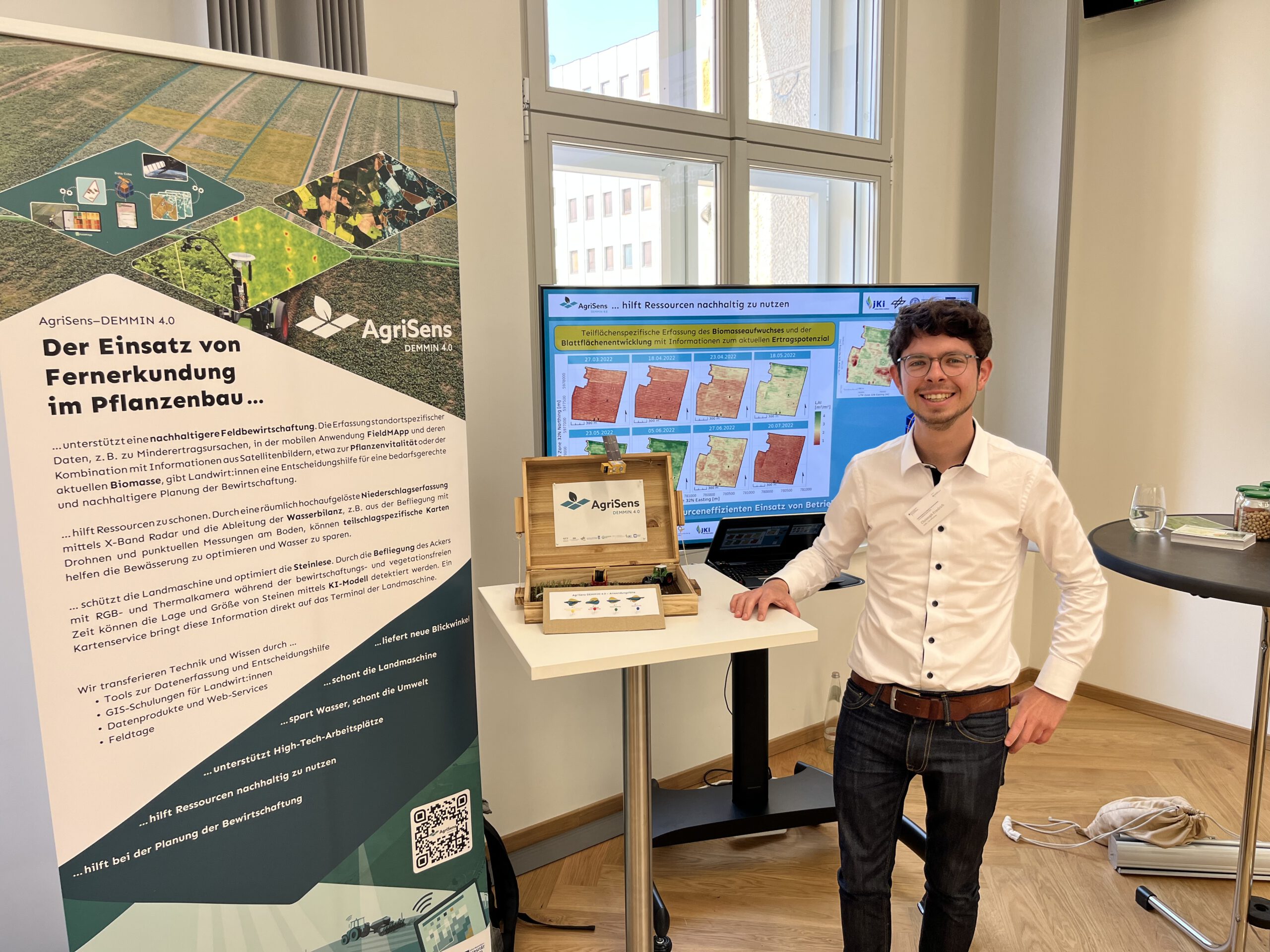
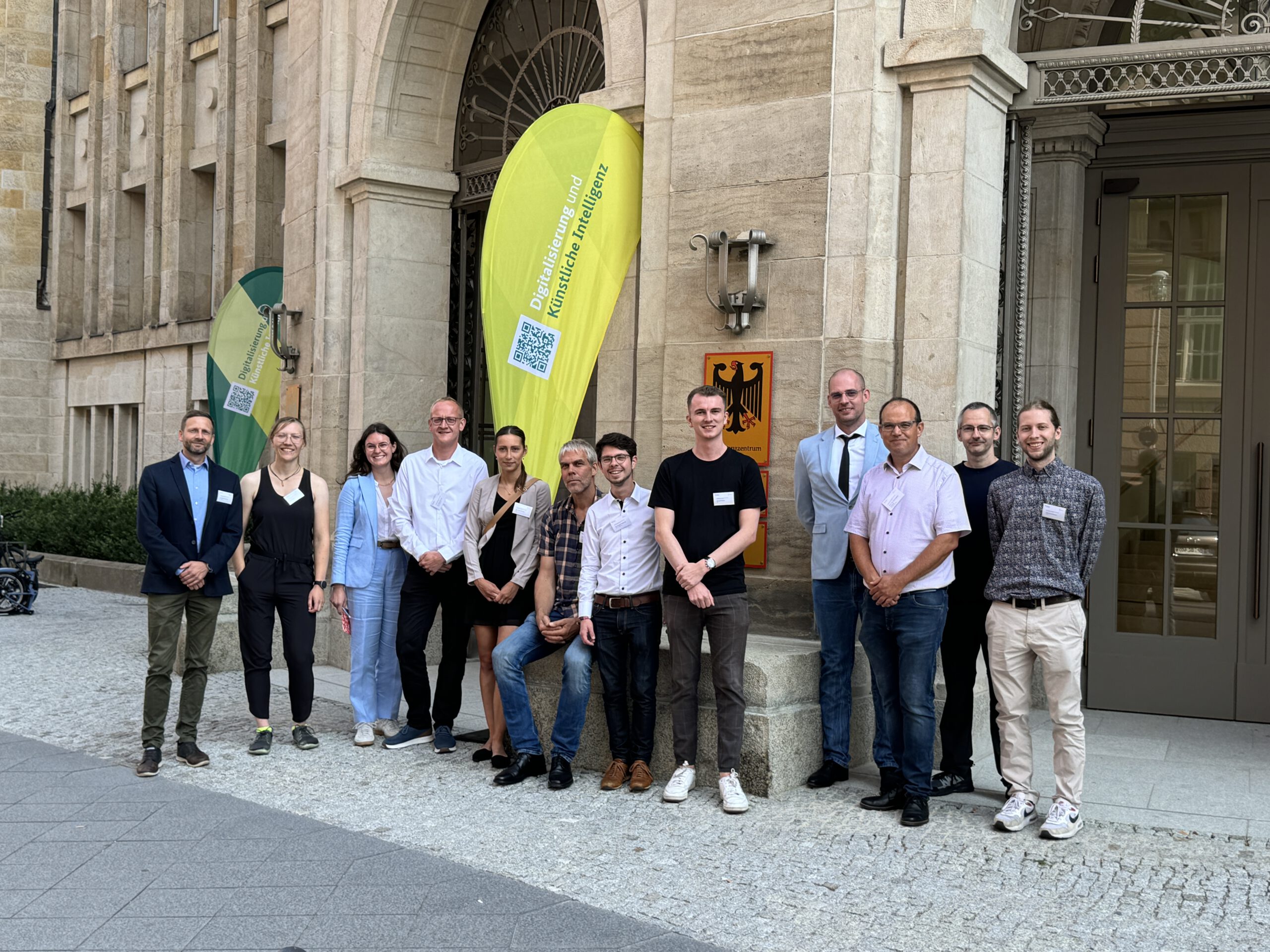
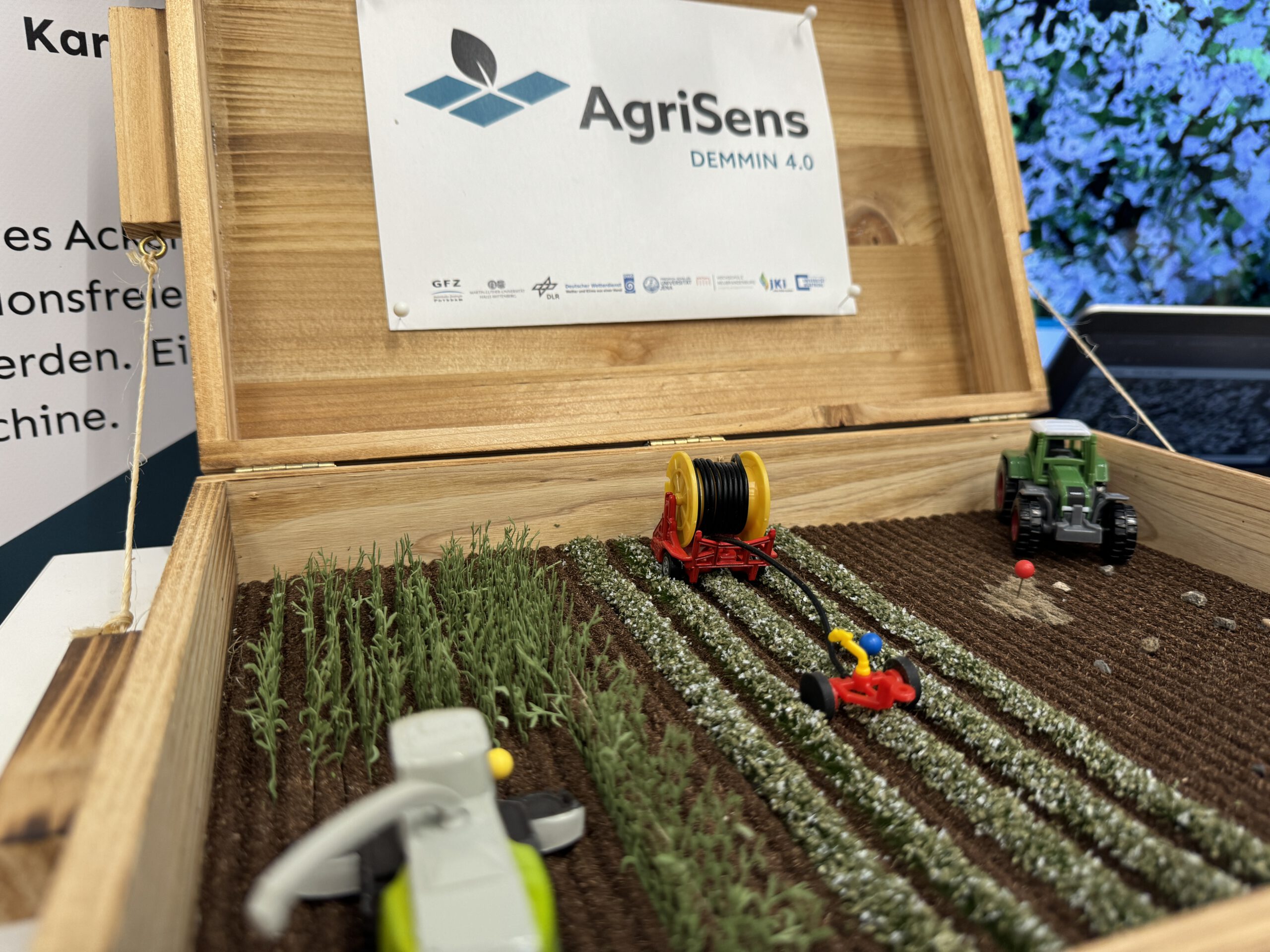
The project “AgriSens DEMMIN 4.0” deals with remote sensing in field crop production and is one of the 14 “experimenting fields” funded by the German Ministry for Agriculture. As the funding period is approaching its end, all 14 projects held a joint conference in Berlin to showcase their results, and of course AgriSens was also proud to display theirs! Our staff member Christoph Friedrich, who took care of the project’s datacube during its second phase, travelled to Berlin to explain everything about satellite data provision, processing and presentation. His luggage also included a self-built miniature model of an agricultural scene that illustrates the four use cases of the project: yield prediction, sustainable cultivation, stone detection, and irrigation (right picture below). One of the visitors to the AgriSens booth was State Secretary Silvia Bender, who was very interested to see the mobile application “FieldMApp” that was developed by the project consortium. It helps farmers to track and manage areas of lower yield in heterogeneous fields and gets much of its data from the EORC-powered datacube, which acts as a central hub for all data products generated in the project. The presentation programme that accompanied the exhibition further included four talks by AgriSens staff, from a general overview to highly in-depth topics such as water balance modelling or the search for field stones with thermal drones. Overall, it was very nice to show intermediate results to stakeholders in practice and politics, but the work doesn’t stop just yet: AgriSens has another half a year in which the work that was done so far will be polished and finalised!
follow us and share it on:

you may also like:

AI chatbots in research and teaching

AI chatbots in research and teaching

Let's be honest about something: AI chatbots are not coming to our courses and our research. They are already here, and they have been for a while. ChatGPT, Claude, Perplexity, Gemini, whatever your tool of choice is, our students have been using these things for...

Drone manufacturer Wingtra visits EORC

Drone manufacturer Wingtra visits EORC

Is it possible to combine the efficiency of a fixed-wing drone with the precision of a laser scanner? That question brought researchers from EORC together with Wingtra, a Swiss company designing and manufacturing fixed-wing UAS, to exchange on UAS research and discuss...

How We Learned to Fly: The Story Behind UAS Research at EORC

How We Learned to Fly: The Story Behind UAS Research at EORC

Every research group that's ever bought a drone has a story about the first one it lost. We're no different. So let's just get that out of the way up front: this is the inside story of how UAS (Unoccupied Aerial System) research grew up at the Earth Observation...

MainPro workshop on TLS and LiDAR UAS

MainPro workshop on TLS and LiDAR UAS

This week, a workshop organized by Sebastian Buchelt within our EFRE project MainPro brought together students, researchers, and interested project partners to explore modern UAV technologies. The workshop took place in vineyards close to Würzburg and gave the...

25 Years of Remote Sensing in Würzburg

25 Years of Remote Sensing in Würzburg

Our chair of remote sensing, Professor Stefan Dech, likes to say "science is rarely a sprint, it's a marathon". And if you look at what's grown out of Würzburg over the last 25 years, you'll see exactly what he means. In 2026 the Julius-Maximilians-Universität...

Starkregen in Bayern: Beobachtungen und Dokumentation zählen

Starkregen in Bayern: Beobachtungen und Dokumentation zählen

Starkregenereignisse treten immer häufiger lokal, kurzfristig und mit hoher Intensität auf. Innerhalb weniger Stunden können sie erhebliche Überschwemmungen und Schäden verursachen. Um solche Ereignisse künftig besser zu verstehen und die wissenschaftliche Grundlage...

Share This