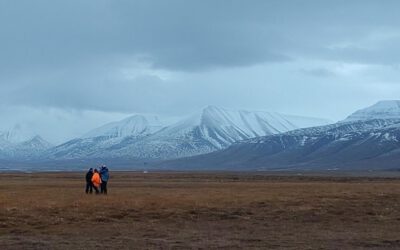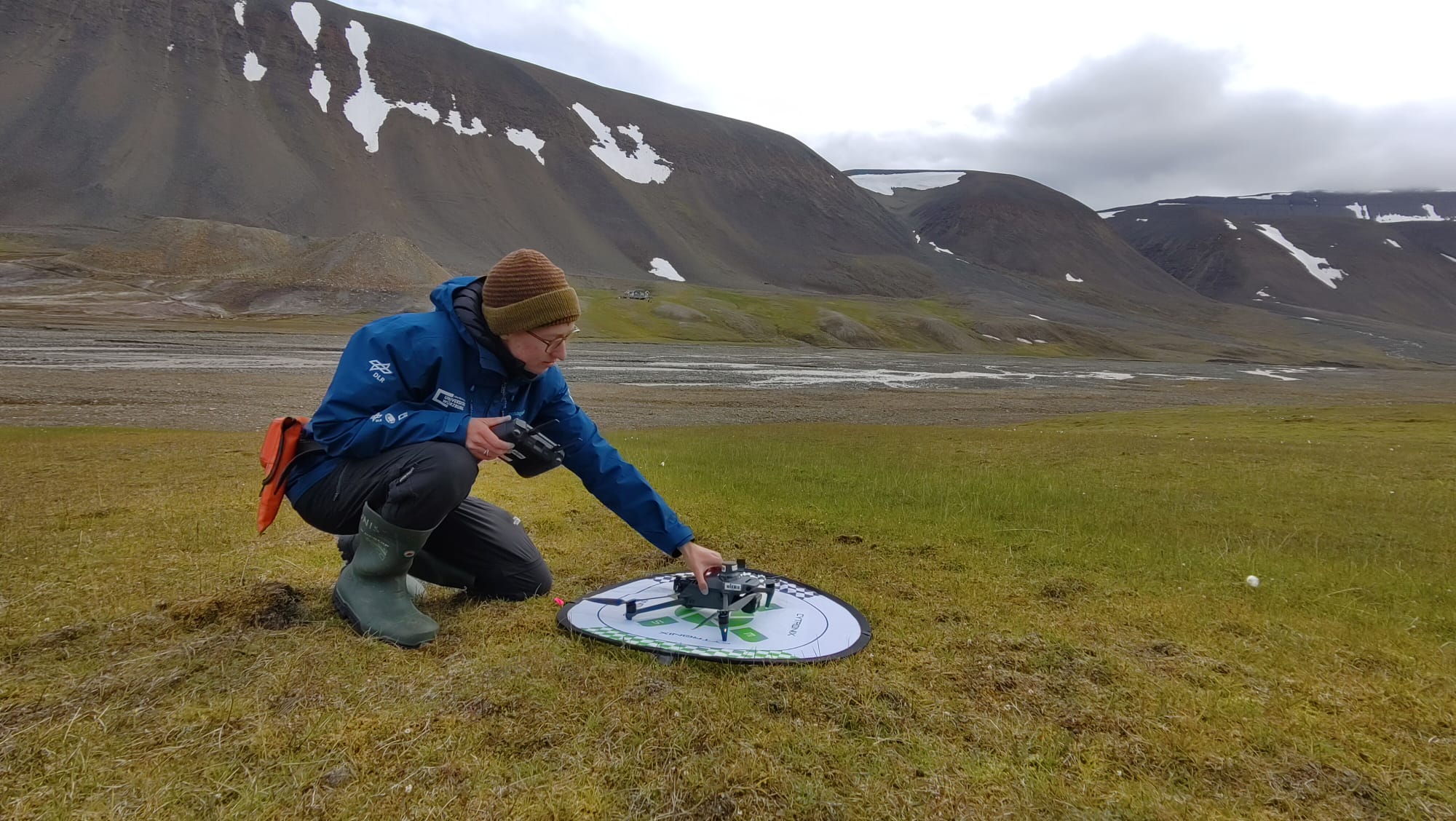

This summer, one of our PhD students, Elio Rauth, embarked on an exciting scientific journey to the High Arctic—conducting detailed vegetation surveys on the remote archipelago of Svalbard. The aim? To better understand the intricate mosaic of Arctic plant communities and how they vary across scales—from ground observations to UAS (drone) data and ultimately satellite imagery.
The fieldwork is part of a larger, ongoing collaboration with the University Centre in Svalbard (UNIS), focusing on UAS- and satellite-based remote sensing in polar environments. Our PhD student combines high-resolution multispectral drone flights with meticulous vegetation ground-truthing to link micro-scale patterns with broader landscape dynamics and is supervised by Prof. Tobias Ullmann.
The upscaling from UAS to satellite data enables us to analyze vegetation structure and distribution across spatial scales—crucial for detecting environmental change in one of the world’s most rapidly warming regions.
The research is conducted under the guidance of Dr. Mirjana Bevanda, head of our UAS research team, and benefits from the support of experienced team members, including Dr. cand. Jakob Schwalb-Willmann, Antonio Castaneda-Gomez, and Sebastian Buchelt. Together, this collaboration brings together field ecology, cutting-edge sensor technology, and scalable data processing to shed light on Arctic ecosystems.
We’re looking forward to the insights this work will bring—and to continuing our collaborative efforts with UNIS to push the boundaries of remote sensing in extreme environments.
Stay tuned for updates as we process the data and dive deeper into the Arctic’s green patterns.