
Building Capacity for Climate Research: Remote Sensing Training with West African PhD Students

Building Capacity for Climate Research: Remote Sensing Training with West African PhD Students

January 21, 2026

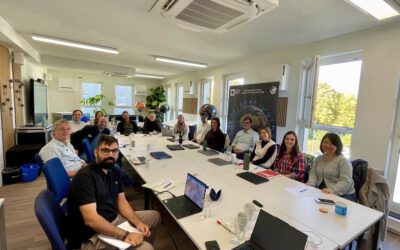
For two weeks, our NetCDA Team, this time formed by our colleagues Lilly Schell and Michael Thiel, is back at the Kwame Nkrumah University of Science and Technology (KNUST) as part of the WASCAL Graduate School on Climate Change and Land Use, supporting PhD candidates in developing their own skills on remote sensing analyses related to climate change in West Africa.
In addition to covering theoretical foundations, we place a strong emphasis on hands-on, application-oriented training using real-world data. Whenever possible, the exercises are closely aligned with the individual research questions of the doctoral researchers.

We are very much looking forward to two intensive weeks with 15 PhD candidates from 11 West African countries: Benin, Burkina Faso, Côte d’Ivoire, Ghana, Guinea, Mali, Niger, Nigeria, Senegal, Togo, and The Gambia.
The time at KNUST will allow us to further expand our network and engage with new and exciting research topics.

follow us and share it on:

you may also like:

EAGLE Goes Bouldering: Getting to Know the New Cohort

EAGLE Goes Bouldering: Getting to Know the New Cohort

Some of the best conversations don’t happen in a seminar room but outside during a hike or - in this case - a climb. This week, the new EAGLE students got a chance to prove it, swapping lecture slides for climbing shoes at our bouldering social. We booked the Rock-In...

Teaching activities in the Arctic: EORC at UNIS on Svalbard

Teaching activities in the Arctic: EORC at UNIS on Svalbard

It started a few years ago, when Mirjana Bevanda built up a collaboration with partners at UNIS, the University Centre in Svalbard. Jakob Schwalb-Willmann joined soon after, and today a growing group from EORC heads north to teach there, including Antonio...

bzgl. Art. 50 Verordnung (EU) 2024/1689 (AI Act):

Überwiegend werden eigene originäre Texte und Bilder des EORC genutzt, jedoch sind einige Inhalte von blog post Texten teilweise mit Hilfe von KI überarbeitet worden und einige Bilder sind ganz mit KI erstellt, die jedoch deutlich keine photorealistische Darstellungen abbilden. Aussnahmen sind KI generierte fernerkundliche Datensätze, die explizit für Forschungszwecke mit KI erstellt wurden, hier wird aber durch den assoziierten Text der wissenschaftliche Grund der KI generierten Bilder erläutert.

Share This