
Celebrating Excellence: Jakob Schwalb-Willmann Receives the 2025 GGW Award for Best PhD Thesis

Celebrating Excellence: Jakob Schwalb-Willmann Receives the 2025 GGW Award for Best PhD Thesis

m

December 8, 2025

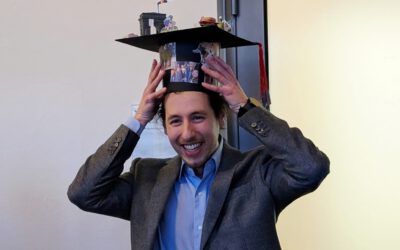
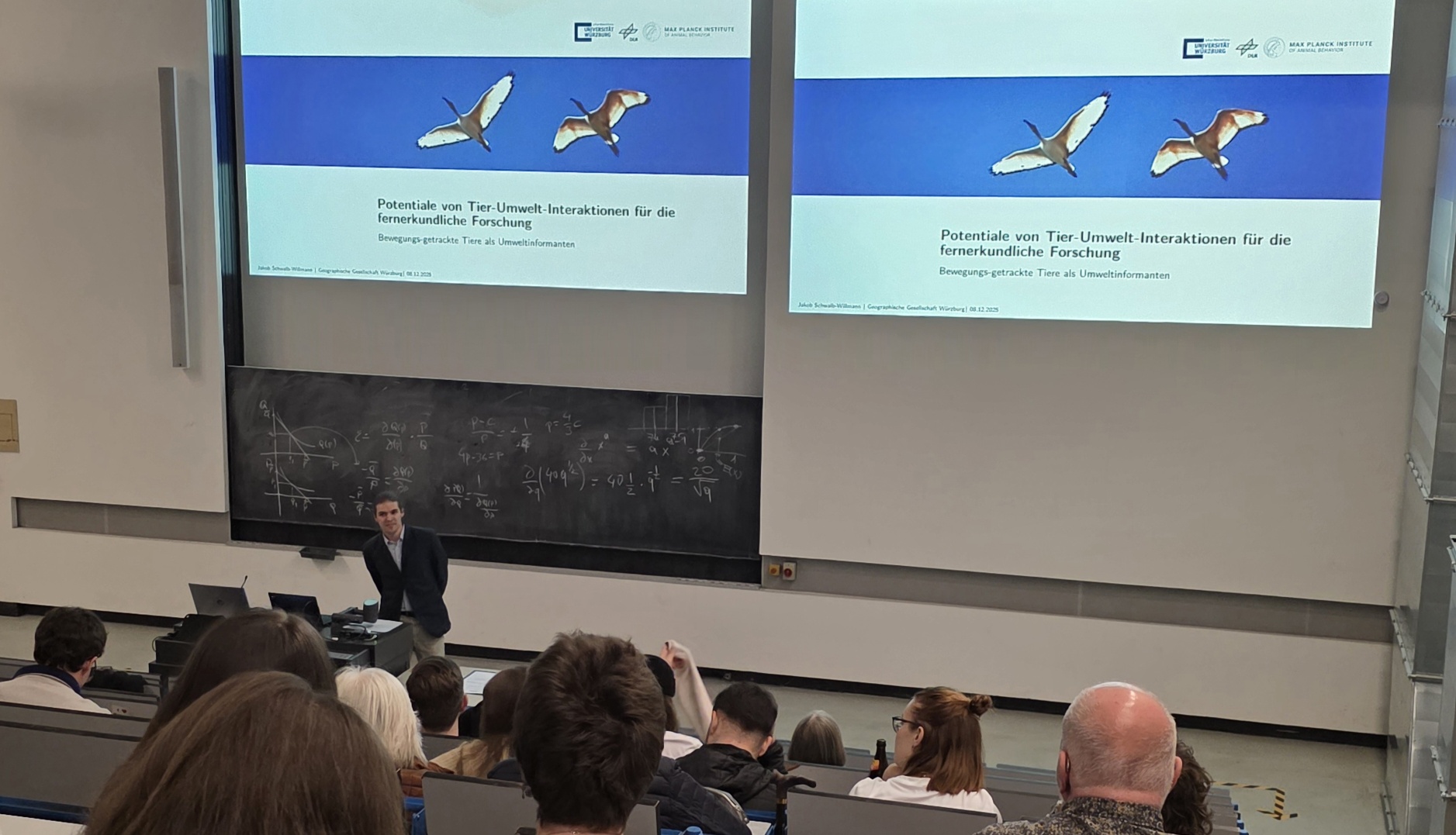
Every once in a while, research opens new ways of looking at the world—literally. Our postdoctoral researcher Jakob Schwalb-Willmann has been honored with the 2025 GGW Award for the Best PhD Thesis, recognizing his outstanding contribution to the field of geo-information science and Earth observation.In his doctoral work, Jakob developed an innovative approach that connects animal movement data with remote sensing techniques to improve how we understand and classify land cover. By bridging behavioral ecology and satellite observation, his research shows how animals themselves can act as fine-scale sensors of their environment. This new perspective offers exciting potential for monitoring dynamic landscapes and biodiversity in a time of rapid environmental change.The GGW Award, presented annually to recognize exceptional PhD theses in geography highlights both scientific excellence and societal impact. Jakob’s work stood out for its creativity, rigorous methodology, and forward-looking applications that could enhance ecological modeling and environmental monitoring around the globe.
We are proud to see Jakob’s efforts celebrated by the GGW community and look forward to following the next steps of his academic journey. 
His achievement reflects the spirit of curiosity, collaboration, and innovation that drives our EORC research group.
Congratulations, Jakob, on this well-deserved recognition!

follow us and share it on:

you may also like:

Geometric calibration study of our thermal UAS sensor

Geometric calibration study of our thermal UAS sensor

At the EORC we deploy a range of space-borne and UAS-based sensors for environmental research. While many systems come with established calibration procedures, some of our UAS sensors require dedicated validation and characterization to ensure scientifically reliable...

EORC researchers teaching drone remote sensing at UNIS, Svalbard

EORC researchers teaching drone remote sensing at UNIS, Svalbard

During their current visit to Svalbard, EORC researchers have been teaching UNIS students from all over Europe on how drones can be used for remote sensing in the high Arctic. Invited by our UNIS collaborators Prof. Dr. Simone Lang (UNIS) and Prof. Dr. Eero Rinne...

Upcoming PhD Defense by Sebastian Buchelt on 11th February

Upcoming PhD Defense by Sebastian Buchelt on 11th February

We are happy to announce that our colleague Sebastian Buchelt will defend his PhD thesis "Potential of Synthetic Aperture Radar time series for mapping and monitoring of small-scale periglacial processes in alpine environments" on February 11th at 12 pm at...

Talk by Dr. Philipp on AI at Airbus

Talk by Dr. Philipp on AI at Airbus

Our former EAGLE M.Sc. graduate and EORC PhD graduate Dr. Marius Philipp will give talk about AI, ML and NLP within his current work at Airbus. The talk will take place next Wednesday, 11th of Feb., at 2pm in John-Skilton Str. 4a. It will take place either in seminar...

Urban Earth Observation Lecture: Understanding Cities from Above

Urban Earth Observation Lecture: Understanding Cities from Above

As part of the EAGLE M.Sc. programme, our international students attended this winter term the Urban Earth Observation lecture by EORC professor Hannes Taubenböck. The session offered a comprehensive overview of how remote sensing has evolved into a central tool for...

Privacy Policy

Lehrstuhl für Fernerkundung & Lehrstuhl für Urbane Fernerkundung

Erdbeobachtung an der Universität Würzburg