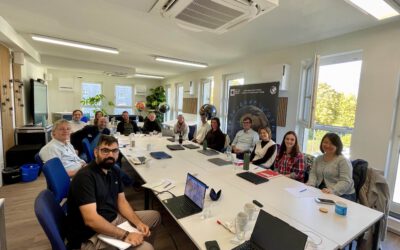
On 27 March 2026, EAGLE MSc student Maximilian Merzdorf successfully defended his Master’s thesis, titled “Assessing the potential of multispectral UAS and PlanetScope imagery for estimating vegetation structure and biodiversity metrics in urban green spaces”
In his thesis, Max explored the potential of multispectral remote sensing data, specifically UAS and PlanetScope imagery, to estimate biodiversity and vegetation structure in urban green spaces. The main objective was to evaluate spectral diversity and texture metrics as predictors of ecological target variables.
The study combines extensive field data with remote sensing datasets of varying spatial resolution. Methodologically, it applies both established and further developed approaches to spectral diversity analysis, systematically assessing their performance.
The results demonstrate that spectral diversity metrics are particularly effective in capturing relative patterns of biodiversity, while the estimation of vegetation structure parameters remains limited. In addition, the study highlights that UAS and satellite data capture ecological information at different spatial scales and therefore complement each other.
The research is highly relevant for urban environments such as Würzburg and comparable cities. In the context of urbanization, climate change, and biodiversity loss, efficient monitoring approaches for urban green spaces are increasingly important. The analyzed sites represent a broad range of management intensities, reflecting typical urban ecosystems and enhancing the transferability of the findings.
Overall, the thesis provides a valuable contribution to advancing remote sensing-based biodiversity assessments in urban contexts, highlighting both practical application potential and methodological limitations.
The thesis was supervised by Dr. Sarah Schönbrodt-Stitt from our Earth Observation Research Cluster (EORC) and Prof. Dr. Nadja Simons, Applied Biodiversity Sciences, Chair of Nature Conservation Biology and Forest Ecology, Biocentre, at the University of Würzburg.
We would like to sincerely thank Prof. Dr. Nadja Simons for her valuable collaboration as second supervisor. We congratulate Max on successfully completing his degree and wish him all the best for his future career.