
On December 09, 2025, Daria Ushakova will present her Master Thesis on ” Detecting Snow Phases and Runoff Using Sentinel-1 SAR and Multispectral–Optical Data ” at 13:00 in seminar room 3, John-Skilton-Str. 4a.
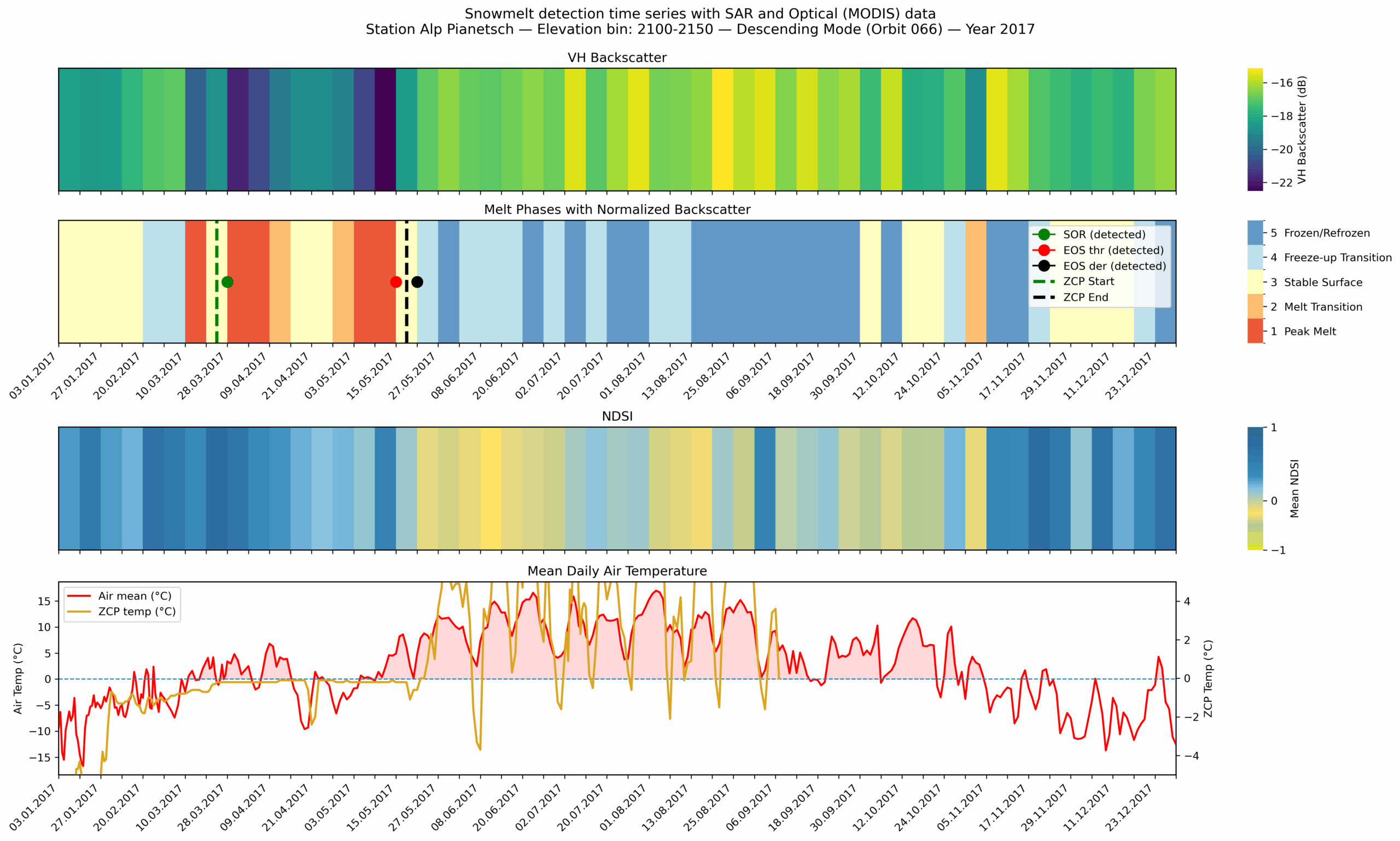
From the abstract: Snow is a crucial component of the Earth system, regulating global climate through albedo and energy balance while storing freshwater. In mountain regions such as the Alps, seasonal snow drives runoff generation, supports hydropower production, and controls glacier mass balance. As climate change leads to shorter snow-cover duration and earlier melt onset, monitoring the timing of snow phase transitions has become essential for hydrological forecasting and water-resource management. This study investigates the potential of Sentinel-1 (S1) synthetic aperture radar (SAR) time series and optical data to detect seasonal snow phase transitions and runoff onset. Multi-year (2017–2021) Sentinel-1 Ground Range Detected (GRD) time series acquired over the Swiss Alps, together with MODIS-derived Normalized Difference Snow Index (NDSI), were used to identify the start of runoff (SOR) and end of snow cover (EOS). Backscatter time series are analyzed at three aggregation levels: station-level, elevation-band level and catchment-scale level. For the catchment and elevation level, a rule-based detection framework are developed using percentile-based normalization to identify SOR and EOS dates. All results are then validated against in-situ zero-curtain phase (ZCP) timing derived from ground temperature observations at eight Alpine stations. Both SOR and EOS from Sentinel-1 are detected within about six days of the in-situ ZCP, indicating that SAR captures the key melt transitions with close timing agreement. Consistent agreement between SAR, MODIS NDSI, and in-situ data confirms that all sensors capture the same physical melt transition, demonstrating that spatial aggregation is essential for robust SAR-based snowmelt detection in complex terrain. Overall, the framework enables reliable, transferable detection of alpine snow phase timing and shows strong potential for operational snowmelt monitoring and application in other mountain regions worldwide.
1st supervisor: Prof. Dr. Tobias Ullmann
2nd supervisor: Sebastian Buchelt
From the abstract: Snow is a crucial component of the Earth system, regulating global climate through albedo and energy balance while storing freshwater. In mountain regions such as the Alps, seasonal snow drives runoff generation, supports hydropower production, and controls glacier mass balance. As climate change leads to shorter snow-cover duration and earlier melt onset, monitoring the timing of snow phase transitions has become essential for hydrological forecasting and water-resource management. This study investigates the potential of Sentinel-1 (S1) synthetic aperture radar (SAR) time series and optical data to detect seasonal snow phase transitions and runoff onset. Multi-year (2017–2021) Sentinel-1 Ground Range Detected (GRD) time series acquired over the Swiss Alps, together with MODIS-derived Normalized Difference Snow Index (NDSI), were used to identify the start of runoff (SOR) and end of snow cover (EOS). Backscatter time series are analyzed at three aggregation levels: station-level, elevation-band level and catchment-scale level. For the catchment and elevation level, a rule-based detection framework are developed using percentile-based normalization to identify SOR and EOS dates. All results are then validated against in-situ zero-curtain phase (ZCP) timing derived from ground temperature observations at eight Alpine stations. Both SOR and EOS from Sentinel-1 are detected within about six days of the in-situ ZCP, indicating that SAR captures the key melt transitions with close timing agreement. Consistent agreement between SAR, MODIS NDSI, and in-situ data confirms that all sensors capture the same physical melt transition, demonstrating that spatial aggregation is essential for robust SAR-based snowmelt detection in complex terrain. Overall, the framework enables reliable, transferable detection of alpine snow phase timing and shows strong potential for operational snowmelt monitoring and application in other mountain regions worldwide.
1st supervisor: Prof. Dr. Tobias Ullmann
2nd supervisor: Sebastian Buchelt