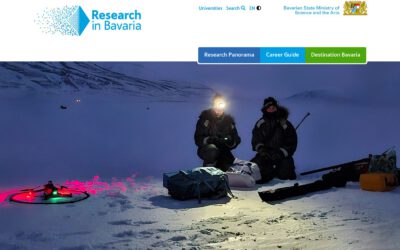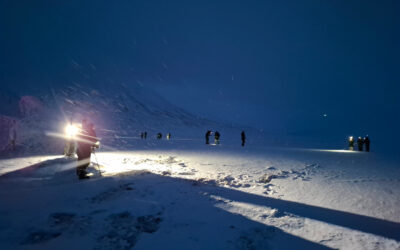
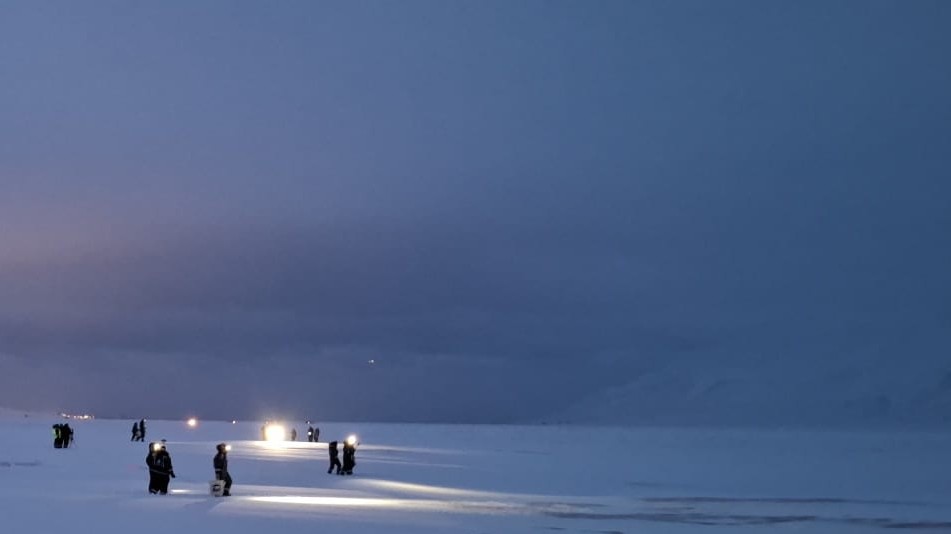

The Arctic landscape presents unique challenges and opportunities for earth observation research. This winter, two colleagues from our Earth Observation Research Centre (EORC), Dr. Jakob Schwalb-Willmann and Dr. Mirjana Bevanda, are contributing their expertise as guest lecturers at the University Centre in Svalbard (UNIS), where they are teaching international students about uncrewed aerial systems (UAS) and their applications in arctic ecology.
Bridging Theory and Practice
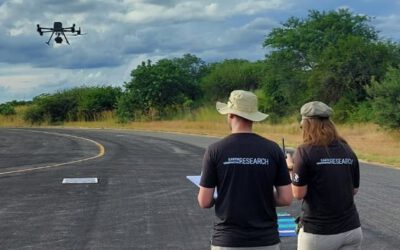
What distinguishes these courses from conventional remote sensing instruction is the emphasis on hands-on fieldwork. Rather than limiting their education to classroom theory, the students venture into the Arctic environment to conduct real data acquisition campaigns. Working with UAS technology in sub-zero conditions, they learn firsthand about the practical considerations that shape successful remote sensing missions in extreme environments.
The field component includes not only drone flights but also the collection of corresponding in-situ measurements, essential for validating remotely sensed data. Students experience the complete workflow that professional researchers follow: from mission planning and safety protocols to data capture under challenging weather conditions.
Collaborative Data Analysis
Following their time in the field, students return to analyse the collected datasets. This phase proves equally valuable, as they process UAS imagery alongside their ground measurements, learning to identify patterns, assess data quality, and draw meaningful ecological conclusions.
The collaborative discussions that follow these analyses form a crucial part of the learning experience. Students engage with questions about the value and limitations of UAS-based earth observation for ecological research, considering factors such as spatial resolution, temporal frequency, cost-effectiveness, and the types of ecological phenomena that can be reliably detected from aerial platforms.
International Perspectives
The diverse backgrounds of UNIS students enrich these discussions considerably. Participants bring perspectives from various national research traditions and previous fieldwork experiences, creating a productive exchange of ideas about how UAS technology might address different ecological research questions across Arctic regions and beyond.
We are grateful to our colleagues for representing EORC in this capacity and contributing to the next generation of researchers working at the intersection of remote sensing and arctic ecology. Their commitment to practical, field-based education reflects the collaborative spirit that characterises much of European earth observation research.
For more information about UNIS and its programmes, visit unis.no