
Fieldwork in the Arctic

Fieldwork in the Arctic

July 8, 2024

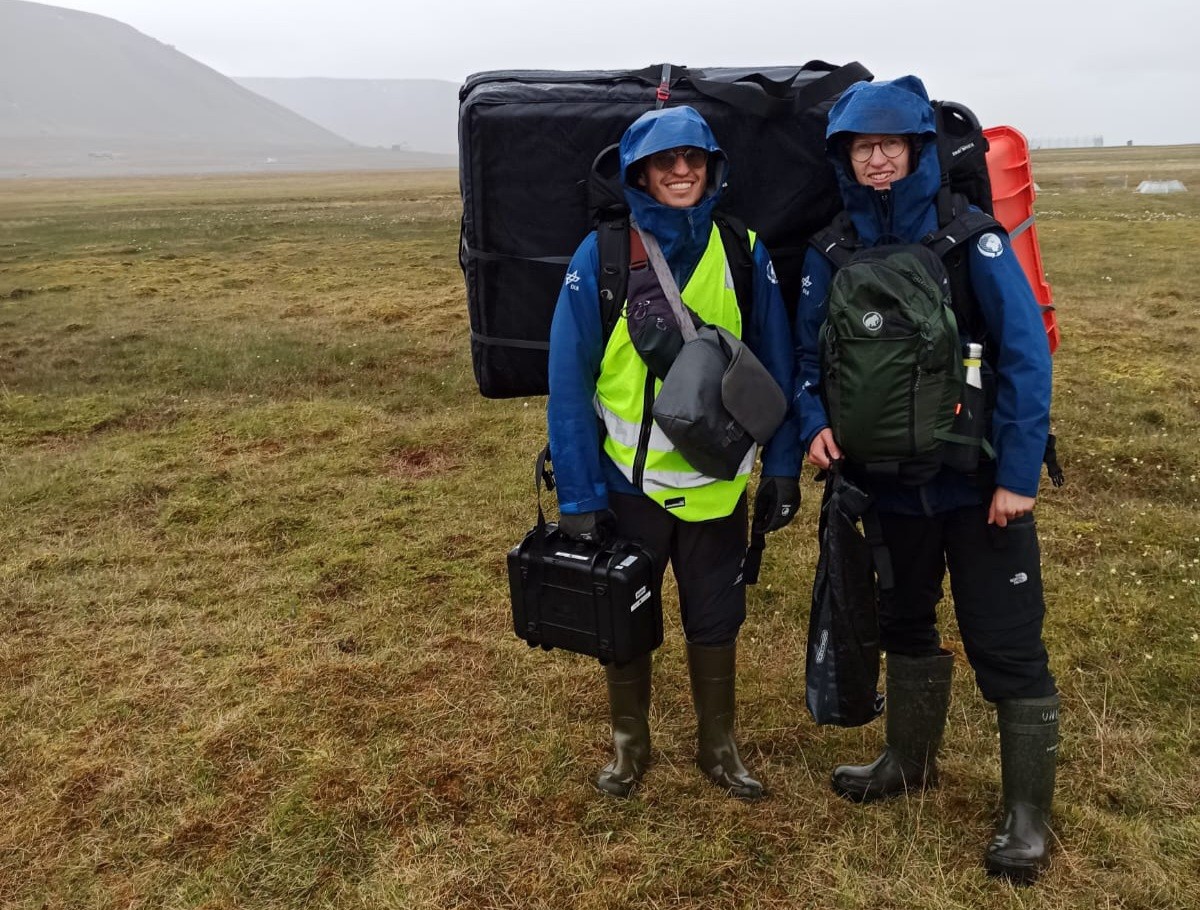
Our UAS team is currently conducting fieldwork in the Arctic and is facing rapidly changing weather conditions. Even though the weather did not work out as planned and only first test flights with our Lidar, multispectral, oblique or thermal sensors were possible the mood was still good because of the amazing landscape unimportant of the weather conditions.

While the two PhD students of the UAS team, Elio Rauth and Antonio Castaneda under supervision from Dr. Mirjana Bevanda and in close cooperation with Prof. Larissa Beumer and Prof. Simone Lang from UNIS, are awaiting better conditions, the missions are refined and the accessibility of the different sites are discussed – while accounting for different means of transport, from car to walking with all the equipment. Many more missions are scheduled for the next weeks and we are very much looking forward to some great multi-sensor analysis and interdisciplinary applications of our UAS earth observation data sets.

follow us and share it on:

you may also like:

EORC at the joint NSO-GfÖ 2026 conference in Odense, Denmark

EORC at the joint NSO-GfÖ 2026 conference in Odense, Denmark

This week, the EORC is participating in the joint NSO-GfÖ 2026 conference in Odense, Denmark. The conference brings together researchers of all career stages from all across ecology research, representing a wide range of methods and applications, including topics at...

Johannes Mast wins Bernd Rendel Prize

Johannes Mast wins Bernd Rendel Prize

Johannes Mast is awarded the 2026 Bernd Rendel Prize for Geosciences by the Deutsche Forschungsgemeinschaft (DFG) for outstanding research as part of his dissertation. Johannes’s highly interdisciplinary work bridges the Geosciences, Linguistics, Data Science, and...

bzgl. Art. 50 Verordnung (EU) 2024/1689 (AI Act):

Überwiegend werden eigene originäre Texte und Bilder des EORC genutzt, jedoch sind einige Inhalte von blog post Texten teilweise mit Hilfe von KI überarbeitet worden und einige Bilder sind ganz mit KI erstellt, die jedoch deutlich keine photorealistische Darstellungen abbilden. Aussnahmen sind KI generierte fernerkundliche Datensätze, die explizit für Forschungszwecke mit KI erstellt wurden, hier wird aber durch den assoziierten Text der wissenschaftliche Grund der KI generierten Bilder erläutert.

Share This