
When you think of a research internship in remote sensing, your mind probably jumps to lab screens, stacks of satellite imagery, and a lot of coffee. What you probably don’t picture is standing in the middle of Kruger National Park, watching elephants move through the bush while your laptop is processing LiDAR point clouds. But that’s exactly where a group of EAGLE MSc students found themselves this year, and they’ve got quite a lot to report.
The internship placed students directly in one of Africa’s most iconic landscapes, Kruger National Park in South Africa, tasked with something that sounds deceptively simple: map the vegetation. Of course, anyone who’s tried to classify a savanna from orbit knows there’s nothing simple about it. You’re dealing with a mosaic of woody cover, open grassland, seasonal change, shadow effects from sparse tree canopies, and a phenological cycle that doesn’t care about your classification scheme. It’s exactly the kind of problem where Earth observation earns its keep.
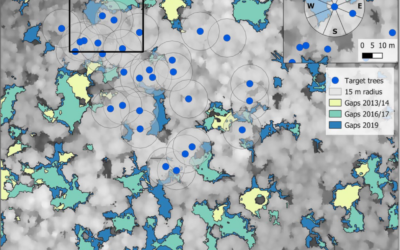
Students worked across the full EO toolkit. Multispectral imagery formed the backbone, letting the team track vegetation indices, separate photosynthetically active cover from dry biomass, and build up a picture of how plant communities shift across the landscape. But the real interesting datasets were the LiDAR datasets. Three-dimensional point clouds let you do things that optical imagery simply can’t, pulling apart canopy height from understory density, estimating above-ground biomass, characterising the structural complexity that determines what animals can actually use a patch of habitat for. In a system as structurally diverse as Kruger, that vertical dimension matters enormously.
And that’s where the animal-environment side of the work got genuinely interesting. Vegetation structure isn’t just an ecological variable sitting in a spreadsheet. It’s the thing that shapes where elephants browse, where lions have cover, where herbivores choose to graze versus avoid. Linking the spatial outputs from the EO analysis to species distribution patterns and movement data is exactly the kind of integrative work that makes remote sensing relevant beyond cartography. Students got hands-on experience building those links, which, honestly, is the kind of thing you can’t replicate in a classroom.
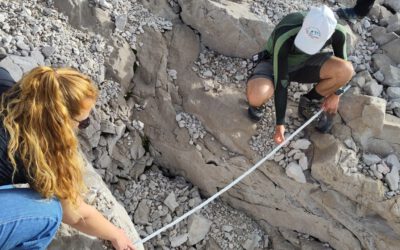
The whole internship was done with SANparks, Dr Ben Wigley and Dr Corli Coetsee, jointly supervised by Dr. Mirjana Bevanda, whose expertise in animal ecology and spatial analysis gave the project its scientific backbone. Having that kind of guidance meant the students weren’t just producing maps, they were producing maps that actually meant something ecologically. On the ground, PhD student Luisa Pflumm joined the team, bridging the field reality with the remote sensing analysis and making sure what was being processed back at the desk matched what the landscape actually looks like when you’re standing in it. That ground-truth perspective is something every remote sensing project desperately needs, and having someone physically present in the park to provide it was invaluable.
For the students, this was the EAGLE program doing exactly what it’s supposed to. You can teach image processing. You can teach classification workflows and accuracy assessments. But you can’t really teach what it feels like to own a real research question in a complex environment, to wrestle with data that doesn’t behave the way your tutorial dataset did, and to produce outputs that feed into actual conservation science. That’s what Kruger gave them.
The reports coming back from the students reflect that. There’s a confidence in talking about sensor choice, about the tradeoffs between spatial and spectral resolution, about what LiDAR adds that passive optical can’t deliver. But there’s also an ecological literacy that’s hard to fake, a sense of why the vegetation mapping matters beyond the technical exercise of doing it.
Remote sensing is at its best when it’s solving a real problem for a real place. Kruger, with its scale, its ecological complexity, and the genuine conservation stakes involved, is about as real as it gets.