
The climate crisis is exacerbating flood risks worldwide – extreme events are becoming more frequent, more severe and more difficult to predict.
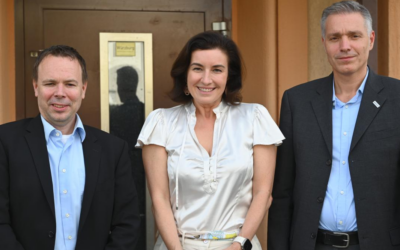
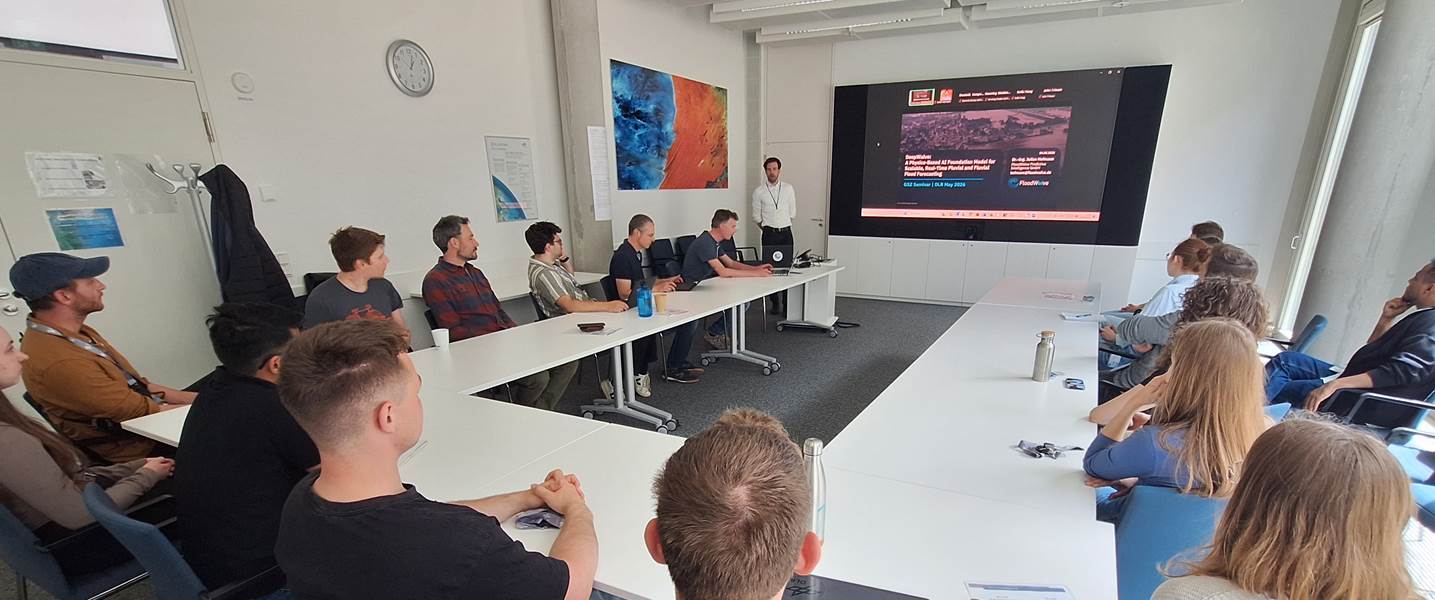
Today, we had Dr Julian Hofmann, Managing Director & Co-Founder of FloodWaive https://www.floodwaive.de/, as our guest at the DLR-DFD in Oberpfaffenhofen. In our seminar series in the “Georisks and Civil Security” department, he presented how the combination of AI, data and expertise can create solutions to the challenges of climate change. With FloodWaive, Julian and his team are not only developing early warning systems for floods, but also creating a platform for physically-informed AI whose applications can be transferred to other climate-related extreme events – such as low water or forest fires. In his inspiring presentation titled “DeepWaive: A Physics-Based AI Foundation Model for Scalable, Real-Time Pluvial and Fluvial Flood Forecasting“, many points of contact were identified with our work at DLR-DFD and our EORC in the areas of natural hazards, georisks, exposure, ZKI and our PRESTO system.
Here is the Abstract of the talk: The increasing frequency and severity of extreme precipitation events demand innovative approaches to flood forecasting, rapid response, and risk management. Traditional hydrodynamic modeling, while physically robust, faces significant computational constraints that hinder real-time, high-resolution probabilistic forecasting. This presentation introduces DeepWaive, a physics-based deep learning foundation model specifically designed for the scalable prediction of both pluvial and fluvial flooding. DeepWaive fuses transformer-based neural network architectures with 2D hydrodynamic numerical models, translating precipitation- or discharge-driven boundary conditions together with standard geospatial inputs, including digital elevation models, soil data, land use, building footprints, and river network data, into transient, spatially explicit 2D inundation dynamics within seconds. This processing speed allows, the parallel evaluation of ensemble precipitation forecasts, such as the ECMFW products or SINFONY from the German Weather Service (DWD), facilitating probabilistic flood forecasting at previously unattainable spatial and temporal resolutions. A core breakthrough of the DeepWaive architecture lies in its zero-shot generalization capability. Unlike conventional machine learning approaches that require resource-intensive retraining for specific geographical domains, DeepWaive is inherently designed for global applicability on unknown model data. Optional site-specific fine-tuning using regional hydrodynamic models or in-situ sensor data further enhances local predictive accuracy. Furthermore, the model’s capabilities extend beyond pure forecasting to include the dynamic, real-time evaluation of flood protection measures during ongoing extreme events. Given the critical role of near-real-time crisis monitoring and satellite-based flood detection at the DLR and ZKI, this talk will highlight how DeepWaive’s scalable, AI-driven approach can synergize with remote sensing workflows to provide decision-makers with robust, instantaneous, and actionable intelligence for risk mitigation and disaster response.
We thank Julian very much for visiting us at DLR, for the inspiring lecture, the interesting follow-up discussions and we look forward to future collaborations.