
new B.Sc. thesis: UAV-based cemetery map

new B.Sc. thesis: UAV-based cemetery map

June 20, 2018

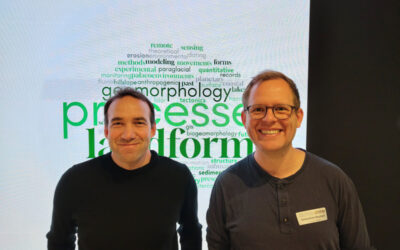
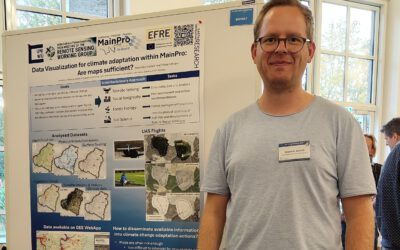
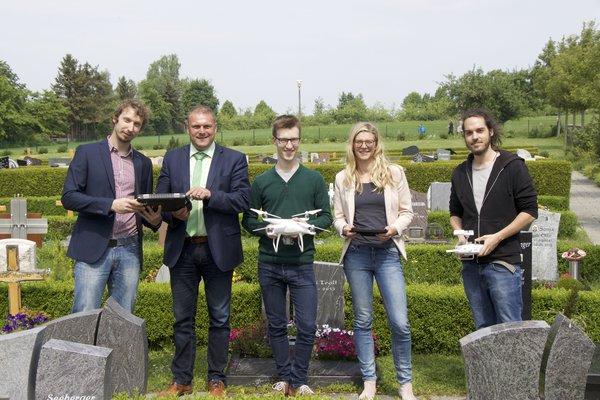
from left to right: Hendrik Flock, Thomas Eberth, Florian Baumgartner, Carina Kübert and Steven Hill, source: MainPost

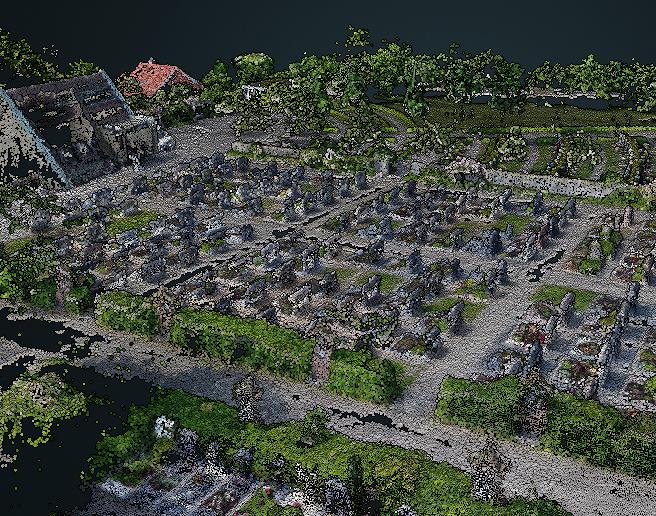
Florian Baumgartner started his B.Sc. thesis titled “Object-oriented derivation of a digital cemetery plan from very high resolution aerial imagery – a case study for the municipality of Kürnach”. The aim of his thesis is to derive a high-resolution UAV-based graveyard map that can be used by the municipality for further planning within the cemetery administration.

Florian has already planned and performed an overflight with our Phantom 4 drone that took place in April this year. Watched by the mayor of Kürnach (Thomas Eberth), a representative of the AKDB (public agency developing IT solutions for municipal authorities, Hendrik Flock) our UAV expert (Steven Hill) and me (mentoring the thesis), the drone was flying at a height of 30m for 15 minutes and took more than 200 images.


The images will be used to derive a georeferenced orthophoto as well as a three-dimensional Digital Surface Model.
Florian will apply object-oriented segmentation and classification methods in order to develop a digital cemetery map. His thesis can be seen as a feasibility study within the process of the digitization of administrative tasks.

More information can be found here:
Best practice Tutorial for low budget UAV (in English and German)
report written by the municipality of Kürnach (in German only)
report written by AKDB (in German only)
report of the local daily newspaper MainPost (in German only)

follow us and share it on:

you may also like:

Starkregen in Bayern: Beobachtungen und Dokumentation zählen

Starkregen in Bayern: Beobachtungen und Dokumentation zählen

Starkregenereignisse treten immer häufiger lokal, kurzfristig und mit hoher Intensität auf. Innerhalb weniger Stunden können sie erhebliche Überschwemmungen und Schäden verursachen. Um solche Ereignisse künftig besser zu verstehen und die wissenschaftliche Grundlage...

Seeing the World in Points: Lidar Course for the EAGLEs

Seeing the World in Points: Lidar Course for the EAGLEs

Lidar has a funny way of sneaking up on you. You think you know what it is, a laser that measures distance, fine, but then someone shows you a point cloud of a forest canopy with individual branches floating in 3D space and suddenly you realize there's a whole...

RTL covers EORC: TV Crew Films MONID Habitrack Fieldwork

RTL covers EORC: TV Crew Films MONID Habitrack Fieldwork

A bit of extra excitement at EORC recently, an RTL television crew showed up to film a segment on the MONID Habitrack project, and Dr. Ariane Droin was right in the middle of it, walking them through what Earth Observation actually brings to the table for a project...

Ticks from Above: UAS Fieldwork for the MONID Habitrack Project

Ticks from Above: UAS Fieldwork for the MONID Habitrack Project

Forest edges are tricky places. They're where woodland meets open ground, where light and shade trade off every few meters, and where, it turns out, ticks tend to do really well. That last bit is exactly why Dr. Ariane Droin, Sofica Garcia de Leon, Dr. Jakob...

Course on urban EO by Michael Wurm

Course on urban EO by Michael Wurm

Walk through any city and you pick up on things that are hard to put a number on. The noise of a main road, the heat that sits between buildings in summer, the question of whether that little park around the corner is really enough green space for the whole...

EireR R package: unified gateway to Irish geospatial data

EireR R package: unified gateway to Irish geospatial data

Anyone who's tried to do geospatial work across the whole island of Ireland knows the headache. Ireland is one island geographically, but it's split across two jurisdictions, the Republic and Northern Ireland, and each one runs its own data infrastructure. Different...

Share This