
Environmental factors such as air pollution, noise, temperature and artificial light at night can influence human health. Understanding how these factors relate to acute cardiovascular emergencies is an important step towards identifying potential environmental health risks and improving our understanding of regional differences in health outcomes.
To investigate these relationships, remote sensing data, environmental and other spatial datasets were combined with health data to analyse the associations between environmental exposures and acute cardiovascular emergencies across Germany. The study integrates satellite-derived information on vegetation, artificial light at night and land surface temperature with data on air pollution, noise, climate, socioeconomic conditions and hospitalizations. By linking these diverse datasets at the district level, it was examined how environmental factors relate to different types of acute cardiovascular emergencies while accounting for spatial patterns and other potential influencing factors.
A key aspect of this work was the close collaboration between remote sensing and medical expertise. Working closely with Dr. Christian-Alexander Behrendt from the Department of Vascular and Endovascular Surgery at Asklepios Clinic Wandsbek and Asklepios Medical School in Hamburg, Germany, allowed to connect environmental exposure assessments with clinically relevant health outcomes.
The paper, entitled ‘Assessing the relationship of major cardiovascular emergencies and environmental factors in Germany‘, has now been published in the journal Discover Public Health. It was authored by Agnes Zwick, Thilo Erbertseder, Christian-Alexander Behrendt, Hannes Taubenböck and John Friesen.
Here is the abstract of the paper:
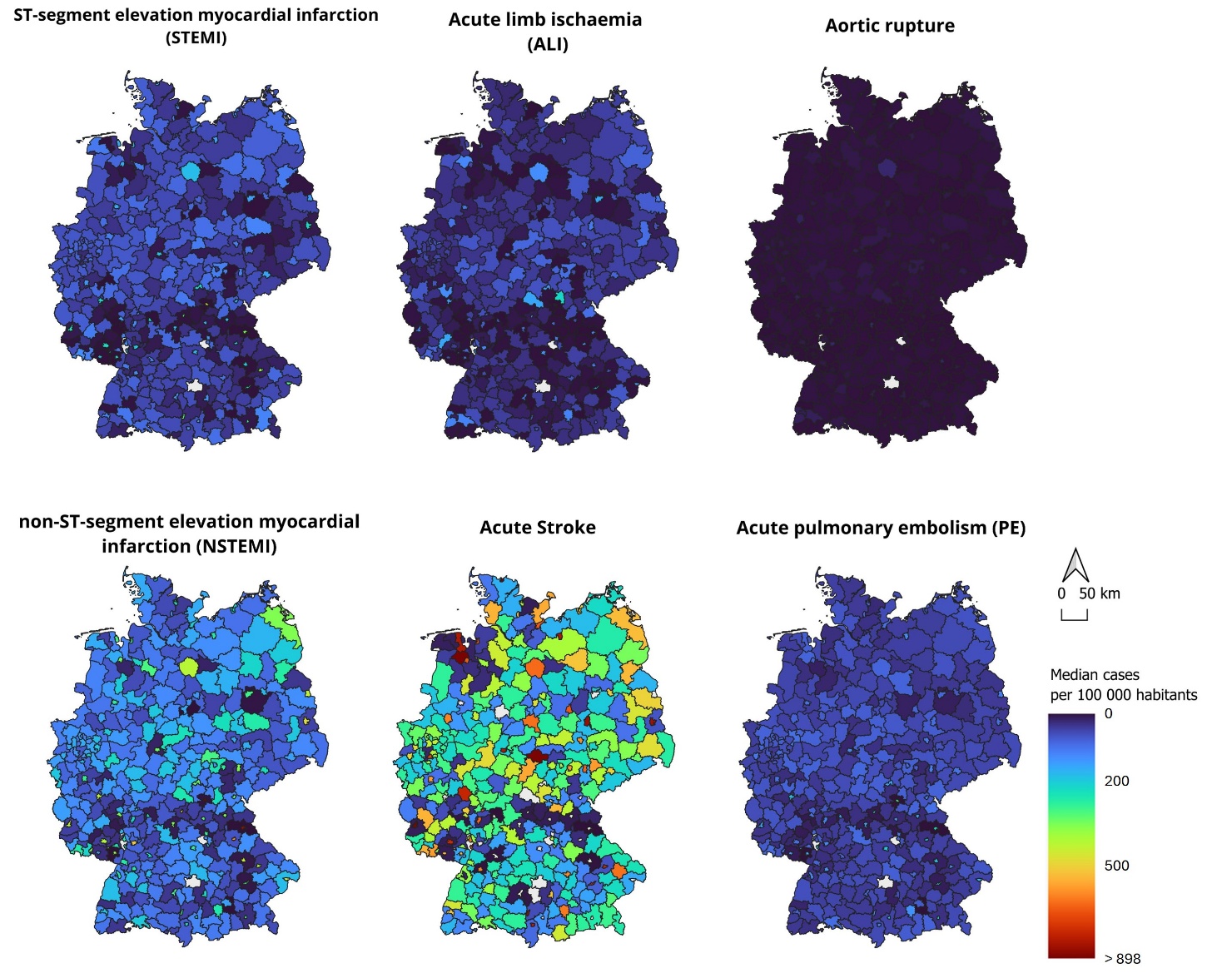
Objective: Environmental factors such as air pollution, noise, extreme temperatures and artificial light at night are associated with acute cardiovascular events. This study assesses the suitability of district-level environmental exposure metrics across Germany, including estimates derived from inhabited areas only, and examines how these regionally variable factors relate to acute ST-segment elevation myocardial infarction (STEMI), non–ST-segment elevation myocardial infarction (NSTEMI), acute limb ischaemia, acute stroke, acute pulmonary embolism, and aortic rupture across all German districts.
Methods: This retrospective observation study relied on year-specific hospitalization rates obtained from the German Hospital Quality Registry. It compiles a district level summary of the hospitalization rates and sixteen environmental variables on vegetation, artificial light or land surface temperature derived by open-source satellite data, air and noise pollution data from the European Environment Agency, and climate information from the German Weather Service (DWD). We utilized a generalized additive model (GAM) framework to analyse cardiovascular emergencies while adjusting for population size, spatial structure, socioeconomic factors and temporal trends.
Results: A total of 3,784,737 acute cardiovascular emergencies were recorded. Before adjustment, 56 exposure–outcome associations were statistically significant, whereas only 12 remained significant after adjustment. Noise exposure was the only environmental variable showing robust associations with acute limb ischemia (RR = 2.47, 95% CI: 1.53–3.96), aortic rupture (RR = 1.47, 95% CI: 1.12–1.91), and pulmonary embolism (RR = 1.27, 95% CI: 1.02–1.58) after full adjustment. The remaining significant associations were predominantly characterized by non-linear exposure response patterns, often without a consistent monotonic increase or decrease in risk across the exposure range. Across most exposure–outcome combinations, adjustment for socioeconomic, land-cover, and spatial factors substantially altered both the magnitude and shape of the estimated associations.
Conclusion: Most associations between environmental exposures and acute cardiovascular emergencies were substantially attenuated after adjustment for socioeconomic and spatial factors. Environmental noise emerged as the most consistent exposure associated with acute vascular emergencies.
The open access paper can be read or downloaded here: https://link.springer.com/article/10.1186/s12982-026-02560-3