
Cities are complex entities that are defined and distinguished by their physical, social, economic, environmental and other structural characteristics. Our remote approach to the city is primarily from a physical-structural perspective. Through Geolingual Studies, we gain a further means of shedding light on these complexities – through the discourse taking place on social media.
A new publication entitled ‘Global regularities and regional patterns in social media discourse: Topic variety, language diversity, and user behaviour across 29 cities‘ distinguishes between issues discussed regionally and globally within cities. This enables to better understand the geographical relevance of topics in digital urban discourses. The paper has just been published in the Journal Cities by Richard Lemoine-Rodríguez, Carolin Biewer, Johannes Mast, and Hannes Taubenböck. The team of authors is from our Earth Observation Research Cluster (EORC), the Chair of English Linguistics, the Geolingual Studies team of the University of Würzburg and the Earth Observation Center (EOC) of the German Aerospace Center (DLR).
Here is the abstract of the paper: In our increasingly interconnected world, digital communication operates with variable geographic reach. Distinguishing between regionally and globally discussed issues allows us to better understand the geographical relevance of topics in digital urban discourses. This study compared the diversity of topics, languages, and user behaviors across 29 cities around the world using Twitter (now X) data posted around New Year’s Eve 2021–2022. Applying topic modeling, we identified 145 topics and classified them into relative types of
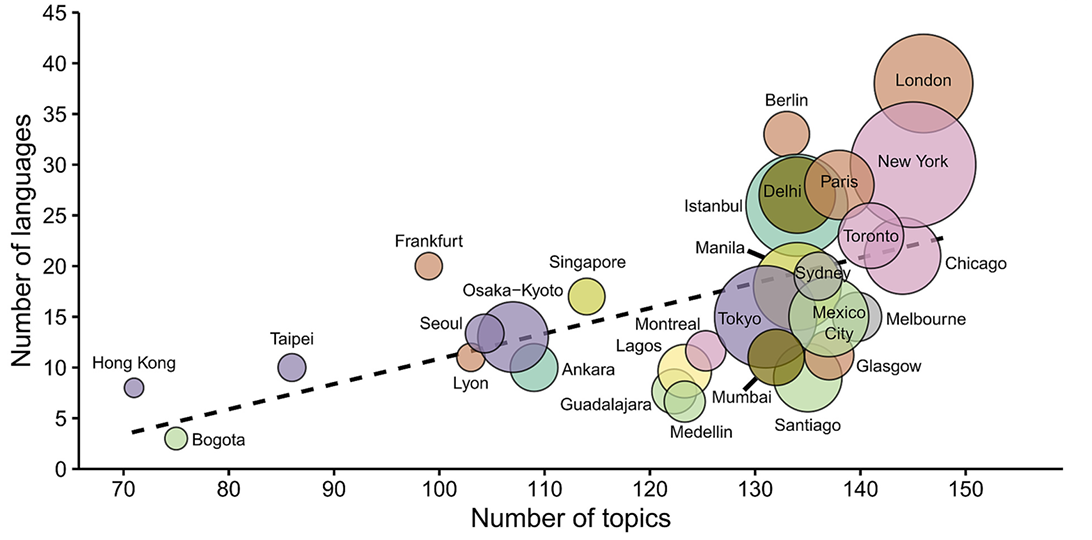
geographic diffusion (i.e., ‘low’, ‘intermediate’, or ‘global’) according to the number of cities and world regions where they were discussed. Topics discussed across the globe included “Food”, “Music”, “Family”, “Religion”, and “Politics”, while conversations with a low relative diffusion reflected on region-specific issues such as “Brexit” in the UK or the “Year of the Tiger” in East Asia. Intermediate topics such as “Healthcare/Medicine”, “Feminism”, and “Booster Vaccination” were common across most regions but displayed distinct emphases. Topic diversity tended to increase with language diversity, and the number of languages used increased as topics shifted from low to global diffusion. Twitter user behavior exhibited consistent Zipf-like patterns across all cities, with a small fraction of highly active users producing most tweets and discussing the highest number of topics. Regional differences emerged, with East and South-East Asian cities showing more balanced user participation and European and North American ones being the most unequal. Viewed through the lens of social media, these patterns reveal both the commonalities that connect human societies and the persistent differences that define them, reflecting a world that is increasingly interconnected but far from being homogeneous
The open access paper can be read or downloaded here: https://www.sciencedirect.com/science/article/pii/S0264275126009297
For more related works in the domain of Geolingual studies, please see some selected studies here:
- Geolingual Studies on Urban Space. https://edinburghuniversitypress.com/book-geolingual-studies-on-urban-space.html
- From Measured to Experienced Heat: A Multimodal Analysis of Temperature, Urban Form, and Social Media in Mexico City. https://doi.org/10.1109/JSTARS.2026.3728299
- Are urban form and function related to urban discourse? Insights from remote sensing and social media data for 15 major cities across the globe. https://doi.org/10.1016/j.habitatint.2026.103907
- From Spatial to Platial Decision Support in Planning – Collecting Platial Experiences of Well-Being. https://doi.org/10.5281/zenodo.23071628
- Integrating Corpus Linguistics and NLP Methods to Explore Social Media Discourse from Edinburgh and London. https://doi.org/10.1515/csh-2025-0026
- Africa’s digital urban frontier: Inequality in social media activity between consolidated and newly urbanized areas in Africa. https://www.sciencedirect.com/science/article/pii/S0143622825001821
- Geospatiality: the effect of topics on the presence of geolocation in English text data. https://doi.org/10.1080/13658816.2025.2460051
- Online Concerns About Urban Heat: Social Media, Temperature, and Urban Form. http://doi.org/10.1109/JURSE60372.2025.11075998
- Can Social Media Data Help to Understand the Socio-spatial Heterogeneity of the Interests and Concerns of Urban Citizens? A Twitter Data Assessment for Mexico City. https://doi.org/10.1007/978-3-031-61440-8_10
- The voices of the displaced: Mobility and Twitter conversations of migrants of Ukraine in 2022. https://doi.org/10.1016/j.ipm.2024.103670
- The migrant perspective – Measuring migrants’ movements and interests using geolocated tweets. https://onlinelibrary.wiley.com/doi/10.1002/psp.2732
- The unseen – An investigative analysis of thematic and spatial coverage of news on the ongoing refugee crisis in West Africa. https://doi.org/10.3390/ijgi12040175
- Are the poor digitally left behind? Analyzing urban divides using remote sensing and twitter data. https://www.mdpi.com/2220-9964/7/8/304